

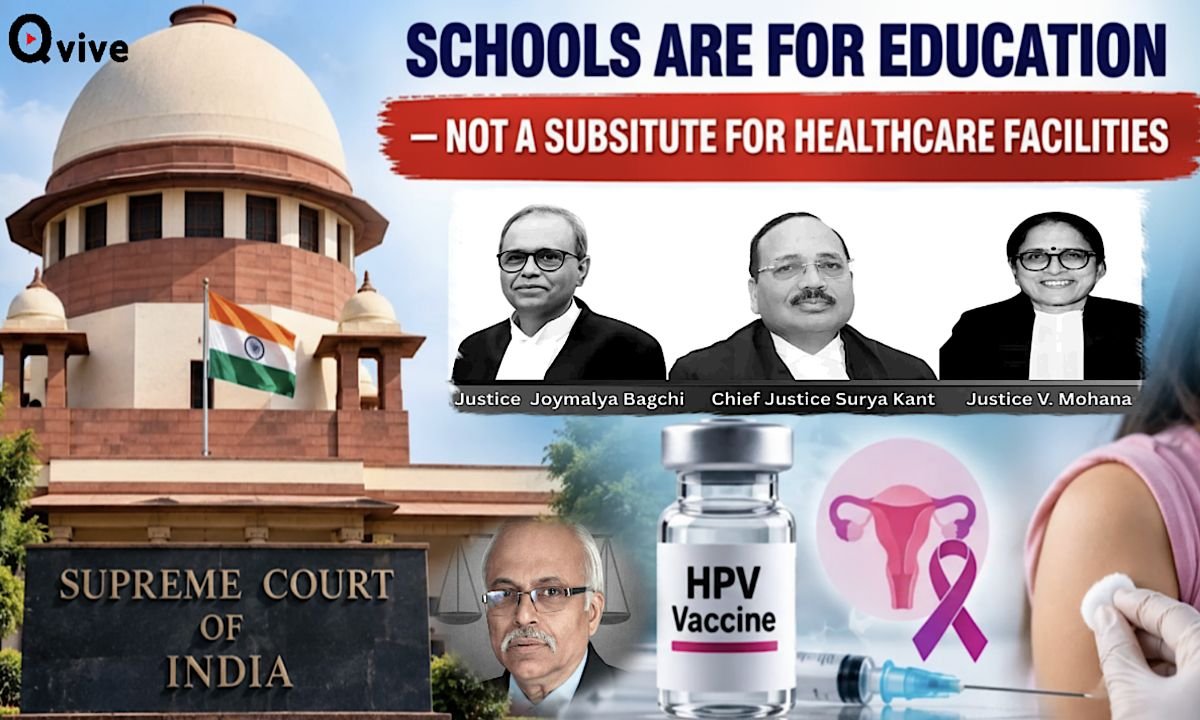
A wave of deep public distress and legal questioning has erupted across India following a recent Supreme Court bench—comprising Chief Justice Surya Kant and Justices Joymalya Bagchi and V. Mohana—dismissing a Public Interest Litigation (PIL) regarding the government-backed Human Papillomavirus (HPV) vaccination drive.

The petition, filed by the Universal Health Organisation (UHO), challenged the aggressive implementation of the vaccine campaign, particularly within educational institutions. However, the dismissal has left parents, health advocates, and legal observers questioning whether the judiciary overlooked critical systemic failures concerning long-term vaccine safety, informed consent, and the fundamental purpose of schools.
THE FIVE QUESTIONS PARENTS DESERVE ANSWERS TO
1. CONSENT
Was meaningful, informed parental consent obtained before vaccination?
2. SAFETY
What happens when a child reports a serious adverse event?
3. DATA
Where can parents see reliable, regularly updated AEFI information?
4. COMPENSATION
What exactly does “ordinary rules of compensation” mean for an affected child?
5. ACCOUNTABILITY
Who is ultimately responsible when a medical programme is delivered through a school?
“Manufactured Crisis” Film Exposes Motives Behind Mass HPV Vaccinations and Deadly Side Effects
Gardasil and Cervarix: The following is a preview of the Alliance for Natural Health documentary scheduled for release in early Autumn. It is titled, ‘Manufactured Crisis: HPV Hype & Horror.’ This documentary tells the heart wrenching stories of families from the United Kingdom, America, Spain and Denmark who have survived the aftermath of HPV vaccinations.
The families in this documentary have one clear message to parents around the world: “Don’t sacrifice your child’s health for the greater good – research the risks!”
A dramatic look at the so-called silver bullet for prevention of cervical cancer. Something every parent should know.
A substantial new documentary film released online to audiences in the UK and across Europe this week, questions claims made by UK, Danish and Spanish health authorities that widespread administering of the HPV vaccine is both safe and a guaranteed means of preventing cervical cancer.
It comes at a time when – flying in the face of independent science – UK and European medical experts are proposing to extend the vaccine’s use from teenage girls, adding teenage boys and children below the age of puberty.
‘Manufactured Crisis: What they’re not telling you about the HPV Vaccine‘ exposes cases of severe, life-changing adverse reactions experienced by girls and young women following doses of the commercial HPV vaccines Gardasilor Cervarix – cases from which the public has previously been shielded.
‘Manufactured Crisis: What they’re not telling you about the HPV Vaccine’ is produced by Focus for Health and Freda Birrell and is directed by Tim Reihm. You can watch the hour-long documentary on Rumble
Recorded adverse reactions include severe disability, paralysis and even death.
Throughout Manufactured Crisis, victims and their families tell their own, often heartrending, stories.
What is the primary issue raised in the Public Interest Litigation?
-
Petitioner: Universal Health Organisation (UHO), represented by Chairperson Dr. Amitav Banerjee, through Advocate Shivam Raghuwanshi.
-
Constitutional basis: The PIL was filed under Article 32 of the Constitution of India before the Supreme Court.
-
Main concern: The main issue being discussed is the PIL filed by the UHO in India, which challenges the legal and constitutional aspects of the HPV vaccination program being implemented in schools.
Why did the UHO file this PIL?
The UHO claims that the HPV vaccination program violates constitutional rights related to:
- Bodily autonomy: The right to make decisions about one’s own body.
- Transparency: Clear information about what the vaccine entails.
- Accountability: Responsibility to address concerns and questions from the public.
What are the main problems with the current HPV vaccination rollout according to the UHO?
The petition highlights several key issues:
- Informed consent: There is no proper system in place to ensure that parents understand what they are consenting to before their children receive the vaccine.
- Risk disclosure: Parents are not adequately informed about potential risks and alternative options.
- Adverse events reporting: There is no accessible system to track side effects of the vaccination.
- Compensation scheme: There is no defined process to compensate individuals who may face health issues resulting from the vaccination.
What specific requests does the UHO make in the PIL?
The UHO requests several actions from the Supreme Court:
- Suspension of the school-based HPV vaccination component until a proper consent process is established.
- Formation of an independent committee to assess vaccine safety and consent practices.
- Creation of a public dashboard to report adverse events following immunization.
- Establishment of a national compensation scheme for vaccine-related injuries.
- Development of comprehensive consent documents available in multiple languages.
Universal Health Organisation (UHO) Weekly Newsletter – 11 September 2026
The Battle Over School-Based Vaccination
At the heart of the public backlash is a growing existential question: Are schools turning into makeshift hospitals and experimental laboratories rather than centers of learning?
For generations, parents have entrusted their children to school authorities under the assumption that the primary focus is education, moral development, and future preparation. Critics of the school-based vaccination drives argue that turning campuses into vaccination hubs breaches that sacred trust.
“School is not a market for vaccine drives,” said one distressed parent association representative. “Innocent children are sent to school for education, not to bear the brunt of medical trials or aggressive public health campaigns. When side effects strike, parents are left facing astronomical financial burdens, exhausting their life savings on hospitalizations, specialized medical care, and costly pharmaceutical treatments.”
Protesters and health advocates emphasize that while some children may not exhibit immediate adverse reactions, the long-term side effects remain unmonitored due to what they term a complete “system failure” in adverse-event reporting.
The Question of Compensation and Government Contradiction
During the proceedings, the Supreme Court noted that ordinary rules on compensation would apply in cases of incorrect vaccination. This statement has drawn sharp criticism.
That statement needs to be distinguished from the March 2026 Rachana Gangu judgment.
So, analytically, there is an interesting tension:
March 2026: the Supreme Court recognised that ordinary fault-based remedies may be insufficient for vaccine injuries arising from a mass public-health programme and directed creation of a no-fault framework.
September 2026: in the HPV proceedings, the Court stated that cases of “incorrect vaccination” would be dealt with under ordinary compensation rules.
The March judgment dealt specifically with serious adverse events following COVID-19 vaccination and directed the government to formulate a no-fault compensation framework. It also recognised that ordinary fault-based litigation could be an inadequate mechanism for mass-vaccination injuries.
The Supreme Court’s judgment recorded concerns about restrictions imposed by State governments, employers and educational institutions on people who had not been vaccinated.
Critics point out a profound contradiction in the state’s approach: although vaccination was officially described as voluntary, individuals in practice were sometimes required to show vaccination certificates to access workplaces, educational institutions, travel and certain public spaces or services.
Furthermore, while the Court mandated that data regarding adverse events be made regularly available to the public—a transparency that critics argue has been glaringly absent—questions remain as to how and when this data will be enforced, given that government and school authorities have often failed to publish transparent safety metrics.
Clashes Over the WHO and Judicial Scrutiny
The petition by the UHO also brought the role of international bodies into question. Reports from the courtroom indicated friction, with remarks highlighting that “Doctors should not question WHO,” leading the petitioner’s counsel to eventually withdraw the plea.
This interaction has sparked fierce debate outside the courtroom. UHO members and independent critics have openly questioned the absolute authority granted to the World Health Organization (WHO), pointing to international controversies, funding withdrawals by nations like the United States, and growing global skepticism regarding institutional oversight. Many legal experts and citizens claim the judgment contains significant loopholes, failing to adequately examine consent protocols, compensation frameworks, and the lack of robust post-market vaccine surveillance in India.
Unethical Conduct: Using Tribal Girls as Test Subjects in Cervical Cancer Research.
Priorities Misplaced: The State of Government Schools
Public frustration extends beyond the vaccine debate to broader systemic neglect. Critics argue that instead of turning educational institutions into medical outposts, the government and the judiciary should address foundational crises within the schooling system.
Health, advocates stress, begins with basic hygiene. Public health experts are asking why authorities are prioritizing mass vaccination inside schools while basic infrastructure crumbles. According to a recent NITI Aayog report, India lost nearly 94,000 government schools in a decade, with the total number dropping from 11.07 lakh in 2014–15 to 10.13 lakh in 2024–25, largely driven by dropping enrollments and school mergers.
Observers argue that the government should be held accountable for ensuring that schools maintain proper sanitation, clean drinking water, adequate nutrition, and basic hygiene practices before deploying health interventions.
A Final Plea
As public distress mounts, the message from parents and health advocates is unequivocal: schools must return to their core mission of education and holistic child development. The government and school managements must take moral and financial responsibility for children affected by adverse medical events on campus. Until a transparent, foolproof system of compensation, rigorous adverse-event monitoring, and true informed consent is established, classrooms must remain sanctuaries of learning—not centers of clinical experimentation.
Also Read:
A Vaccine Developer Reveals: HPV Vaccine Doesn’t Work and Poses Major Risks
Exposed! The cruel experiments conducted by Fauci resulted in the deaths of many children.
The Link Between Guillain-Barré Syndrome and HPV Vaccine: The Truth Behind Paralysis and Deaths
Latest News: