

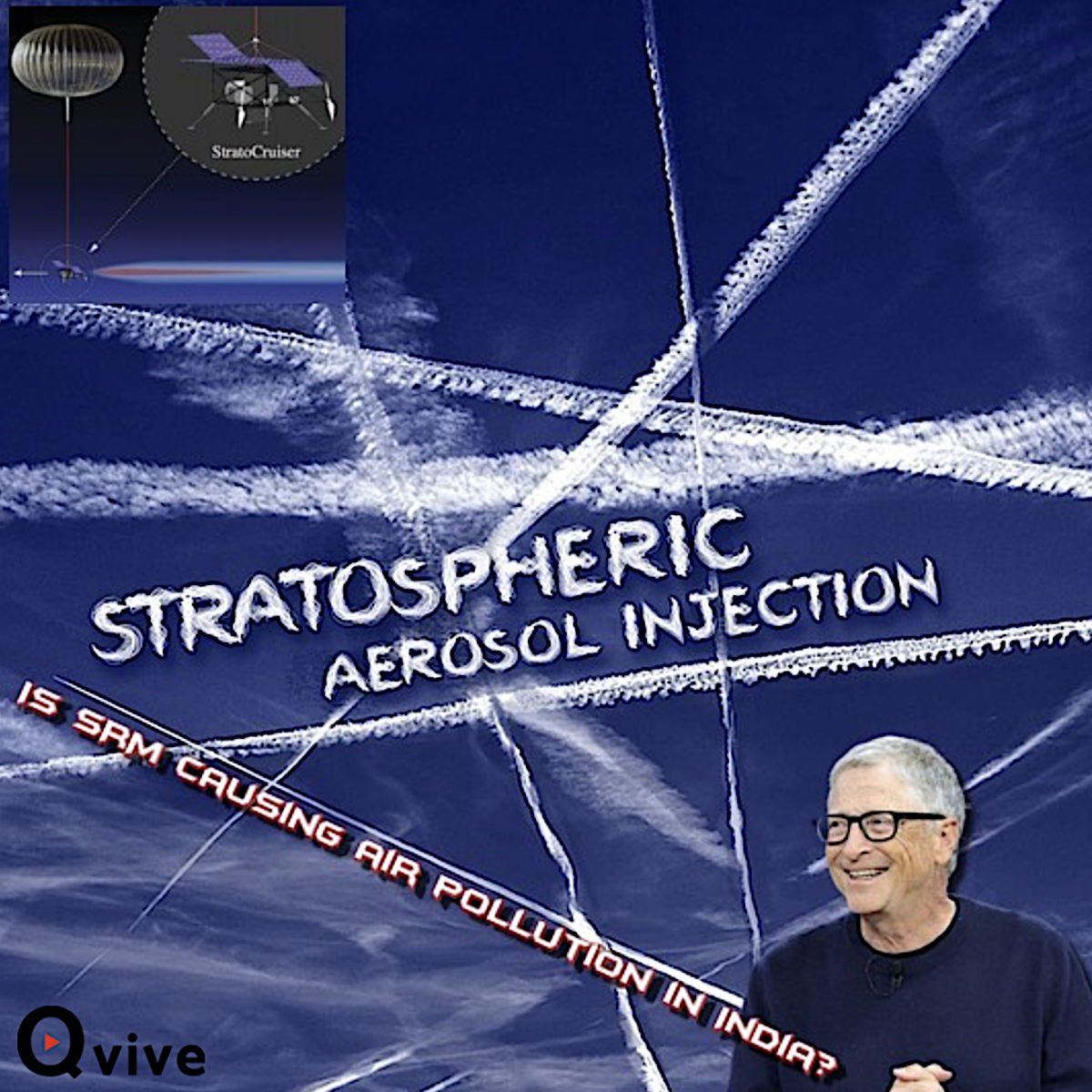
On September 19, 2024, a team of scientists in India, led by Govindasamy Bala, published a study focusing on the impacts of stratospheric aerosol injection (SRM) on global precipitation, particularly how the altitude at which these aerosols are deployed affects climate conditions.
The study highlights the need for further research to fully understand how different deployment altitudes of aerosols affect local weather, such as the Indian monsoon.
Several Indian scientists are studying solar geoengineering (SRM), especially via sulfate aerosols (i.e., sulfur-based particles).

Solar Radiation Modification (SRM), also known as solar geoengineering, involves deliberate interventions to reflect sunlight away from Earth to mitigate climate change impacts. In India, SRM research has primarily focused on modeling potential regional effects—such as on the monsoon—rather than field experiments or deployment.
The altitude at which these aerosols are injected is crucial. The study examined three different heights:
- 22 km (higher)
- 18 km (mid-level)
- 16 km (lower)
- Cooling Effectiveness: Higher altitudes tend to have a stronger cooling effect because the particles can reflect more sunlight. However, cooling and precipitation changes interact in complex ways.
- Precipitation Sensitivity: Interestingly, the researchers found that while higher altitudes led to more cooling, the changes in precipitation levels were less sensitive to this altitude. This is because the quick responses in the atmosphere largely counterbalance the cooling effects at different heights.
How Are Temperature and Precipitation Related?
- Cooling Effects: SRM particles cool the planet by reflecting sunlight. This helps lower average temperatures, which in turn influences how much precipitation (rain and snow) falls.
- Local Warming Effects: The aerosols also absorb some sunlight, which can create a warming effect in the part of the atmosphere where they are injected. This causes immediate changes (fast responses) in temperature and precipitation patterns.

What is Stratospheric Aerosol Injection?
Think of SRM as a way to artificially cool the Earth’s temperature. It involves releasing tiny particles (aerosols) into the stratosphere—the second layer of Earth’s atmosphere—to reflect sunlight back into space. This is similar to how a reflective umbrella can keep you cool on a sunny day by blocking direct sunlight.

Solar Radiation Modification (SRM) poses significant risks to monsoon systems, particularly the Indian Summer Monsoon (ISM)
Solar Radiation Modification (SRM), particularly through stratospheric aerosol injection (SAI), could alter the Indian Summer Monsoon (ISM) by reducing precipitation intensity, shifting its timing, and increasing variability. These hydrological changes do not directly harm human health but trigger cascading effects on agriculture, water supply, disease patterns, and food security. SRM’s aerosols (e.g., sulfates) may also introduce direct physiological risks via ozone depletion or atmospheric deposition. Below is a categorized list of key health impacts, drawn from modeling studies and risk assessments focused on India and South Asia.
SRM does not address root causes like CO2 accumulation or ocean acidification; instead, it could alter atmospheric circulation, hydrological cycles, and regional precipitation patterns in unpredictable ways. Below, I outline key risks based on modeling studies, focusing on India and South Asia.
Our ED @KellyWanser spoke at @TEDxGateway in Mumbai about the unique role India can play in advancing research into potential climate interventions, like solar radiation modification (#SRM). Watch her full #TEDTalk: https://t.co/Uin6cqPTnF
— SilverLining (@SilverLiningNGO) October 28, 2024
Direct Health Impacts (From SRM Aerosols and Atmospheric Changes)
| Impact | Description | Potential Effects in India |
|---|---|---|
| Increased UV Radiation Exposure | SAI delays stratospheric ozone recovery, allowing more harmful UVB rays to reach the surface, especially in high-altitude or rural areas. | Higher rates of skin cancers (e.g., melanoma, BCC, SCC), cataracts, and immunosuppression; rural populations in the Himalayas or Deccan Plateau at elevated risk, with up to 20-30% more cases in vulnerable groups. |
| Respiratory and Toxicological Effects | Sulfate aerosols could deposit as acid rain or fine particulates (PM2.5), exacerbating air quality in polluted regions. Toxicity levels are understudied but analogous to volcanic emissions. | Aggravated asthma, COPD, and cardiovascular diseases; potential for 5-15% rise in respiratory hospitalizations in northern India (e.g., Indo-Gangetic Plain) during post-monsoon periods. |
| Vitamin D Deficiency Risks | Reduced solar radiation (dimming) limits UVB for vitamin D synthesis, compounding monsoon-season shortfalls. | Weakened immunity, bone disorders (rickets, osteoporosis), and higher vulnerability to infections like tuberculosis; affects 70-80% of India’s vitamin D-deficient population, worsening in urban slums. |
Indirect Health Impacts (Via Monsoon Disruptions)
| Impact | Description | Potential Effects in India |
|---|---|---|
| Malnutrition and Food Insecurity | 5-20% monsoon rainfall decline reduces crop yields (e.g., rice, wheat) in rainfed areas, affecting 60% of agriculture. Termination shock could cause 20-50% precipitation surges, leading to crop losses. | Protein-energy malnutrition, micronutrient deficiencies (e.g., iron, zinc); increased stunting in children (already 35% prevalence) and anemia in women; up to 10-15 million additional undernourished people annually. |
| Waterborne and Vector-Borne Diseases | Altered rainfall distribution causes droughts (water scarcity) or floods (contamination), shifting mosquito breeding and pathogen spread. SRM may interact with El Niño for extremes. | Spikes in cholera, diarrhea (killing 100,000+ children/year), dengue, and malaria; 15-25% more cases in eastern India (e.g., Bihar, Odisha) during erratic monsoons, straining healthcare. |
| Heat-Related Illnesses (Paradoxical Effects) | While SRM cools globally, uneven regional cooling or termination could amplify heatwaves in non-monsoon seasons. | Dehydration, heatstroke, and kidney disorders; elderly and laborers in arid zones (e.g., Rajasthan) face 10-20% higher mortality, offset partially by overall cooling but risky post-termination. |
Low-income farmers, women, children, and indigenous communities in monsoon-dependent states (e.g., Uttar Pradesh, Maharashtra) bear the brunt, exacerbating inequities.
How SRM Can Cause Air Toxicity
Solar Radiation Modification (SRM) techniques, particularly Stratospheric Aerosol Injection (SAI) and Marine Cloud Brightening (MCB), involve introducing aerosols into the atmosphere to reflect sunlight and cool the Earth. While these methods aim to mitigate global warming, research indicates potential risks of air toxicity due to the materials used.
Stratospheric Aerosol Injection (SAI): This is the most researched SRM method and involves injecting small reflective particles, often sulfur dioxide (SO2), into the stratosphere.
- Formation of Sulfate Aerosols: Once in the stratosphere, SO2 reacts with water vapor to form sulfate aerosols (e.g., sulfuric acid droplets). These aerosols are effective at reflecting sunlight, but they can also affect atmospheric chemistry.
- Impact on Ozone Layer: Sulfates, the most commonly proposed aerosols, can delay the recovery of the stratospheric ozone layer, which protects Earth from harmful ultraviolet (UV) radiation. A weakened ozone layer could lead to increased UV radiation reaching the surface, posing health risks.
- Regional Air Quality: While injected into the stratosphere, some of these aerosols or their precursors could eventually descend into the troposphere (the lower atmosphere where we live and breathe). This could potentially contribute to particulate matter pollution, which is known to cause respiratory and cardiovascular problems.
Stratospheric Aerosol Injection proposes injecting substances like sulfur dioxide (SO2), hydrogen sulfide, carbonyl sulfide, black carbon, calcium carbonate, diamond dust, or engineered nanoparticles (e.g., metallic aluminum, aluminum oxide, barium titanate) into the stratosphere. The primary concern for air toxicity stems from direct exposure to these aerosols.
- Sulfates (from SO2, H2S, COS): Large volcanic eruptions, such as Mount Pinatubo in 1991, have demonstrated the cooling effect of stratospheric sulfate aerosols. However, exposure to sulfuric acid aerosols can cause local irritant effects, and occupational exposure to strong inorganic mists containing sulfuric acid is considered carcinogenic. Sulfur dioxide exposure can lead to respiratory issues, especially in asthmatics, including increased airway resistance, cough, irritation, and in high concentrations, severe airway obstruction and even death. Hydrogen sulfide can cause respiratory symptoms, eye irritation, metabolic abnormalities, and neurological symptoms, with high concentrations being lethal. Carbonyl sulfide, which metabolizes to carbon dioxide and hydrogen sulfide, can cause similar acute symptoms, including profuse salivation, headache, vertigo, and respiratory paralysis at high levels.
- Black Carbon: While black carbon is a proposed aerosol, its intentional addition to the atmosphere would exacerbate existing adverse health effects from unintentional ground-level releases. Occupational exposure to black carbon is linked to respiratory effects like cough, bronchitis, pneumoconiosis, and decreased lung function, and it is classified as possibly carcinogenic to humans.
- Aluminum and Aluminum Oxide: These materials, if used, could lead to occupational exposures during manufacturing and deployment. Exposure to fine aluminum dust has been associated with wheezing, dyspnea, impaired lung function, and pulmonary fibrosis.
- Barium Titanate: This engineered nanoparticle is considered promising due to its potential for self-levitation and longer suspension times. However, its toxicological properties are not well understood. Barium salts are known to affect respiratory, cardiovascular, gastrointestinal, musculoskeletal, metabolic, and neurological systems. The behavior of barium titanate as a nanoparticle could also introduce unique toxicological concerns, as particle size, surface area, chemistry, solubility, and shape influence toxicity.
Marine Cloud Brightening (MCB) involves injecting sea salt aerosols into low-level marine clouds to increase their reflectivity. While sea salt is naturally occurring, large-scale artificial injection could alter atmospheric composition and potentially impact air quality in coastal regions or areas downwind of deployment. Analogs like ship tracks show a small global cooling effect, but the long-term and widespread impacts of intentional MCB on air quality are still under investigation.

This method involves injecting sea salt aerosols into low-level marine clouds to increase their reflectivity.
- Sea Salt Aerosols: MCB uses very small droplets of seawater to create sea salt aerosols. These particles act as cloud condensation nuclei, leading to more numerous and smaller cloud droplets, which makes clouds brighter.
- Potential for Localized Impacts: While sea salt is naturally occurring, large-scale, continuous injection could potentially alter local atmospheric chemistry and deposition patterns, though the direct toxicity concerns are generally lower than with sulfur-based aerosols. The net climate effect of injecting aerosols into the lower atmosphere for MCB is complex and difficult to project.
Here is a clear, evidence-based list of the specific air-toxicity and respiratory-health hazards that could arise from large-scale stratospheric aerosol injection (SAI) — the most-discussed SRM technique — with relevance to India’s already high baseline pollution levels.
| # | Specific Air Pollution Risk | Mechanism | Quantified Increase (India-relevant estimates) | Health / Environmental Consequence in India |
|---|---|---|---|---|
| 1 | Chronic fine particulate matter (PM₂.₅) | Stratospheric sulfate aerosols slowly descend and add to tropospheric sulfate PM₂.₅ | +5 to +30 μg/m³ annual mean over northern and central India for moderate-to-high SAI scenarios (Eastham et al. 2023; Visioni et al. 2023) | 100,000–400,000 additional premature deaths per year in India alone (comparable to adding another Delhi winter every year, permanently) |
| 2 | Peak PM₂.₅ episodes after monsoon | Monsoon efficiently washes sulfate out of the atmosphere → massive wet deposition followed by dry-season re-suspension | Post-monsoon spikes of 50–150 μg/m³ possible in Indo-Gangetic Plain | Severe AQI “red-alert” days prolonged by weeks; huge surge in heart attacks, strokes, and child hospital admissions |
| 3 | Acid rain and acidic dry deposition | H₂SO₄ droplets → sulfuric acid rain and direct particle fallout | Rain pH drop from ~5.6 to 4.8–5.2 in northern/eastern India | Crop damage (rice, wheat yield losses 3–12 %); leaching of aluminium and heavy metals from soil; worsening of existing arsenic groundwater crisis in Bihar/West Bengal |
| 4 | Surface ozone (O₃) changes | Stratospheric cooling + chemistry changes alter tropospheric O₃ production | Most models: slight decrease (−5 to −10 ppb); some scenarios: regional increase +5 to +15 ppb over polluted north India | If O₃ rises → additional 20,000–60,000 respiratory deaths/year; if it falls → partial respiratory benefit (but outweighed by PM₂.₅ harm) |
| 5 | Increased UV-B from ozone depletion | Sulfate aerosols destroy 5–25 % of the ozone column (greatest in tropics/mid-latitudes) | Surface UV-B +6 % to +30 % (highest over central India and Himalayan foothills) | 10–40 % higher skin cancer and cataract rates in outdoor workers and high-altitude populations |
| 6 | Interaction with existing pollution | Added sulfate mixes with black carbon, biomass smoke, and NOx → more efficient formation of secondary aerosols | Amplification factor of 1.2–2× on existing pollution burden | Effectively cancels out many of the clean-air gains India is trying to achieve through BS-VI, NCAP, and biomass-cooking programs |
| 7 | Termination-shock air-quality rebound | If SAI is suddenly stopped, the extra sulfate clears in ~2 years while temperature jumps 1–2 °C → extreme heat + stagnant pollution | Short-term PM₂.₅ and O₃ spikes far above anything seen today | Hundreds of thousands of heat-and-pollution deaths in the first 2–3 years after termination |
India
— Geoengineering Info (@geoengineering1) August 2, 2024
PI: Dr Manish Kumar Shrivastava
Host institution: The Energy and Resources Institute (TERI), New Delhi
Title: Exploring Asian perspectives on the governance of solar radiation modification
Page link: https://t.co/3WAGGec2Ma
6/9 pic.twitter.com/lVeQC13fN8
Solar Radiation Modification (SRM) in India
This timeline highlights key developments, drawing from scientific publications, funding awards, conferences, and policy discussions. India’s engagement has grown cautiously, emphasizing governance, equity, and risks to vulnerable regions like South Asia.
| Year | Event | Description |
|---|---|---|
| 2006 | Seminal global paper sparks Indian interest | Paul Crutzen’s influential paper on stratospheric sulfate injections for albedo enhancement prompts initial discussions in India. Indian researchers begin exploring SRM as a potential “Plan B” alongside emissions reductions, though no formal Indian-led studies emerge yet. |
| 2009–2010 | Early modeling studies on SRM impacts | Indian Institute of Science (IISc) researchers, including Govindasamy Bala, publish initial climate modeling papers assessing SRM’s effects on global and Indian hydrology. These lay groundwork for regional impact analysis, focusing on temperature stabilization without addressing precipitation fully. |
| 2011 | First international SRM governance conference in India | Council on Energy, Environment and Water (CEEW) hosts the inaugural international conference on SRM governance in New Delhi, in collaboration with the Solar Radiation Management Governance Initiative (SRMGI). Discussions emphasize India’s role in equitable global frameworks, highlighting risks to the monsoon-dependent economy. |
| 2013–2015 | Advanced modeling of SRM scenarios | IISc-led studies compare SRM methods (e.g., reduced solar constant vs. sulfate aerosols) and their hydrological impacts over India. A key paper models “cocktail geoengineering” for stabilizing both temperature and precipitation, noting potential monsoon disruptions. |
| 2016 | Second CEEW-SRMGI conference on governance | CEEW organizes a follow-up conference in New Delhi, focusing on lab research, field experiments, and deployment risks. It calls for inclusive Global South perspectives, amid growing concerns over SRM’s transboundary effects on India-Pakistan water sharing. |
| 2018 | Comprehensive review of Indian SRM research | Bulletin of the American Meteorological Society publishes “Solar Geoengineering Research in India,” summarizing a decade of IISc and other efforts. It highlights modeling of precipitation extremes and calls for more funding via SRMGI’s DECIMALS program for developing-country impacts. |
| 2019 | Funding for SRM risk analysis | Indian researchers receive SRMGI grants under the Degrees Initiative (formerly SRMGI) to model SRM’s regional risks, including ozone depletion and agricultural impacts. This supports broader calls for precautionary governance under international law. |
| 2022 | Governance proposals linking SRM to Montreal Protocol | CEEW publishes “Solar Geoengineering and the Montreal Protocol,” advocating for the ozone treaty as a forum to regulate SRM aerosols (e.g., sulfates). It stresses transparency, public participation, and preventing “side effects” like ozone harm over India. |
| 2023 | TEDx talk and youth discussions on SRM equity | SilverLining’s Executive Director delivers a TEDxGateway talk in Mumbai on India’s potential leadership in SRM research for climate justice. Concurrently, the International Youth Conference (IYC) in India discusses SRM’s moral and geopolitical implications, emphasizing Global South voices. |
| 2023 (Sep) | IISc grant for monsoon impact modeling | IISc scientists secure funding to study SRM’s effects on summer monsoon rainfall over India and tropical regions. The project examines sulfate injection scenarios, warning of potential crop failures and ecosystem shifts. |
| 2024 | TERI grant for Asian SRM governance | The Energy and Resources Institute (TERI) receives Degrees Initiative funding to explore Asian perspectives on SRM governance, including India’s stance on equity and transboundary harms. This builds on calls for non-use agreements amid rising global trials. |
| 2024 (Apr) | IMD study highlights natural SRM challenges | India Meteorological Department (IMD) reports a 30-year decline in sunshine hours due to aerosols and clouds, reducing solar potential by up to 10%. This underscores SRM’s risks, as artificial dimming could exacerbate existing trends. |
| 2024 (Nov) | Growing scientific interest amid global debates | Mongabay reports rising interest among Indian scientists in advancing SRM research, despite opposition over unintended consequences like altered monsoons. Discussions intensify on governance, with India advocating for UNEP/WMO-led assessments. |
| 2025 (May) | UNEP-WMO workshop includes Indian perspectives | Geneva workshop on SRM risks features Indian input on uncertainties, with CEEW emphasizing inter-generational equity and precautionary principles. No deployment occurs, but modeling highlights India’s vulnerability to termination shock. |
| 2025 (Sep) | Delhi announces urban cloud seeding trial | Government of Delhi plans “Technology Demonstration and Evaluation of Cloud Seeding” with IIT Kanpur and IMD to mitigate air pollution. While not full SRM, it tests aerosol-based modification, raising governance concerns for scaling. |
| 2025 (Nov) | WMO Weather Modification Conference in Pune | World Meteorological Organization hosts its 11th conference in Pune, showcasing SRM-related atmospheric interventions. Indian researchers present on monsoon modeling, amid global calls for moratoriums on outdoor tests. |
Bill Gates has invested in geoengineering experiments, including Solar Radiation Management (SRM), which involves spraying aerosols into the upper atmosphere to cool the climate.

The Bill & Melinda Gates Foundation, established by Bill Gates, has a comprehensive database of its committed grants dating back to 1994. This database includes grants for global health, global development, and education programs worldwide. However, the provided content does not specify any grants directly related to SRM research or implementation in India within this database.
The broader discussion around SRM governance highlights that funding for SRM research has seen an “explosion” from philanthropic sources, and organizations like the Degrees Initiative (formerly Solar Radiation Management Governance Initiative – SRMGI) have spearheaded capacity building and engagement in the Global South, including supporting researchers in 22 developing countries. While India is a prominent developing country, the text does not explicitly state that Bill Gates or his foundation are direct funders of these specific initiatives within India. The Degrees Initiative, for instance, has supported over 170 researchers across 37 projects in 22 developing countries, and some of these scientists are now playing influential roles in the field

The SRM governance review mentions:
- 2018: The Solar Radiation Management Governance Initiative (SRMGI) launched the DECIMALS Fund (now Degrees Modelling Fund – DMF) to fund SRM research in the Global South. This fund, along with the later Socio-Political Fund (SPF), has supported over 170 researchers across 37 projects in 22 developing countries. While not explicitly stating Indian projects, it indicates a mechanism through which Indian researchers could potentially engage with SRM research.
- 2023: The Alliance for Just Deliberation on Solar Geoengineering (DSG), an NGO, conducted an SRM scenario development workshop in India with an Indian research institute and a US-based scientist. This is a direct mention of an SRM-related activity taking place in India, albeit focused on scenario development and governance rather than direct modification initiatives.
- 2024: DSG staff engaged in international governance discussions on SRM, including at UNEA-6 and at Conferences of the Parties to the Convention on Biological Diversity (CBD) and the United Nations Framework Convention on Climate Change (UNFCCC). India’s participation in these international forums would naturally involve engagement with SRM discussions.
One Sun One World One Grid
- 2015: India, as a founder member, proposed the International Solar Alliance (ISA), headquartered in India, to promote solar energy worldwide. This demonstrates India’s leadership in global solar energy initiatives.
- 2020: India put forward the concept of “One Sun One World One Grid” and “World Solar Bank” to harness abundant solar power on a global scale. These initiatives reflect India’s proactive stance on global energy solutions and climate change, which could be seen as an alternative to or a complement to discussions around SRM.
- 2025: India is projected to be the third-largest producer of solar power globally, after China and the United States. This indicates a strong national focus on solar energy as a primary climate change mitigation strategy.
- 2025: India’s solar power potential is assessed at 10,830 GW. This vast potential suggests a strong emphasis on harnessing renewable energy domestically.
- 2025: India’s solar power installed capacity was 129.92 GWAC as of October 31, 2025. This figure underscores the rapid deployment of solar power infrastructure.
- 2025: The Gujarat Hybrid Renewable Energy Park, which will be the world’s largest hybrid renewable energy park, is expected to be fully completed by December 2026, generating 30 GWAC from both solar and wind. This project exemplifies India’s large-scale renewable energy ambitions.
Ref:
- https://www.nature.com/articles/s41598-021-89249-6
- https://pmc.ncbi.nlm.nih.gov/articles/PMC9976694/
- https://pmc.ncbi.nlm.nih.gov/articles/PMC7854580/
- https://academic.oup.com/oocc/article/5/1/kgaf012/8089845
- https://www.downtoearth.org.in/energy/increased-emissions-threaten-solar-infrastructure-in-india-study
- https://www.livemint.com/opinion/online-views/solar-radiation-modification-srm-india-climate-change-monsoon-rainfall-stratospheric-aerosols-global-warming-adaptation-11757672674893.html
- https://www.climate.gov/news-features/understanding-climate/solar-radiation-modification-noaa-state-science-factsheet
- https://en.wikipedia.org/wiki/Solar_radiation_modification
- https://www.nextias.com/ca/current-affairs/10-10-2025/solar-dimming-in-india
- https://disaster.shiksha/physical-geography/understanding-insolation-solar-radiation/
- https://climateconnection.org.in/updates/solar-radiation-management-controversial-approach-mitigate-global-heating
- https://www.frontiersin.org/journals/energy-research/articles/10.3389/fenrg.2022.859321/full
- https://www.academia.edu/75211151/Evaluation_of_long_term_changes_of_solar_radiation_in_India
- https://www.oneearth.org/srm-who-should-control-the-weather/
- https://journals.ametsoc.org/view/journals/bams/100/1/bams-d-18-0122.1.xml
- https://www.degrees.ngo/
- https://www.csis.org/blogs/new-perspectives-asia/india-and-atmospheric-sulfate-injection-double-edged-sword
- https://www.nature.com/articles/d41586-018-05288-6
- https://www.ceew.in/publications/solar-geoengineering-and-montreal-protocol
- https://www.geoengineeringmonitor.org/quarterly-review-i-part-2-solar-radiation-management-new-field-trials-research-projects-and-funding-and-growing-opposition
- https://www.thehindu.com/news/national/study-warns-of-decreasing-trend-in-solar-radiation-for-electricity-in-india/article68110685.ece
- https://india.mongabay.com/2024/11/indian-scientists-are-showing-an-interest-in-advancing-solar-geoengineering-research/
- https://www.unep.org/ocs/Solar-radiation-modification
- https://www.geoengineeringmonitor.org/geoengineering-the-clouds-solar-radiation-management-in-the-lower-atmosphere
- https://solargeoengineeringupdates.substack.com/p/monthly-solar-geoengineering-updates
- Sikina Jinnah and Zachary Dove. (Critical Review) Environ. Sci.: Atmos., 2025, 5, 656-673. [ https://pubs.rsc.org/en/content/articlehtml/2025/ea/d5ea00008d ]
- https://pubs.rsc.org/en/content/articlehtml/2025/ea/d5ea00008d
- https://www.degrees.ngo/about/early-days/
- https://www.degrees.ngo/research-funds/
- https://www.degrees.ngo/about/
- Geoengineering and human health: an overview of concerns and knowledge gaps. [ https://pmc.ncbi.nlm.nih.gov/articles/PMC4717532/ ]
- SCI-Image
Also Read: