

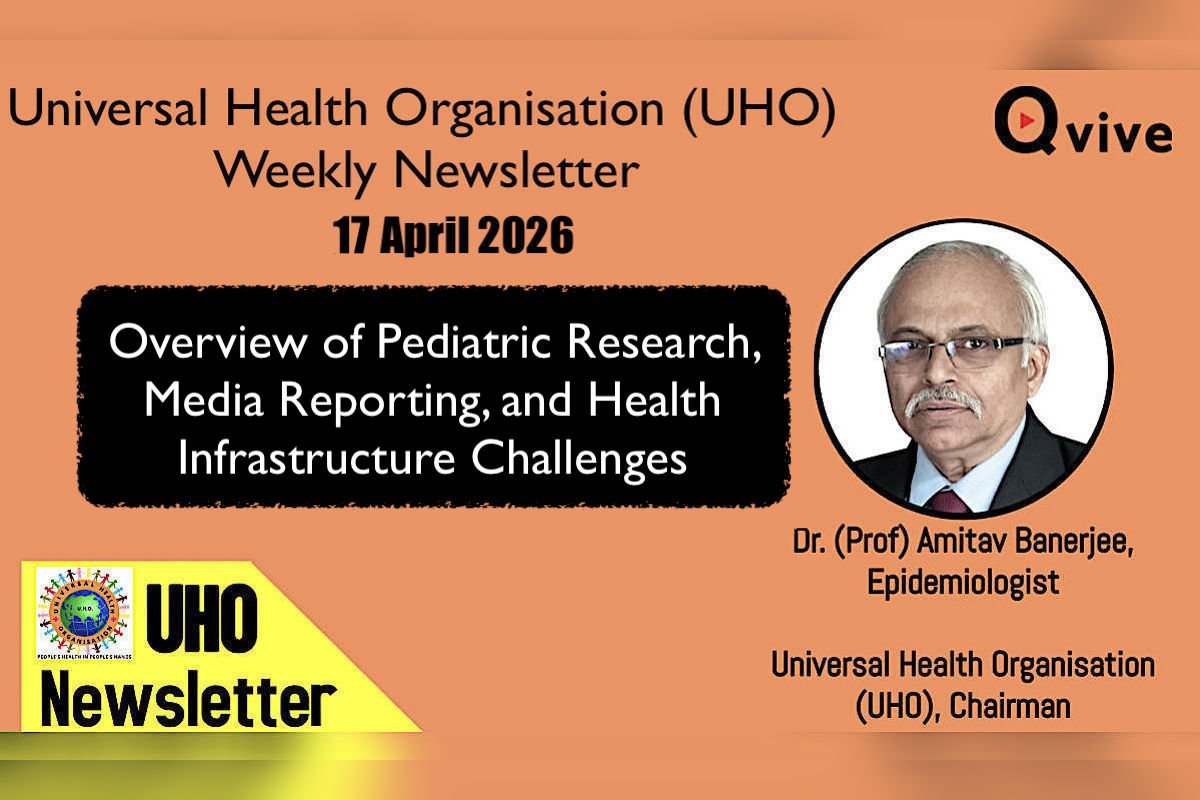
Highlights:
- US National Academies pushes for research in children: UHO expresses concerns.
- Media can hype out of context: Only 1 in 4 young Indians disease free reports ET.
- The wheels of mobilizing public health infrastructure grinds really slow: Premier Institute functioning delayed for over year due to lack of electric meter!
Website: https://uho.org.in
By Dr. Amitav Banerjee, Chairperson of the Universal Health Organisation (UHO)
US National Academies pushes for research in children: UHO expresses concerns.
An article in the British Medical Journal (BMJ) has discussed recent opinions on conducting more research on children instead of shielding them from new medical interventions. So far, children have been considered a vulnerable group demanding extreme caution while trying out new medical interventions. The ICMR ethical guidelines on research also explicitly include children among vulnerable groups.
But this caution is now being questioned by a report from the US National Academies of Science as mentioned in the BMJ article on the ground that an abundance of caution in paediatric research means that opportunities to improve children’s health and survival are being missed.
The report was commissioned by the US Congress in 2024, under the administration of President Joe Biden. At that time, “children in the United States [were] experiencing rising rates of chronic diseases and poor mental, emotional, and behavioral health,” the report says. It mentions that only 13% of US research funds are spent on paediatrics, despite children being 22% of the US population.
The report comes at a time when children’s health is under scrutiny, with major changes being made to vaccine guidance, dietary advice and research funding since Robert F Kennedy Jr was appointed health secretary.
UHO has noted some points of concern in this BMJ article. Most of the childhood conditions mentioned in the report are due to lifestyle factors like over-nutrition among the affluent populations and under-nutrition in poor communities. These conditions require non-pharmaceutical interventions and should not be medicalized. They are social problems and should not be defined, diagnosed, and treated as medical pathologies or disorders. It shifts the understanding of these childhood conditions into the realm of medicine, often focusing on individual treatment rather than broader social causes.
That the report is biased towards research on childhood vaccines is obvious from the statement of one expert quoted in the BMJ article who regrets that children were not included in Covid-19 vaccine trials earlier on. According to her, ““Adults had a vaccine that was tested only in adults within 10 months, and that turned around the pandemic,” she says. Meanwhile, children finally got an approved vaccine in the US 18 months into the pandemic.
The result, according to the expert, is that the disease became concentrated in children “because the adults had a vaccine available, and the children did not.”
That posed a risk of transmission to the population at large, showing the potential benefit of including children in clinical studies, particularly in emergency situations, according to her.
This naivety exposes the expert, if she can be called an expert after this statement. She still is sticking to the narrative that the covid-19 vaccines halted the pandemic and that children posed a risk of transmission to adults.
The timing of the report, just when Robert F Kennedy Jr is trying to cut down on unnecessary vaccinations among children (like the Covid vaccine and Hepatitis B vaccine for all newborns), makes it obvious that strong lobbies influenced by big pharma are out to oppose him tooth and nail in his efforts for health reforms.
Media can hype out of context: Only 1 in 4 young Indians disease free reports ET.
A report in ETHealthworld is alarming. According to it only 1 in 4 individuals are disease free by the age 30, and this drops to 7% by age 40.
Elaborating further, the report states that these findings are based on above three million preventive health assessments conducted in 2025, by Apollo chain of hospitals in the country. The news goes on to state that many risk factors go undetected before symptoms occur. The report goes on to say that among 20, 165 students aged 17 – 25 years, nearly 2 out of 3 had one underlying health risk. Half of the individuals were obese with abnormal cholesterol levels. Around 70% had low vitamin D levels, while 50% were deficient in Vitamin B12. Nearly 2/3rd showed poor flexibility, strength or balance indicating poor health and decreased lifespan.
While at first glance, these results can generate panic, a closer examination of the actual report released by Apollo Hospitals state that this cannot be taken as a population level survey. It draws on preventive health assessments conducted across Apollo’s pan-India networks among individuals who came to them for health checkups. To sum up the report is based on compilation of various investigations undertaken by the chain of hospitals on patients seeking checkups or treatment.
According to us, this media report raises certain questions. Why did the report not make it clear at the outset that the results are not part of a proper survey but based on passive collection of investigation reports of those seeking checkups in hospitals belonging to a particular corporate chain? Was it to generate public panic making people rush for costly diagnostic tests? Was the hospital aware of how the report was distorted by the media? If so, why did it not ask the news outlet to publish a correction? Or was it party to the exercise to increase footfalls in their chain of hospitals?
The wheels of mobilizing public health infrastructure grinds really slow: Premier Institute functioning delayed for over year due to lack of electric meter!
While corporate hospitals are actively pursuing measures to increase patient footfalls in their hospitals across the country, the public hospitals seem to be apathetic with a couldn’t care less attitude.
According to a report in the ETHealthworld, a super-specialty block in the Ram Manohar Lohia Hospital, built at a cost of Rs 400 crores of taxpayer’s money, has remained nonfunctional for over a year not due to lack of infrastructure, staff or equipment, but due to delay in installing a simple electricity meter.
The facility built for treatment of cancer patients was completed in early 2025 and could have started services much earlier. However, the lack of power supply kept it from operating. This was not due to any delay in payment, tenders, or installation of power supply but for lack of an electricity meter which kept pending for months. This was a minor task which took the maximum time, and epitomizes the apathy of authorities when it comes to boosting up the public health infrastructure.
If this is the state of affairs in a premier institute in the Capital of the country, one can imagine the state of affairs in our overall public health infrastructure throughout the country. UHO recommends a thorough enquiry to pinpoint the blame for this poor management those responsible should be penalized.
The weekly newsletters bring the updates on the science, battered and bruised during the pandemic, legal updates and impact of activism for a just society, across the world. These are small steps to promote Transparency, Empowerment and Accountability – the ethos of the UHO.
Announcement: Membership & endorsements to the UHO invited: https://uho.org.in/member.php
Also Read:
Universal Health Organisation (UHO) Weekly Newsletter – 10 April 2026