

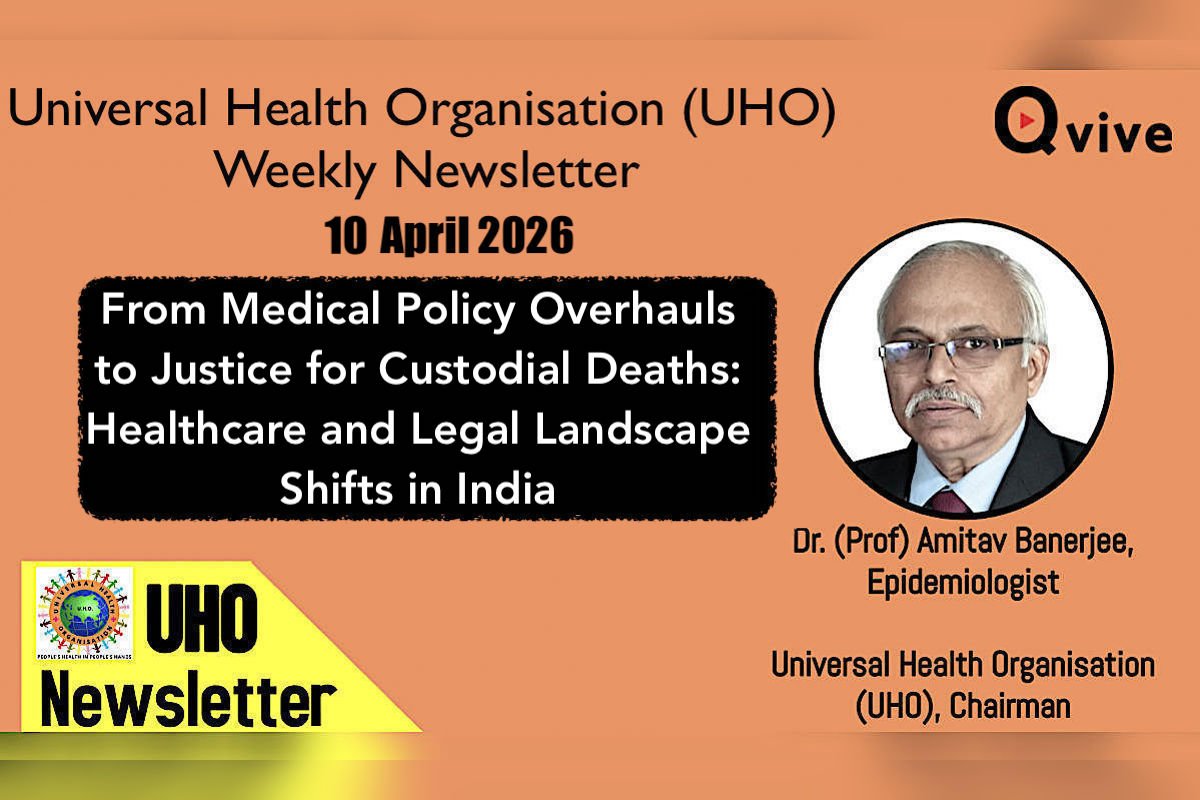
Highlights:
- New PMJAY rules disqualifying hundreds of Cancer specialists: Is it to fill super-speciality seats?
- At Last! NExT – Or is it? Doctors divided on exit exam to reform medical education.
- Covid-19 Pandemic Atrocities: Death for 9 Police Officials for Custodial Deaths.
- Diminished Ovarian Reserve rising in India according to experts: UHO recommends monitoring of impact of HPV vaccine, if any.
Website: https://uho.org.in
By Dr. Amitav Banerjee, Chairperson of the Universal Health Organisation (UHO)
New PMJAY rules disqualifying hundreds of Cancer specialists: Is it to fill super-speciality seats?
Several states are excluding hundreds of experienced, fellowship trained oncologists in the private sector from treating PMJAY patients. Their exclusion is not due to inadequate training or lack of experience but because they do not hold NMC recognized super-specialty degrees such as DM (Doctor of Medicine), or MCh (Magister Chirurgiae).
This move overlooks the fact that until a few years ago, fellowship was the only route to specialization in oncology, formal coursed did not exist. Many of this earlier generation of cancer specialists have gone on to become department heads, medical directors, and senior surgeons, each have decades of experience in treating cancer patients, some even have taught DM and MCh students.
UHO questions whether we can afford the luxury of degree against experience when we have a large unmet need for functioning doctors. Or the move is to fill the ever increasing super-speciality seats in Government and Private Medical Colleges, and earning degrees paying hefty fees?
At Last! NExT – Or is it? Doctors divided on exit exam to reform medical education.
The National Medical Commission’s (NMC’s) proposed common exit exam for the MBBS course, i.e. the National Exit Test (NExT), is yet to see the light of day. Meanwhile, a fresh debate among the medical community has surfaced regarding its necessity and timing of implementation.
While a section of doctors call for immediate implementation of this reform, others are hesitant and expressed concerns of a hasty move of this long awaited measure.
NExT was introduced by a NMC Act 2019, as a common exit licentiate examination, which will replace the final MBBS examination. As an added advantage it was to also replace the NEET for PG, and the Foreign Medical Graduate Examination (FMGE).
UHO concurs with those who are recommending that NExT should be implemented without much delay. This will create one common standard for doctors passing out, reduce the mismatch between different medical colleges, and offer a level playing field for Indian and foreign medical graduates (FMGs). The results in NExT would also indicate which medical colleges are producing good doctors and may eliminate the need for frequent inspections of medical colleges by NMC teams which have occasionally come under a cloud due to allegations of corruption and manipulating inspections.
However, UHO does not expect that this reform would come about soon as various stakeholders with their conflicts of interest in the field of medical education which has become a most lucrative business, would be stalling the process.
Covid-19 Pandemic Atrocities: Death for 9 Police Officials for Custodial Deaths.
In a custodial death case investigated by the Central Bureau of Investigation (CBI), the Single Judge Bench of First Additional District Judge, G. Muthukumaran, held that it was a clear case of abuse of authority and fell in the rarest of the rare cases; all the accused persons were convicted of the charges of murder and destruction of evidence.
During the COVID-19 Pandemic, in 2020, the deceased were apprehended by police officials of Sathankulam Police Station and were wrongfully confined. During their confinement, they were subjected to severe physical assault and torture by the convicted police personnel. Consequently, son succumbed to his injuries, followed by the death of the father in judicial custody.
P Jeyaraj, 58, and his son Benicks, 38, both died in jail in the southern state of Tamil Nadu – days after they were detained for allegedly keeping their mobile phone shop open in breach of lockdown rules during the Covid-19 pandemic.
The two men were stripped and ruthlessly assaulted in front of each other, the sentencing judge said on Monday – describing the case as a clear abuse of authority.
“They did this with the intention of killing,” he said.
Government of Tamil Nadu transferred the investigation to the Central Bureau of Investigation (CBI). Accordingly, on the request of the Tamil Nadu Government and further notification by the Government of India, the CBI took over the investigation and registered two cases.
The investigation revealed that the deaths of the deceased had directly resulted from the brutal custodial violence by police personnel of Sathankulam Police Station. Upon completion of the investigation, a combined charge-sheet was filed under Sections 302, 201, 120-B, 342, 182, 193, 211, 218 and 34, Penal Code, 1860. CBI filed a charge-sheet against nine persons, namely, S. Sridhar, Inspector, the then SHO, P. Raguganesh, SI, K. Balakrishnan, SI, S. Murugan, HC, S. Chelladurai, PC, M. Muthuraja, PC, A. Samadurai, HC, X. Thomas Francis, PC, S. Veilumuthu, PC. One additional accused, a Sub-Inspector, died during the course of the investigation. All the accused were arrested and remained in judicial custody.
The trial, which spanned over five years, resulted in the conviction of all nine accused persons for offences including murder and destruction of evidence. The Court awarded the death penalty to all nine convicted police officials and held that there was a clear and egregious abuse of authority. Accordingly, the Court held that the present case fell within the category of the “rarest of the rare” cases, warranting capital punishment.
In the conviction, the role of the key witness, a brave woman police constable, Revathi, is laudable. She was a constable in the police station where this Nazi like gruesome torture and murder took place.
A mother of two children she volunteered to give evidence against her superiors, after requesting for protection of her family. She narrated how the policemen kept brutally beating the father and son and also stomped on their private parts, stopping only to take sips of alcohol. They stripped the victims naked and kept beating them. Revathi not only gave a detailed account of the crime as an eyewitness but also helped in collecting DNA samples from the furniture and the crevices in the walls as the scene of crime was cleaned up.
UHO commends the courage of this brave police constable who demonstrated extraordinary courage found wanting in many during the pandemic. We also express concern and apprehension that the clumsy ham-handed way the draconian and restrictive measures were implemented and later applied with brutality by the police and administration may have resulted in many such atrocities on the helpless citizens and this incidence may be the tip of the iceberg. We call on our policy makers to avoid such draconian measures, which maim and kill many more than any virus, in the future.
Diminished Ovarian Reserve rising in India according to experts: UHO recommends monitoring of impact of HPV vaccine, if any.
During a fertility conclave hosted by ETHealthworld, experts highlighted the increasing burden of diminished ovarian reserve (DOR) in the country with the present prevalence ranging from 19-32%. This represents a decline in egg quality and quantity adversely impacting fertility. While experts stressed on anti-oxidant therapy to counter the mitochondrial dysfunction thought to cause DOR, the role of HPV vaccine as a possible, albeit unconfirmed factor, was overlooked.
UHO recommends the monitoring of the impact of the HPV vaccine on ovarian function for two reasons. Firstly, a research paper published in the prestigious Nature Scientific Reports, detected disproportionate rise of premature ovarian insufficiency (POI), and related events including amenorrhoea, irregular menstruation, and premature menopause, from the data available in the US FDA’s Vaccine Adverse Events Reporting System (VAERS) following administration of the HPV vaccine, the authors concluding that this strong signal needs further investigation. Secondly, and more importantly, our country is rolling out mass scale HPV vaccine for girls 9-14 years of age. Connecting the dots of increasing DOR, POI from the Nature study and rollout of HPV vaccination in the country, a strong case can be made for robust monitoring of girls for signs of ovarian failure, after getting the HPV jabs.
The weekly newsletters bring the updates on the science, battered and bruised during the pandemic, legal updates and impact of activism for a just society, across the world. These are small steps to promote Transparency, Empowerment and Accountability – the ethos of the UHO.
Announcement: Membership & endorsements to the UHO invited: https://uho.org.in/member.php
Also Read:
Universal Health Organisation (UHO) Weekly Newsletter – 03 April 2026