

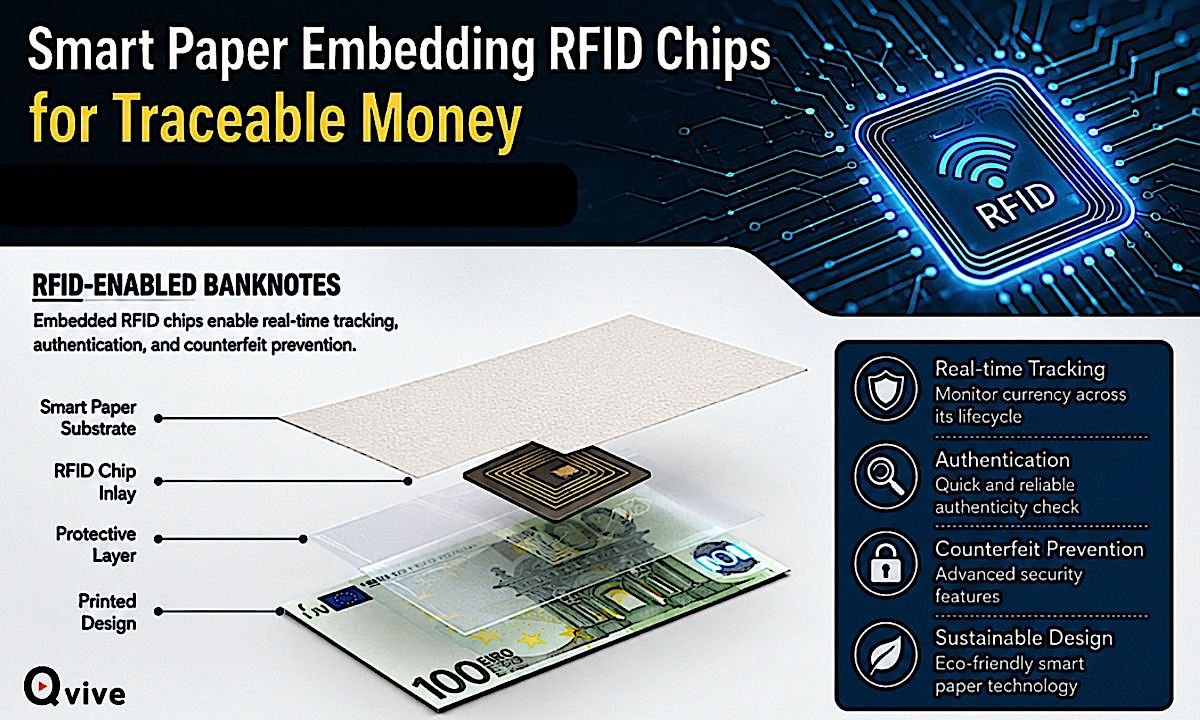
Researchers from North Dakota State University developed an innovative method to integrate radio frequency identification (RFID) chips into ordinary paper, creating a concept called “smart paper.” This advancement could revolutionize how money and documents are tracked and verified, promising benefits for banks, governments, and consumers.
What are RFID Chips?
Think of RFID chips as tiny electronic tags, similar to the barcodes you see on products in stores. They can store information and can be read wirelessly by special devices. This allows items tagged with RFID to be tracked and identified easily without needing a physical connection.
The Development of Smart Paper
The research team led by Val Marinov has utilized a new technology known as Laser Enabled Advanced Packaging (LEAP). This technology allows for:
- Embedding ultra-thin RFID chips into paper.
- Quick and precise placement of these chips.
- Creating flexible, durable paper that can still undergo the wear and tear of daily use.
Saudi Arabia introduces Arab world’s first plastic banknote
Saudi Arabia’s “smart paper money” refers to its 5-riyal polymer banknote, which was introduced as the first plastic bill in the Arab world
The base material used for this currency is GUARDIAN polymer substrate, which is manufactured into film using petrochemical pellets produced directly in Saudi Arabia
The Material: The core of the money is synthetic polymer, which replaces traditional cotton-paper used for older editions.
Durability: These polymer notes are highly durable, dirt-resistant, and built to withstand the Kingdom’s severe summer heat.
Security & Smart Features: The notes feature transparent windows, color-changing patterns, and advanced anti-counterfeiting technologies (as opposed to being tracked via built-in electronic smart-chips).
Eco-Friendly: When these notes reach the end of their lifecycle, the polymer can be melted down into pellets and repurposed into other materials.
Countries/Entities that explored RFID banknotes:
| Country/Entity | Central Bank | Timeline | Outcome |
|---|---|---|---|
| Eurozone (EU countries) | European Central Bank (ECB) | 2001–2005 | Started a “hush-hush” project in 2001 to embed RFID tags into euro banknote fibers by 2005; worked with technology partners. |
| Japan | Bank of Japan | 2004 | Reportedly started talks with Hitachi in 2004, considering RFID tags for 10,000-yen banknotes. |
Chronology of India’s Plastic Currency Plans

Field Trials 2012
- Approved Scale: The central government originally approved a trial run of one billion pieces of ₹10 polymer banknotes.
- Selected Cities: The trial targeted five specific cities chosen for their contrasting geographical and climatic profiles: Kochi, Mysuru, Jaipur, Bhubaneswar, and Shimla.
- Primary Objective: The effort was centered strictly on prolonging the lifespan of low-value paper currency rather than targeting counterfeiters.
- The Bottle-neck: The initial project was shelved due to persistent technological and operational hurdles, specifically note-handling mechanics and ATM calibration constraints that failed to recognize and dispense polymer media seamlessly.
Note: Bill Gates visited India from May 30 to June 1, 2012
Radio Frequency Identification perfectly exemplifies Bill Gates’ maxim by providing businesses with the ability to track, manage, and utilize data instantaneously.
Bill Gates has a long history with Radio Frequency Identification and digital identification.
The Current Shift

- Recent Discussions: The proposal was thoroughly evaluated at recent RBI board meetings held in Patna and Mumbai.
- The Technological Solution: The RBI is re-engaging with this strategy because previous ATM processing constraints have been resolved via specialized sensors and automated sorting advancements.
- Strategic Metros: While the initial phase targeted regional climates, the upcoming pilot is expected to target high-volume major metros like Mumbai and Delhi to stress-test high transaction frequencies.
Do polymer banknotes generally contain animal fat?
Yes, trace amounts of animal fat (tallow) are used as an additive in the manufacturing process of many polymer banknotes, specifically acting as a slip agent or lubricant in the polymer pellets.
The inclusion of animal-derived additives has led to significant debate and pushback in several countries, including the United Kingdom, from vegan, vegetarian, and religious groups who object to its use.
Facts About the Use of Tallow in Polymer Notes:
- Where It’s Used: Tallow is generally incorporated into the polypropylene pellets used as the base material for the notes. It helps prevent the newly manufactured plastic sheets from sticking to one another during production.
- The Scale: Traces of tallow have been found in the polymer currency of over two dozen countries, including Australia, Canada, the UK, and New Zealand.
- The Controversy: When the Bank of England introduced its plastic notes, the revelation that they contained beef tallow sparked massive public outcry.
India’s planned “plastic notes” are made from a thin, flexible synthetic polymer substrate, typically biaxially oriented polypropylene (BOPP) or polyethylene terephthalate (PET). The Reserve Bank of India (RBI) is reviving a previous initiative to introduce these notes to cut printing costs and increase durability compared to traditional cotton-based paper currency.
Additional Information:
Dynamic Intelligent Currency Encryption (DICE)
Dynamic Intelligent Currency Encryption (DICE) is a hardware and software system proposed in 2014 by EDAQS that integrates RFID chips and AI into physical banknotes to verify, track, and remotely cancel them.
It claims to allow central banks to track the movement of physical cash and remotely “deactivate” or cancel specific notes.
Concepts of DICE
Think of DICE as a high-tech security system for cash, similar to having a GPS tracker in your car. If someone tries to steal a banknote or use it in a crime, it can be quickly deactivated, much like disabling a stolen vehicle. Here’s how it works:
- Tracking and Monitoring: DICE uses special codes (known as Machine Readable Codes) or tiny tags (RFID tags) embedded in banknotes. This allows each bill to be registered in a central computer system, making it easier to identify and manage.
- Crime Prevention: If a banknote is involved in a criminal act, it can be “remotely devalued.” This means the note becomes worthless to prevent the thief from using it. It’s similar to a bank freezing your account if they suspect fraudulent activity.
- Cash Management: DICE is designed to help businesses and banks monitor cash flow efficiently, offering benefits like reducing cash-related crimes without completely eliminating cash from use.
Technology Behind DICE
At the heart of DICE is advanced technology:
- ID Modules: Each banknote has a unique identifier, much like a fingerprint. This can be in the form of a barcode or a chip.
- Blockchain Integration: The DICE system operates using blockchain technology, which is a secure, decentralized way of storing data. This ensures that the records of all transactions and statuses of banknotes are safe and tamper-proof.
- RFIT Microchips: A special chip, developed with a partner company, is incorporated into the banknotes. These chips are lightweight and have a very limited range for reading, enhancing security. It’s like how your smartphone only works with very specific chargers – it keeps out the undesired connections.
Financial Inclusion:
The Bill & Melinda Gates Foundation has actively explored and funded blockchain-based mobile payment systems and digital currencies. Gates views this as a vital tool to bring banking and asset valuation to unbanked populations in developing nations.
Reception of DICE
EDAQS promotes DICE as a solution that allows banks to keep a tight grip on cash flow, reducing opportunities for crime while respecting the privacy of cash users. They suggest that better tracking could unlock new research avenues in economics. However, not everyone is on board; some groups, like the German and Austrian Pirates Party, have raised concerns over privacy implications.
RFID Security and Privacy:
Embedding RFID (Radio Frequency Identification) in banknotes is designed to deter counterfeiting and allow for easy remote authentication. However, this presents major security risks and privacy threats, primarily the potential for unauthorized scanning (skimming) and the mass tracking of an individual’s financial movements
RFID systems are inherently vulnerable because they transmit data wirelessly without standard native controls. Without strong countermeasures, these networks face significant data security and location privacy threats, making them susceptible to unauthorized scanning, interception, and tracking.
The Core Privacy Threat: “Squealing” Banknotes
- Remote Tracking: Because RFID tags broadcast wirelessly, anyone with a portable reader can covertly scan the money in your wallet without your knowledge. This allows attackers to determine exactly how much cash you are carrying.
- Loss of Anonymity: Unlike physical cash, which is famously anonymous, RFID-enabled cash connects physical bills to an owner if a transaction or withdrawal is recorded. A malicious actor could track the lifecycle and movement of specific banknotes
Security Vulnerabilities
- Counterfeiting and Cloning: If the data on a banknote’s RFID tag isn’t properly encrypted, counterfeiters can easily clone the tag and embed it in fake currency.
- Database Hacking: Even if tags transmit only a serial number, they serve as “meta-serial-numbers” that can be linked to databases to trace individual transaction histories.
- Eavesdropping & Sniffing: Attackers intercept unencrypted radio signals to capture sensitive transmission data.
- Cloning & Spoofing: Hackers read a legitimate tag’s information and write it to a blank tag to bypass physical access controls or duplicate assets.
- Man-in-the-Middle (MITM) Attacks: Adversaries intercept and alter the communication path between a tag and a reader in real time, modifying asset records or transaction values.
- Denial of Service (DoS): Attackers flood RFID readers with rogue signals, disrupting system operations and causing data gaps.
Privacy Vulnerabilities
- Tracking & Profiling: Because tags constantly broadcast fixed, unique IDs, unauthorized scanners can track the real-time physical location of tagged goods or individuals.
- Traffic Analysis: Even when tag contents are encrypted, attackers can analyze the frequency and timing of tag responses to determine social status, habits, or locations.
The Pros and Cons of Polymer Banknotes
Many countries are transitioning from paper money to banknotes made of polymer because of the latter’s anti-counterfeit features. Below is some more insight into the pros and cons of polymer banknotes.
How times change! Over time, paper money (made of 75% cotton and 25% linen blend) will likely be replaced by polymer banknotes. But why is the polymer craze catching on so fast? Is it safer? Is it better looking? Or does it have more value as compared to the usual paper money?
Polymer banknotes have already become very popular in different countries in the world. For example, they are already in use in Canada, and in the UK the government is planning to phase out its paper banknotes by 2020.
Of course, like everything else, there are both advantages and disadvantages to using polymer banknotes.
What Are Polymer Banknotes?
What exactly is polymer and how is it different from the paper used to print money? Polymer is a clear thin piece of plastic and is more durable than paper.
The Reserve Bank of Australia (RBA) in a combined effort with the Commonwealth Scientific and Industrial Research Organization and the University of Melbourne was the first to develop polymer banknotes. Today, many countries are adopting these notes because of the many benefits. Romania, Canada, Israel, and Vietnam have switched entirely to polymer banknotes.
Cons of Polymer Banknotes
As with many things, there some cons to using polymer banknotes. With these newer notes, there’s a chance that older sorting machines might not be able to sort these notes out as fast as they would with paper money. It’s more probably that these sorting machines will have to be modified or updated to accommodate polymer bills.
The colors of polymer banknotes can fade. A good example is Nigeria in Africa, which went back to paper money after the polymer banknote test failed when the money started fading and sellers started rejecting it.
Polymer banknotes can be difficult to fold. When you force-fold it, it will have a crease along the fold line.
Polymer banknotes can get sticky when wet. This can be frustrating, especially if sorting out the notes.
Pros of Polymer Banknotes
Polymer bills last a long time. The wear and tear typically associated with paper money does not affect polymer notes as quickly as it does for paper money. In 2013, The Guardian stated that polymer banknotes are likely to last 2.5 times longer than paper money.
Polymer banknotes are more difficult to forge than paper banknotes due to detailed images and the fact that the bills are made with expensive technology designed to decrease the likelihood of counterfeiting. Countries that have adopted polymer banknotes have already reported a remarkable reduction in counterfeiting as opposed to countries still using paper money.
As opposed to polymer, paper money can get dirty easily. When subjected to a thorough test, paper money has been known to contain traces of feces, grime, viruses, bacteria and more. Did you know that paper money can pass on flu agents for more than ten days? Compared to paper bills, polymer banknotes are a significantly cleaner and are less likely to play host to a multitude of bacteria and viruses. This is because polymer banknotes are essentially made of plastic, so if the note happens to get dirty or have liquid spilled on it, cleaning the bill is easier than it would be if a paper banknote needed to be cleaned.
Polymer notes are also able to withstand extreme temperatures. According to the director of currency at the Bank of Canada, polymer banknotes can withstand temperatures of up to 140 degrees, Celsius. Polymer bills are also able to withstand freezing temperatures without suffering damage.
Ref:
- https://www.banknoteworld.com/blog/the-pros-and-cons-of-polymer-banknotes
- Wikipedia
- https://spectrum.ieee.org/smart-paper-makes-traceable-money-possible
Also Read: