

Opportunity plays a vital role in politics. You could even call it opportunism. Some people seize the opportunity and reach the pinnacle of power, while others, unable to seize it, sink into the abyss. You might say that opportunity is useful everywhere, so why am I discussing its usefulness in politics? You’re right! Opportunity is useful everywhere, but there’s a significant difference between the usefulness of opportunity in other places and the usefulness of opportunity in politics. In other places, the usefulness of opportunity is determined by certain principles, but in politics, principles don’t matter. Here, anyone can sacrifice their principles and seize the opportunity. At times, close allies become staunch opponents to serve their own interests, while at other times, even staunch opponents become close allies to gain advantage. Principles are not considered here, but only one’s own benefit.
Several names, such as Jyotiraditya Scindia and Himanta Biswa Sarma, can be cited as examples of arch-rivals seizing the opportunity to become one’s own. These two leaders were once considered prominent figures in the Congress party, but now they are considered prominent figures in the Bharatiya Janata Party, a staunch opponent of the Congress party. Jyotiraditya Scindia is a minister in Narendra Modi’s cabinet, while Himanta Biswa Sarma is the Chief Minister of Assam.
Leaders like Sharad Pawar and Mamata Banerjee can be cited as examples of prominent figures becoming arch-rivals. Both were once considered prominent figures in the Congress party, but when the opportunity arose, they left the party and formed their own party, becoming Chief Ministers. Sharad Pawar enlisted the support of the Bharatiya Janata Party, a staunch opponent of the Congress party, to become Chief Minister, and Mamata Banerjee, after leaving the Congress party, also enlisted the support of the Bharatiya Janata Party, a staunch opponent of the Congress party, to become Railway Minister at the Centre. Later, she also served as Chief Minister of West Bengal for three consecutive elections on her own.
Following the Bharatiya Janata Party’s landslide victory in the Maharashtra and West Bengal Assembly elections, a new opportunity has emerged. This opportunity did not arise on its own; rather, following its overwhelming success in the West Bengal elections, the BJP created this opportunity by inciting Trinamool Congress MLAs and MPs to rebel against their own party. The BJP created this opportunity because Prime Minister Narendra Modi desperately wants to pass the new Constitution Act and the Delimitation Act in Parliament during the monsoon session, and he needs MPs to do so.
After the West Bengal elections, when the BJP formed its government in Bengal with Suvendu Adhikari as Chief Minister and created this new opportunity by inciting TMC MLAs and MPs to rebel against their own party, the Congress also jumped at the opportunity. It proposed that the Mamata Banerjee-led TMC and the Sharad Pawar-led NCP merge with the Congress. In return, Mamata Banerjee was offered the promise of becoming the Congress Vice President, sending her to the Rajya Sabha, and giving her nephew Abhishek Banerjee a prominent position in the Congress. A similar offer was made to Sharad Pawar. However, the deal failed, and the Congress lost the opportunity.
With the Congress losing this opportunity, the BJP, led by PM Modi, is now determined to seize the opportunity. Given Mamata Banerjee’s stance, the BJP in West Bengal has, without negotiating with her, instead turned her MLAs and MPs into rebels and rallied them to its side. To prevent any law like the anti-defection law from thwarting the BJP’s deliberate ploy, the rebel TMC MLAs and MPs have not been merged into the BJP. A separate group has been created for the rebel TMC MLAs in the Assembly, and its leader, Ritu Vrat Banerjee, has been appointed Leader of the Opposition, while the rebel TMC MPs have been made members of a less prominent party like the NCPI.
After West Bengal, the BJP led by PM Modi played a similar small game of rebellion in Maharashtra, where it brought six Shiv Sena (UBT) MPs to its side by inducting them into the Shiv Sena led by Eknath Shinde. Now, the BJP led by PM Modi is going to capitalize on this opportunity in Maharashtra with a larger game.
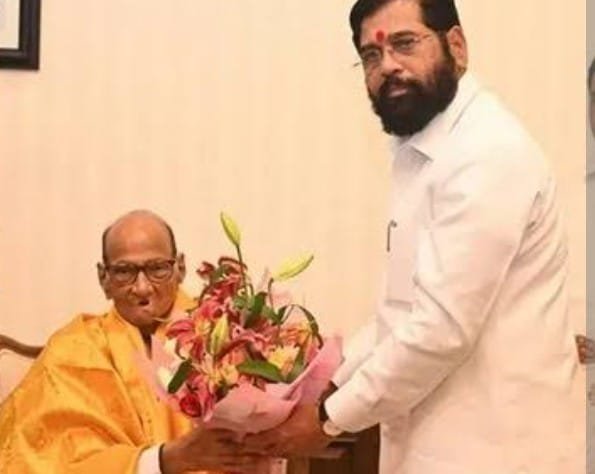
This time, the BJP is not going to play the rebel game in Maharashtra. While the NCP led by Sumitra Pawar is already with the BJP, the BJP is now working to bring the Sharad Pawar-led NCP completely to its side. The BJP has given Eknath Shinde the responsibility for implementing this policy of PM Modi. Now, Eknath Shinde has also started using this tactic. In this context, Eknath Shinde and Sharad Pawar met and discussed, but what was discussed was not disclosed to anyone. Others were simply told that it was a courtesy meeting. But in this courtesy meeting itself, Eknath Shinde politely told Sharad Pawar that firstly, you are so old now that you will not be able to do politics actively till the next elections, secondly, your daughter Supriya
Sule will also receive a ministerial position. Sharad Pawar left the meeting after agreeing not to publicize what happened inside the dining hall.
The Congress Party and Shiv Sena (United) strongly opposed Sharad Pawar’s meeting with Eknath Shinde. However, despite the opposition from the Congress Party and Shiv Sena (United) Party, Sharad Pawar did not dismiss this courtesy meeting with Eknath Shinde as inappropriate, signaling his party’s move to the NDA camp. The BJP, by delaying Prime Minister Narendra Modi’s potential cabinet reshuffle, is hinting that Eknath Shinde has already discussed everything with Sharad Pawar, and that once the Sharad Pawar-led NCP joins the NDA, the cabinet expansion will only take place after Sharad Pawar’s daughter Supriya Sule is given a ministerial position. This means that the deal for Sharad Pawar’s entry into the NDA has been finalized. Now, the only awaited opportunity is for Prime Minister Narendra Modi to successfully include Sharad Pawar’s party in the NDA and pass the Nari Shakti Vandan Act and the Delimitation Act in the monsoon session. Prime Minister Narendra Modi has put in all his efforts to get these two Acts passed and make them law so that this time the opposition cannot stop the passage of these bills if his party introduces them again in the House.