


Chinese researchers use lab-grown cyanobacteria to transform barren desert sand into living, fertile ground in just 10 to 16 months.This innovation tackles the issue of desertification, a process where once-fertile land becomes increasingly arid, ultimately transforming into desert.

Understanding Biological Soil Crusts
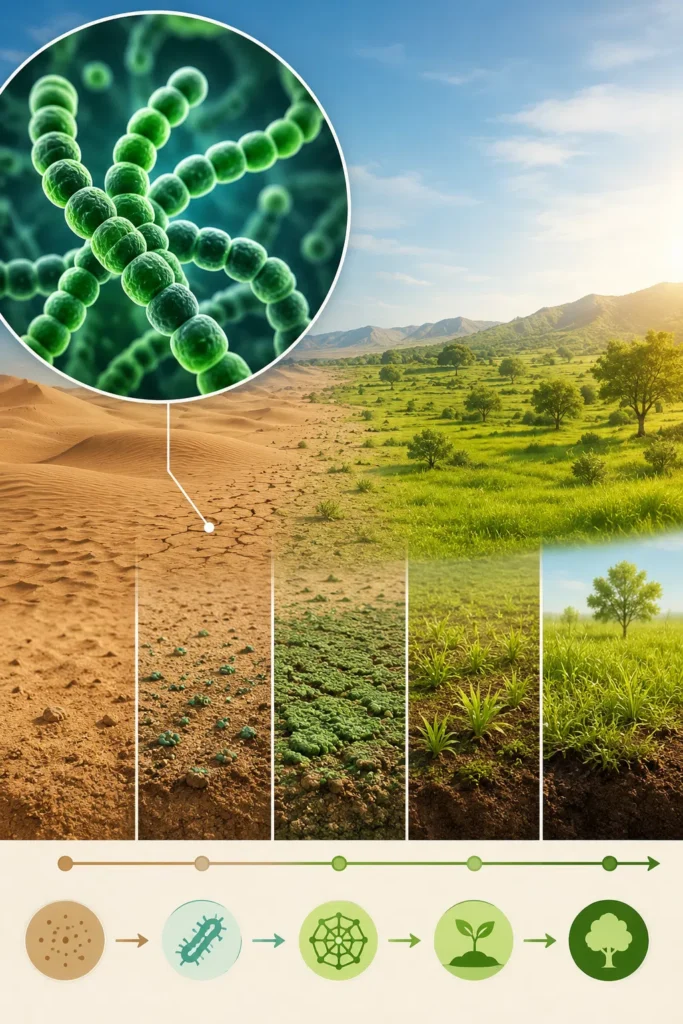
At the heart of this process is a concept known as biological soil crusts. These are thin layers of living organisms, often referred to as the “living skin” of the desert. Think of them as the first layer of defense for the soil. Just like how a healthy skin layer protects our bodies, these crusts help safeguard the soil against erosion and promote life. They develop through three main stages:
- Simple cyanobacteria (tiny, photosynthesizing bacteria).
- More complex lichens.
- Finally, a mature stage dominated by moss.
The Innovation: Lab-Grown Microbes
The scientists used lab-grown microbes, specifically cyanobacteria, to create a stable layer that could bind loose sand together. Imagine building a sandcastle: without water, the sand just collapses. But with water (or in this case, the microbes) binding the grains together, the structure becomes solid and durable. This reinforced surface allows restoration teams to plant shrubs and grasses, providing them with a fighting chance against drought and harsh winds.
In trials held near the Taklamakan and Kubuqi Desert in northwest China, researchers noted that the crusts would stabilize the sand in as little as 10 to 16 months. The key is to focus on building a strong soil base first, which will support the growth of further plant life without needing constant replanting.
How Do They Work?
The biological soil crusts function as a glue for the sand. Under a microscope, you can see a web of bacterial threads wrapping around the grains. These bacteria excrete sticky sugars that help hold the sand particles together, forming a cohesive layer that prevents the soil from easily being disturbed by wind or water.
During the first year, nutrients begin to build up near the top of the treated soil. When mixed with mineral dust and decomposing organic matter, these nutrients create a richer environment for plants. This increase in available nutrients allows the microbial community to thrive, which in turn enhances the soil quality further.
Water Retention and the Ecosystem
Another remarkable feature of these soil crusts is their ability to retain water. After rain, areas covered by the crust keep moisture close to the surface, giving grasses and shrubs more time to establish their roots. Meanwhile, bare sand dries out quickly. This moisture retention is crucial for plant survival during dry spells, as the living crust can even go dormant during extreme conditions, waiting for the right moment to re-activate.
As time progresses, these crusts evolve, starting with mostly microbes and eventually incorporating more complex life forms like lichens and moss. These additions not only strengthen the crust but also enhance its ability to hold moisture and create a habitat for new microbes.
The Bigger Picture: Long-Term Goals
The researchers at the Shapotou Desert Experimental Research Station have been tracking the effectiveness of this method for several decades. They found that adding cyanobacteria to the soil helped speed up the natural process of crust development, which typically takes decades, down to just a few years.
The countries currently adopting, piloting, or collaborating on this lab-grown cyanobacteria technology:
- China
- Mongolia
- Mauritania
- Ethiopia
- Senegal
- Nigeria
Global Implications

If rolled out on a large scale, this technique could play a critical role in global efforts to combat desertification and promote sustainable agriculture in dry regions. It represents a promising opportunity not just for ecological recovery but for improving food security in areas affected by land degradation.
Should You Consume These Cyanobacteria?
No, you should not directly consume the lab-grown cyanobacteria or the biological soil crusts. These microbes are used for soil restoration, not as food. While the crops (barley, watermelon) grown after the crust forms are safe to eat once harvested, the bacteria themselves can produce potent toxins that cause serious health issues if ingested.
Key Health Risks of Cyanobacteria Exposure
Critical finding: Desert crust cyanobacteria have been detected producing microcystins (1.5–53.7 ng/g dry weight) and potentially anatoxin-a(S) (a neurotoxin). If present in dust storms, these could pose significant inhalation risks to humans.
Environmental Impact
What Happens During Sandstorms?
When sandstorms hit:
- Cyanobacteria in dried crusts become airborne as dust particles
- Toxins travel with the dust—research shows airborne cyanobacteria toxins can travel >1 mile inland and reach deep into human lungs
- Inhalation risk increases: Microcystin concentrations in desert crusts could exceed the tolerable daily intake (TDI of 12 ng) for adults via inhalation
- Respiratory irritation occurs as blooms die off and release gases like hydrogen sulfide and methane
Harbin turned from day to night in seconds as a massive sandstorm — among the strongest in years — engulfed the city this afternoon.
— Shanghai Daily (@shanghaidaily) May 31, 2026
Visibility dropped below 100 meters. Trees snapped. Roof sheets tore off buildings. pic.twitter.com/jSJToQPrjF
Ref:
- https://www.sciencedirect.com/science/article/abs/pii/S0048969712001349
- https://www.cdc.gov/harmful-algal-blooms/hcp/clinical-signs/symptoms-freshwater-harmful-algal-blooms.html
- https://coastalscience.noaa.gov/news/study-explores-airborne-health-risks-from-cyanobacteria-blooms-in-florida/
- https://www.youtube.com/watch?v=46ZkVL7NOQU
Also Read: