

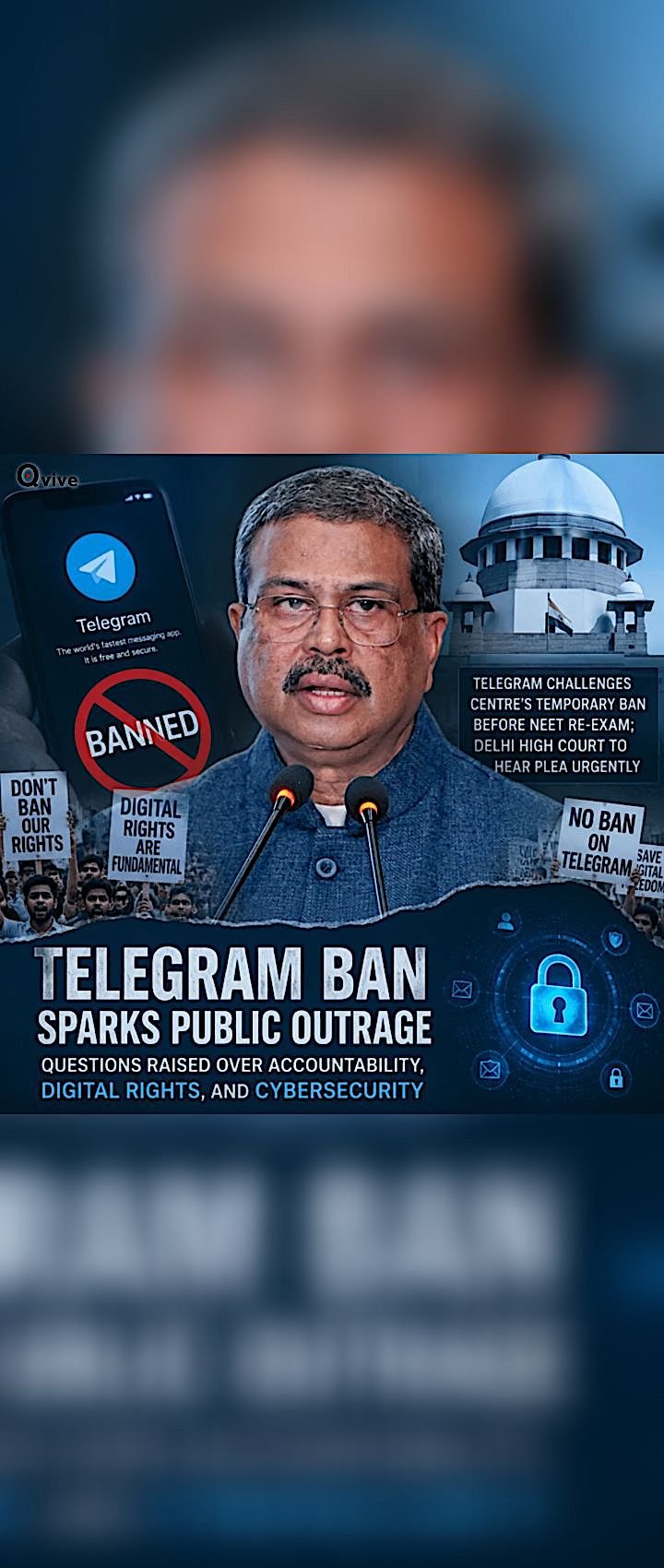
India temporarily blocked Telegram nationwide and restricted its message-editing features ahead of the June 21 NEET-UG re-examination to curb rampant paper leak scams. The drastic measure—effective until June 22—sparked public outrage among millions of regular users and students who depend on the platform for free study materials.
A hypothetical one-week ban on Telegram following a major examination leak has ignited widespread debate across India. Citizens, students, educators, and digital rights advocates have questioned whether restricting access to an entire communication platform is an effective response to wrongdoing committed by a small group of individuals.
Many members of the public argue that the government’s priority should be identifying and prosecuting those directly responsible for the leak rather than imposing restrictions that affect millions of ordinary users. Telegram is widely used for educational discussions, business communication, community groups, and information sharing. Critics contend that a blanket ban punishes legitimate users while failing to address the root causes of the incident.
Telegram founder and CEO Pavel Durov heavily criticized the move, stating that the ban “punishes 150 million ordinary users” in India rather than the insiders responsible for the leaks. He noted that the illicit networks simply moved to other apps.
Digital rights advocates like the Internet Freedom Foundation labeled the block a “disproportionate answer” to exam fraud that negatively impacts digital freedom. They argue that temporary platform bans may set concerning precedents and risk undermining trust in digital governance. According to these critics, governments should focus on targeted investigations, stronger cybercrime enforcement, and transparent accountability mechanisms rather than broad restrictions affecting the general public.
India’s IT ministry banned Telegram for one week because some users shared leaked exam questions.
— Pavel Durov (@durov) June 16, 2026
This punishes 150M+ ordinary Telegram users in India — not the insiders who leaked the exam materials.
And the ban hasn't stopped anything. The leaks just moved to other apps. https://t.co/CzQWN4mXfb
The incident has also prompted a deeper question: How secure is the nation’s cybersecurity infrastructure? If sensitive examination material could be leaked despite existing safeguards, many citizens want answers about how the breach occurred and what preventive measures are being implemented. The public expects not only accountability from those who leaked the information but also assurances that future incidents will be prevented.
Students, who are often the most affected by examination controversies, have expressed frustration. Many believe that the focus should remain on preserving the integrity of examinations and protecting the interests of honest candidates. For them, platform bans appear to be a reaction to the consequences of a problem rather than a solution to the problem itself.
The government faced mounting pressure from opposition leaders, who demanded institutional accountability over systemic examination flaws rather than platform bans.
Critics Question Whether a Telegram Ban Would Address the Real Problem
Many critics have argued that focusing on a single messaging platform may not effectively prevent fraud or information leaks. They point out that individuals engaged in illegal activities can often migrate to other communication channels, including alternative messaging apps, social media platforms, email services, private forums, or encrypted communication tools.
According to this viewpoint, the challenge is not necessarily the platform itself but the individuals and networks responsible for the misconduct. Critics contend that enforcement efforts should prioritize identifying perpetrators, strengthening investigative capabilities, improving cybersecurity measures, and addressing vulnerabilities that allowed the incident to occur in the first place.
Some citizens have also mocked what they see as an inconsistent approach, arguing that if one platform is restricted because it was allegedly used for wrongdoing, similar logic could apply to numerous other digital services that have also been misused by criminals at various times. They argue that technology platforms are tools that can be used for both legitimate and illegitimate purposes, and that the focus should remain on criminal behavior rather than on broad restrictions affecting all users.
Supporters of stricter restrictions, however, maintain that temporary actions against platforms can help disrupt illegal activity and aid ongoing investigations. The debate therefore centers on a key policy question: whether platform-wide restrictions are an effective deterrent or whether targeted enforcement against bad actors would produce better results with less disruption to ordinary users.
Ultimately, the debate extends beyond a single messaging application. It touches on larger issues of internet freedom, cybersecurity preparedness, government accountability, and public trust. Citizens are increasingly asking whether broad platform restrictions improve security or simply create inconvenience while leaving the underlying vulnerabilities unresolved.
As discussions continue, the central question remains: Should governments prioritize platform-wide restrictions, or should they focus on identifying perpetrators, strengthening cybersecurity systems, and ensuring that innocent users are not caught in the crossfire?
Telegram Challenges Centre’s Temporary Ban Before NEET Re-Exam; Delhi High Court to Hear Plea Urgently
Messaging platform Telegram has moved the Delhi High Court against the Central government’s decision to temporarily block access to the platform ahead of the NEET-UG 2026 re-examination. The High Court has agreed to hear the matter on an urgent basis, setting the stage for a significant legal battle over digital access, exam security, and government regulation of online platforms.
Telegram’s Response
- Telegram, which has over 150 million users in India, argues that the government’s ban unfairly targets them while allowing other social media platforms to continue operating. They claim this situation violates Article 14 of the Indian Constitution, which protects against discrimination.
- The company filed a writ petition in the Delhi High Court, stating that blocking its platform as a whole based on the actions of a few users is not justified. They likened this reasoning to punishing an entire community for the wrongdoings of a few individuals, which could threaten the principles of free speech and access to information.
Measures Taken by Telegram
In response to the government’s concerns, Telegram had multiple meetings with government representatives and took steps to address the issues by:
- Removing flagged content quickly—within just one hour of being notified.
- Taking down over 900 links associated with unlawful NEET content.
- Utilizing advanced technology, like artificial intelligence and machine learning, to help identify and manage violations on their platform.
Legal Proceedings
The High Court, recognizing the urgency of the matter, has agreed to hear Telegram’s appeal soon. Advocate Madhav Khosla, representing Telegram, presented their case before Justice Tejas Karia and emphasized that the ban fails to consider the proactive measures taken by the platform.
Furthermore, the legal petition argues that the government’s decision is lacking in reasoning and does not adequately explain the basis on which it was made.
Ref: https://www.barandbench.com/news/telegram-moves-delhi-high-court-against-government-ban-before-neet-ug-re-exam
Also Read: