

India is not a formal member of the G7, but due to its growing economy and global influence, it has frequently been invited to G7 meetings. During the tenure of then-Prime Minister Manmohan Singh in the 2000s, India participated in G7 (and G8) meetings several times. Since Narendra Modi’s appointment as Prime Minister, invitations and participation in the G7, a group of the world’s most powerful nations, have become commonplace.
Indian Prime Minister Narendra Modi, invited to the G7 meeting currently underway in Évian-les-Bains, France, is boldly demonstrating India’s strength to the world by attending this powerful group.
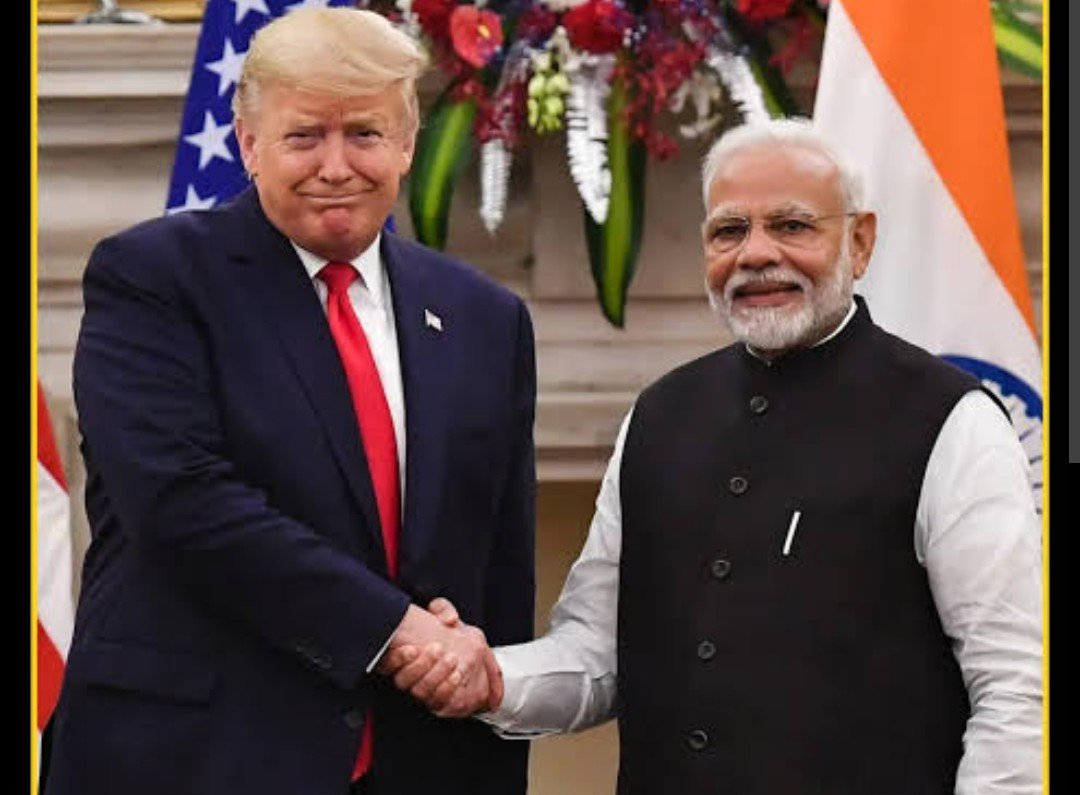
A photo from the G7 meeting in France is currently going viral, demonstrating India’s strength. President Donald Trump of the United States, considered the world’s most powerful nation, is sitting in his chair. Just then, Indian Prime Minister Narendra Modi arrives and, ignoring Trump, moves the chair next to him. Seeing this, US President Donald Trump stands up and shakes hands with Indian Prime Minister Narendra Modi. Donald Trump pats Prime Minister Narendra Modi’s arm, and Prime Minister Narendra Modi stands proudly, looking him in the eye. This gesture of Prime Minister Narendra Modi clearly indicates that he is telling US President Donald Trump that enough is enough. Stop your wickedness. Stop this game of destabilizing India and bringing it under your influence, sometimes in the name of tariffs and sometimes in the name of trade deals. India will not bow down to you. We are ready for a trade deal, but not on your terms, but on terms that serve the interests of India’s 1.5 billion population. We don’t need your agricultural products. If you need our agricultural products, tell us. Just as India is busy exporting its agricultural products to countries like England, Japan, etc., we will do the same for you.
This confidence of Indian Prime Minister Narendra Modi is not without reason. There are solid reasons behind it. First, Donald Trump is currently facing significant embarrassment in the United States over both tariffs and the war with Iran. Trump has been reprimanded by the US Supreme Court on the tariff issue, and on the Iran war issue, the US Senate passed a bill passed by Donald Trump, with even senators from Donald Trump’s Republican Party cross-voting to support the Democrats. Furthermore, midterm elections are due in the US soon. This means that US President Donald Trump will now have to backtrack on both issues. Regarding the Iran war, it is now becoming clear how President Donald Trump may be making superficial gestures, but is secretly working to end this war quickly. On Friday, the heads of state of both countries may sign a deal ending the US-Iran war.
On the other hand, Indian Prime Minister Narendra Modi’s position is currently quite strong. Although PM Modi suffered a slight setback in the 2024 general elections, with his MPs’ numbers dwindling from 303 to 240, the NDA’s victory in 292 seats allowed Prime Minister Narendra Modi to form a government with a full majority. Subsequently, Prime Minister Narendra Modi demonstrated his strength again by winning the Haryana, Maharashtra, Bihar, Delhi, and West Bengal Assembly elections one after another. Subsequently, the BJP has almost compensated for its lack of a majority in the 2024 elections by wooing TMC MPs from Bengal and now several Shiv Sena (UBT) MPs from Maharashtra to its side.
Considering these factors, it is clear that India’s Prime Minister Narendra Modi currently has the upper hand over US President Donald Trump. So, given that Donald Trump himself has repeatedly stated that PM Modi is a great bargainer, on this occasion, when a meeting between Indian PM Modi and US President Donald Trump is scheduled after the G7 meeting, PM Modi will certainly secure a trade deal in India’s favor, thereby giving a befitting reply to his opponents in India who are trying to create a narrative of Narendra surrender, forcing them to call him Narendra Victor instead of Narendra surrender.
At the outreach session of the G7 summit held in France, Prime Minister Narendra Modi delivered the message of “Humanity First” and urged the world to move beyond the old “Donor-Recipient” thinking and build partnerships based on equality and solidarity, advising them to embody the key characteristics of India’s ancient culture: Sarve Bhavantu Sukhinah, Sarve Santu Niramaya, Sarve Bhadrani Pashyantu, Maa Kashchit Dukhbhagbhavet.