

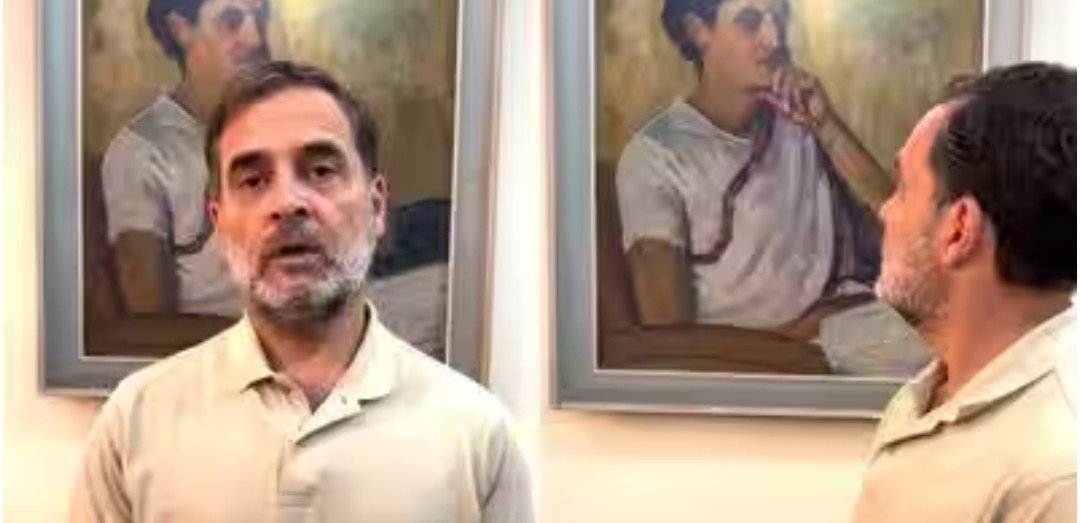
The political sparring between the Congress and the central government over the new UPI fee structure has intensified. Congress MP and Leader of the Opposition in the Lok Sabha, Rahul Gandhi, on Wednesday demanded that Prime Minister Narendra Modi withdraw the new UPI charges. Calling it the “UPI Tax,” he alleged that the government’s decision would impact the common people of the country. In a video message shared on the social media platform X, he appealed to the Prime Minister to immediately withdraw it.
In his statement, Rahul Gandhi took aim at Prime Minister Narendra Modi by referring to former Prime Minister Indira Gandhi. He said that Indira Gandhi was once asked whether she was on the left or right in politics. In response, Indira Gandhi had said that she was neither on the left nor on the right, but stood straight. Rahul Gandhi used this reference to take a dig at Prime Minister Modi.
In his statement, Rahul Gandhi took aim at Prime Minister Narendra Modi by referring to former Prime Minister Indira Gandhi. He said that Indira Gandhi was once asked whether she was on the left or right in politics. In response, she said she was neither left nor right, but rather stood straight. Rahul Gandhi used this context to taunt Prime Minister Modi.
Rahul Gandhi said that Prime Minister Narendra Modi has imposed a tax on every Indian by imposing fees on UPI. He alleged that the government’s new system will also create a way for the United States to receive large sums of money. Rahul Gandhi demanded the Prime Minister to withdraw the new UPI fees and questioned the government’s policy.
Rahul Gandhi also mentioned US President Donald Trump in his statement. He accused Prime Minister Narendra Modi of bowing to the US and Trump. Rahul Gandhi said that Indira Gandhi had once advocated for standing straight instead of aligning her politics with the left or right, while he made a different comment about Prime Minister Modi.
Under the new framework, the Merchant Discount Rate (MDR) has been implemented on certain merchant transactions. A 0.4 percent MDR is imposed on certain merchant UPI transactions exceeding ₹2,000. For transactions exceeding ₹75,000, this fee will be limited to a maximum of ₹300 per transaction. However, according to the government, this fee will not be charged directly to customers.
The central government states that it is incorrect to call MDR a “UPI Tax.” According to the government, this fee will apply to the payment system associated with merchant transactions, and the MDR will not be directly levied on the customer. The government has also clarified that no fee is imposed on person-to-person (P2P) UPI payments.
The Congress party also questioned the government regarding the cost of operating UPI through a post on social media. The party claimed that approximately ₹20,700 crore is required annually to operate UPI. Citing data for the financial year 2025-26, the Congress party mentioned a surplus transfer of approximately ₹3 lakh crore from the RBI to the central government, profits of over ₹4.11 lakh crore by the country’s listed banks, and pre-tax profits of ₹1,888 crore by the NPCI.
In its post, the Congress party claimed that only 7.2 percent of the surplus transferred by the RBI to the government could be sufficient to cover the operating costs of UPI. Based on this, the party questioned why the need to impose MDR on UPI arose when the government already has the financial resources.
Referring to the Tax Amendment Bill introduced in August, the Congress party alleged that it paved the way for imposing MDR on free UPI transactions. The party claimed that on August 6, Finance Minister Nirmala Sitharaman had stated that no decision had been made on MDR, and on August 10, it was also stated in the House that no final MDR framework had been finalized. According to the Congress party, a notification regarding MDR was subsequently issued on September 14th.
The issue of UPI fees has now moved beyond the economic sphere to become a political debate. While Rahul Gandhi and the Congress party are linking it to a potential burden on ordinary people and the digital payment system, the government maintains that MDR is not a tax directly levied on customers. This difference has sparked a heated exchange of words between the two sides.