


Governments around the world are increasingly relying on biometric technologies to identify, authenticate, and monitor people. Fingerprints, facial recognition, iris scans, voiceprints, and DNA data are now routinely collected by public agencies. In the United States, the Department of Homeland Security (DHS) operates one of the world’s largest biometric databases, containing information on hundreds of millions of individuals. While authorities argue that such systems enhance national security, border control, and crime prevention, civil liberties advocates warn that they can also create unprecedented surveillance capabilities.
The expansion of large-scale biometric databases raises important questions about privacy, freedom, due process, and democratic accountability. These concerns are not limited to the United States. Countries such as India, which already operate some of the world’s largest digital identity and biometric systems, face similar challenges and risks.
- The US DHS is developing a $6.158 billion biometric database called the Homeland Advanced Recognition Technology System (HART).
- HART will collect and organize data on over 270 million individuals, including juveniles, sourced from various federal, state, and foreign entities.
- Utilizes advanced military-grade technologies to gather biometric data like facial recognition, DNA, and fingerprints, often without consent or warrants.
- Intended for identifying immigrants and facilitating actions such as surveillance, arrests, and deportations, posing significant risks to civil rights.
- Potential to violate human and privacy rights, especially affecting marginalized groups like Black and immigrant communities.
- Lacks transparency, oversight, and accountability, leading to escalating costs and profits for military contractors and private equity firms.
- Continues to receive congressional funding despite not meeting contract milestones and raising ethical concerns regarding privacy and human rights.
- Report highlights dangers in HART’s mechanics, costs, and involved entities, advocating for the dismantling of HART and freezing its funding.
HART presents unacceptable risks and dangers
- HART will powerfully expand DHS’ surveillance capabilities, enabling ICE, CBP, and other domestic and foreign policing agencies to fuel discriminatory policing and violate the rights of hundreds of millions of people. HART will be especially pernicious for already heavily-surveilled and overpoliced Black and brown communities.
- HART will harvest and exploit facets of our day-to-day lives, jeopardizing the rights of political activists and freedom of assembly, and take away our privacy.
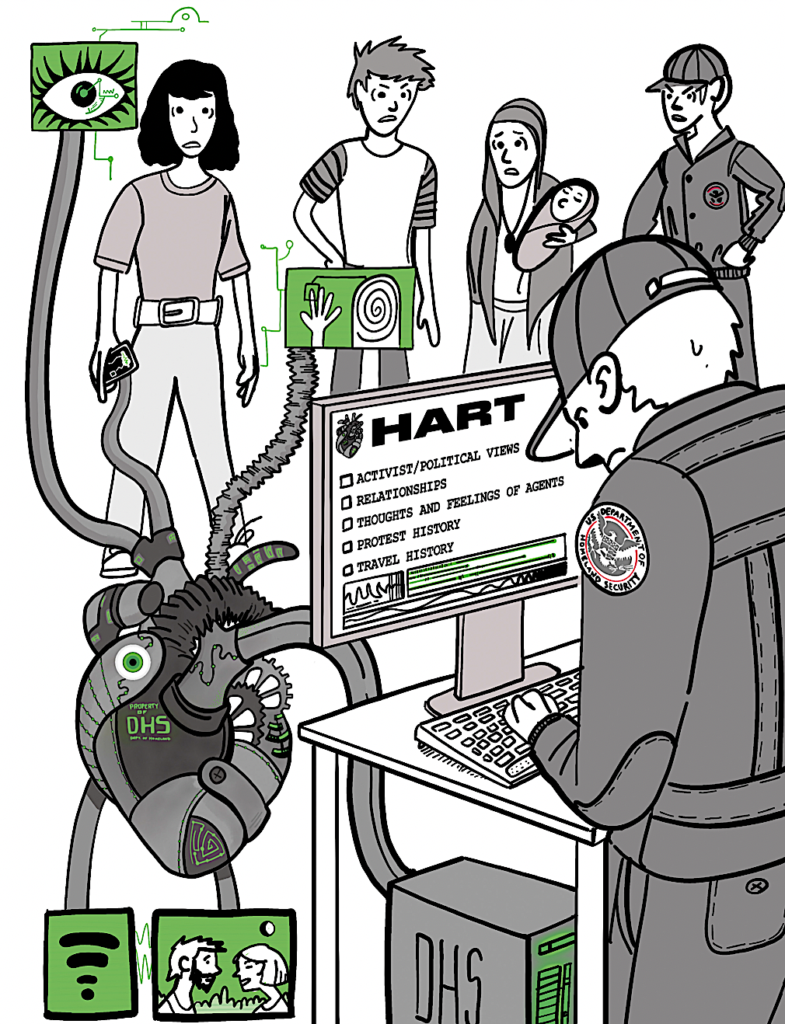
- HART will include invasive personal and biometric data, which could include unverified information about people’s professional roles, religious affiliations, banking information, familial connections and friendships, romantic partnerships, personal activities, political views, travel patterns, and more.
- HART will weaponize information that people are required to submit to access basic government services, such as driver’s licenses.
- HART’s will rely on untested, racially- biased, and unreliable biometrics, as well as data from controversial companies like Clearview AI.
- HART will contain data on juveniles, including biometrics.
- HART is built on data collection without consent.
- DHS “cannot ensure accuracy” and quality of the data in HART, since it says it does not own the data—but it will retain and use this data for at least 75 years nonetheless.
- HART is explicitly designed to shield DHS from scrutiny, accountability, and consequences for its use of data, even when it violates civil and human rights
- HART’s so-called “redress” measures are effectively non-existent, leaving people with almost no way to challenge content in the massive database, access their information, and correct errors in their data.
In 2016, the Department of Homeland Security (DHS) embarked on a colossal multi-year project to build a next-wave biometric repository and data platform, Homeland Advanced Recognition Technology (HART). Initially projected to cost $4.3 billion, HART’s projected cost has since increased to $6.158 billion. Not only does HART promise to be an incredibly powerful weapon for DHS as well as other policing agencies, it has become a lucrative investment vehicle for billionaire private equity investors.
Corporate contractors have already received hundreds of millions of dollars for a project that has breached nearly all of its contract deadlines and is three years behind schedule in completing its first phase, Increment.
Despite the wide-ranging implications of a project of this scale—including significant privacy
and civil rights implications for hundreds of millions of people—DHS has shrouded HART in secrecy with little oversight and few accountability mechanisms. Unfortunately, Congress continues to authorize millions
of dollars in funding despite troubling questions over HART’s mission, the potential for human rights violations, and privacy concerns.
Powered by military-grade technologies, HART is an unprecedented step forward in DHS’ surveillance capabilities. HART is a massive surveillance tool that will aggregate, link, and compare biometrics data, including facial recognition images, DNA profiles, iris scans, digital fingerprints, and voice prints on unique profiles of
more than 270 million people, including juveniles. HART’s purpose is to collect, organize, and share invasive personal data from federal agencies such as Immigration and Customs Enforcement (ICE), Customs and Border Protection (CBP), the Federal Bureau of Investigation (FBI), and the Department of Defense, as well as from local and state law enforcement, and from dozens of foreign governments and international agencies. This includes data collected on refugees by the United Nations. HART
will vastly expand the reach of DHS, and the agency has not clarified the limits of what personal and biometric information will be collected and shared. However, feeder systems into HART raise the clear possibility that it could capture people’s professional roles, religious affiliations, banking information, familial connections and friendships, romantic partnerships, personal activities, political views, patterns of travel, and other sensitive information. DHS could use HART to identify people in public spaces—which would severely limit people’s ability to exercise their rights to protest, assemble, associate, and to live their daily lives.
HART will be an incredibly powerful weapon for domestic and foreign policing agencies, but for the public and people most impacted by it, HART is designed as a “black box” that operates with few limits or mechanisms for accountability. But what we do know about HART raises multiple human rights, civil liberties, and privacy concerns.
As we detail in the report, HART raises particular concerns for Black and brown communities that are already the target of discriminatory policing. HART drastically expands the surveillance power of policing agencies, interferes with everyday lives and undermines freedom of assembly, and weaponizes information that people submit to access government services. In addition, HART relies on untested, racially-biased, and unreliable biometrics and draws on data from controversial and unreliable sources. On top of that, DHS clearly states that it will not ensure that the data is accurate or of sufficient quality, even though HART retains data for 75 years and includes juvenile biometric data.
Our report shows how HART is designed to shield DHS from scrutiny, accountability, and consequences for its use of data to violate civil and human rights. HART undermines privacy rights in multiple ways. HART will collect massive amounts of data without meaningful consent, and its redress measures for violation of privacy and civil rights are effectively non-existent.
HART’s dragnet effect, privacy risks, and biased margins of error in biometric identification are just the most immediate and visible threats to personal and collective freedom that HART presents. Just like Secure Communities—the automatic fingerprint sharing program between police and DHS— helped fuel unprecedented deportation, HART will vastly expand DHS’ ability to target immigrants and separate families. The underlying role and impact of HART will be to turbocharge DHS’ unchecked power—to approve or deny immigration benefits, assemble target lists for ICE raids, expand the tech border wall, and to facilitate surveillance, arrests, immigrant detention and deportation.
What is HART?
HART will be a centralized DHS-wide biometric and biographic database, expected to be the largest biometric database in the United States. HART is intended to “match” people’s identities and create digital profiles of individuals within minutes. It will link biometric information to other information about people, including their political affiliations, location, religious activities, and relationship patterns. HART will also draw from commercial and publicly available sources. It will be the new foundation for immigration enforcement operations and immigrant processing, interfacing with local, state, federal and international databases. This will allow DHS to make target lists for raids; expand deportations, surveillance, arrests and immigrant detention; approve or deny immigration benefits; and increase the technology-fueled “smart border.”
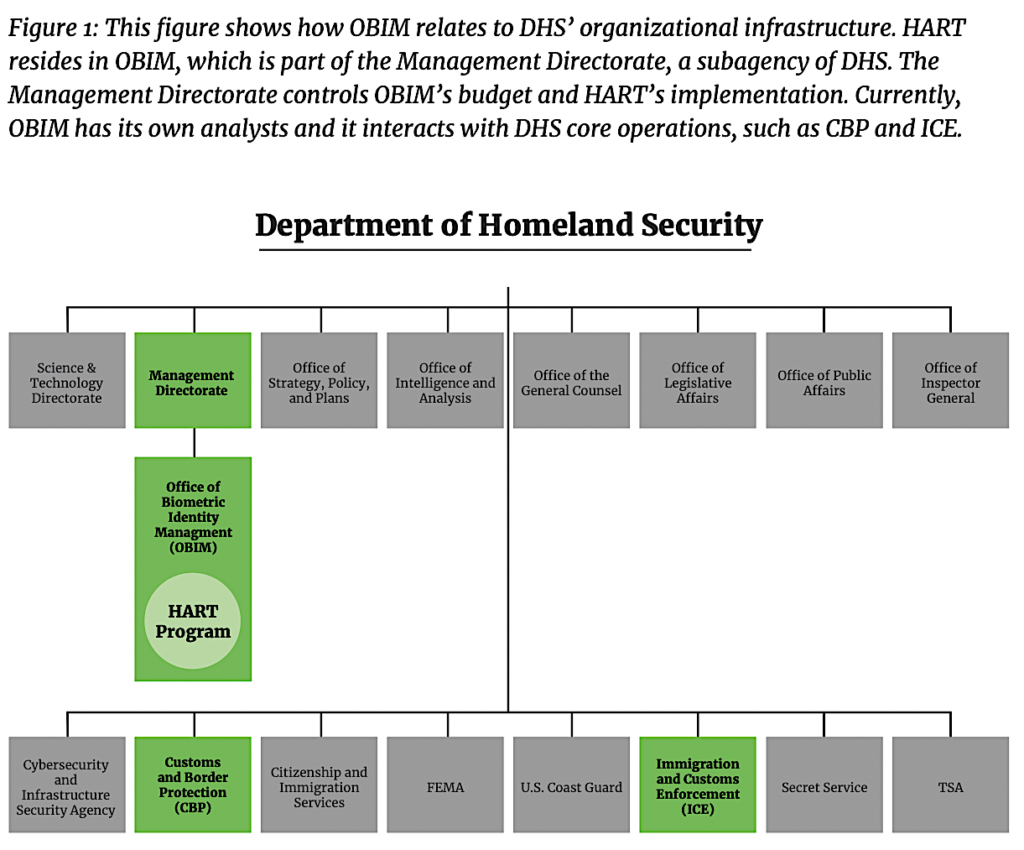
HART is a massive overhaul of the Automated Biometric Identification System (IDENT), a 1994 “legacy Immigration and Naturalization Service (INS)” system that currently vets immigrants for visas and immigration enforcement. In 2015, the DHS Office of Biometric Identity Management (OBIM) announced its plans to replace IDENT with HART, and released its plans for HART several years later. OBIM is a separate sub-agency from ICE or CBP, and is housed within DHS’ “management directorate.”
At this time, IDENT contains 272 million unique identities, including 6.7 million iris pairs and 1.1 billion face images.
DHS is rolling out HART in three stages that they call “increments,” but the rollout is now multiple years behind schedule. HART Increment 1, which has not been completed, involves migrating IDENT to the Amazon Web Services GovCloud. Each increment will include new tech capabilities, machine learning, vast storage, and new biometrics. Very little is known about these increments, except through infrequent “Privacy Impact Assessments” (PIAs) and hard-to-find contract specifications.These companies stand to make billions of dollars from their contracts to develop the database and its components.
What will go into HART?
DHS is designing HART to be a digital profile repository of hundreds of millions of people composed of the personal information— biographic and biometric data—that makes up our daily lives.
Even though HART is not yet built, the Office of Biometric Identity Management (OBIM) already contains the largest collection of biometric information in the US government, all of which will
feed into HART. As of 2019, OBIM was already running hundreds of thousands of transactions and checks for CBP, ICE, TSA, and other DHS components. OBIM shares biometrics with state and federal agencies, as well as with international governments. OBIM’s contractors and employees provide biometric verification and identification services. OBIM’s Biometric Support Center employs approximately 70 BSC examiners. In addition to biometric and biographic data, HART will also rely on artificial intelligence and machine learning capability.
Biometric data
This includes but is not limited to fingerprints, palm prints, latent prints, DNA, iris scans, facial recognition, thermal scans, and voice prints. DHS has not explicitly ruled out the collection of other types of biometric and biographic information. Similar concerns remain for the collection and retention of cardiac signatures, breathing patterns, individuals’ walking gait, or even typing cadence.
Biographic data
This includes biographic information, “encounter data” and “derogatory information,” and DHS officers’ impressions of a person’s life.
More specifically:
- Biographic information includes nicknames and aliases, personal physical details (scars, tattoos,
etc.), gender, ethnicity, occupation, publication records, online identifiers (e.g. social media handles), age, computer name, level of education, signature, and a long list of number identifiers, including A-Number, Social Security Number, FBI Number (FNU), Department of Defense Biometric Identifier (DoD BID), civil record number, and state identification number, and other agency system- specific fingerprint records locator information.
- Encounter and derogatory information includes immigration violations, arrests, criminal record, foreign criminal convictions, wants and warrants, sexual offender registration, “known or suspected” terrorist designation, and even “known or suspected” gang membership, which can be submitted by data providers who are not authorized users.
- Agents’ impressions or feelings will also be included in HART. DHS officers will also be able to add “miscellaneous officer comment information,” and to note what they perceive to be individuals’ political affiliations, religious activities, and friends and family relationships. This could mean that an agent’s beliefs or opinions will make it into HART, even if wholly unsubstantiated.
Artificial Intelligence and Machine Learning
DHS will include AI and machine learning capability through several programs. For example, DHS is developing RAVEn, a $300 million system aimed at identifying immigration targets through “mining social-media information, and processing surveillance footage and biometric data.” HART will be a source repository for RAVEn, allowing it to process information from noncitizens and US citizens—including social media information, biometrics (face, iris, photograph, etc.), location-related data including any geolocation information from surveillance, license plate readers, financial data including “suspicious” financial activity, and case-related information including information from the “darknet.”
What is AI and Machine Learning?
Artificial Intelligence (AI): AI refers to certain computer functions that humans associate with the human mind, but is not the AI in books and movies. AI applications include systems in Google, YouTube, Amazon, Siri or Alexa, self- driving cars, or even chess.
Machine Learning: Machine learning involves the processing of vast amounts of data and is part of AI. DHS’ systems already process billions of pieces of data, and it relies on machine learning to crunch and analyze these vast amounts of information.
Much of this data is collected without people’s consent or even knowledge. Companies and government agencies increasingly use data collection and data harvesting to bypass constitutional requirements around warrants and consent, which protect people’s rights if they are suspected of wrongdoing.
As a result, international, federal, state and local agencies could have access to HART’s biometric and biographic personal information without receiving an individual’s consent or obtaining a warrant. Moreover, people will have no control over how their information is collected, used, accessed, or shared.
What will change when HART comes online?
HART’s capacity and scale go far beyond DHS’ existing web of surveillance systems, which already collect and handle billions of pieces of biographic information. When HART comes online, DHS’ existing systems will either link to or flow into HART. Currently, when individuals
apply for immigration benefits such as a green card, temporary protected status, or DACA, DHS runs their biometrics, including fingerprints, through IDENT or another system to check for any flags in law enforcement and security databases. HART will drastically increase the amount and types of data collected, and expand DHS’ interoperability with other agencies. Yet HART offers limited opportunities for people to hold DHS accountable for violations.
Under HART, there will be virtually no pathways to challenge DHS’ life-and- death decisions. Information in HART will be used to approve and deny immigration benefits and target people for raids, arrests, surveillance, and deportations. However, people most impacted by HART will not be able to know if their data is even included in HART, much less challenge the collection and use of their data. People will be subject to decisions made in seconds, without the ability to apply for redress later on. See more on privacy concerns and lack of redress mechanisms in the report’s section of HART’s violations of basic rights.
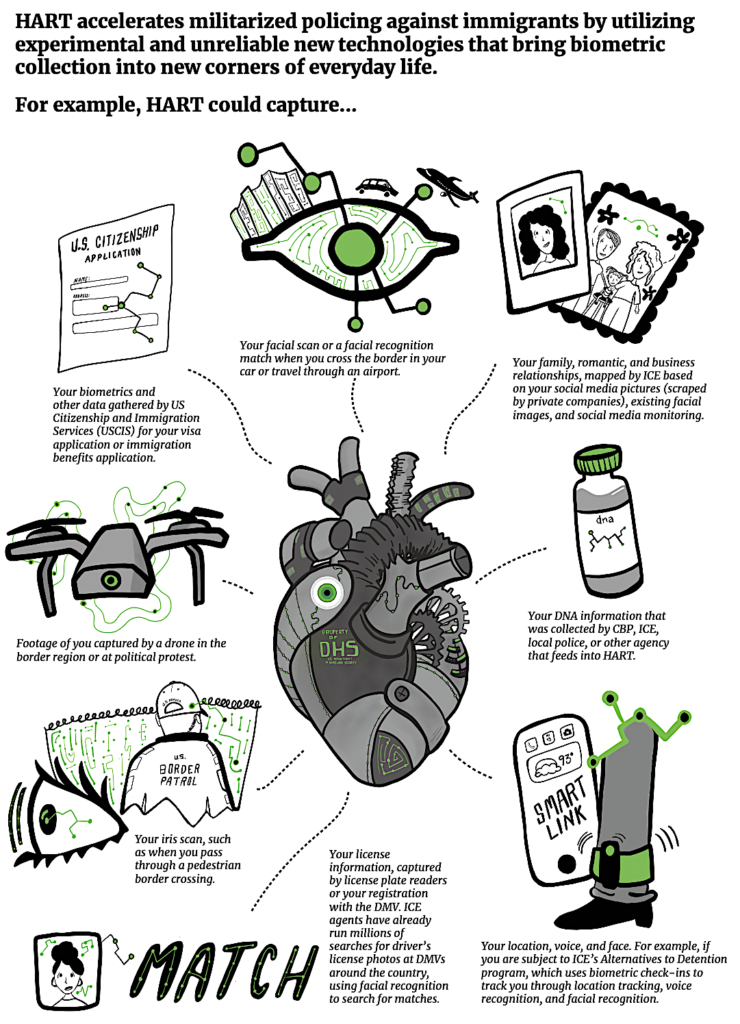
Here are a handful of examples of what data will immediately end up in HART.
- Voice scans: ICE’s Alternatives to Detention (ATD) program uses electronic monitoring devices, including telephonic check-ins, to gather data for voice recognition and location tracking.
- Facial scans: Facial recognition includes photos taken by CBP and ICE, as well as images scraped from social media by ICE contractors, and images from some DMVs.
- Social media: Data from the National Vetting Center, a CBP-led initiative, incorporates social media screening into the vetting of anyone seeking entry or a visa.
- USCIS biometrics data: HART will include information from USCIS biometric appointments that are required for people applying for a green card, work permit, Temporary Protected Status, and other types of status.
- Fingerprints: Agents collect fingerprints using a handheld mobile biometrics application called EDDIE, with data now feeding into IDENT and soon HART. CBP uses an application called the e3 Portal to collect fingerprints and photos of migrants, data that is also transferred to IDENT.
- Location Data: DHS purchases geolocation cell phone data from commercial sources, like Venntel. Agencies argue no warrant requirement exists for them to buy and use this data.
Below is a figure2 that shows the CBP systems flow for travelers entering the United States. As this picture shows, vast amounts of information from travelers and US residents will be enrolled into HART.

Financial and Logistical Issues
The financial trajectory of the HART project is also concerning. Initially budgeted at $4.3 billion, costs have soared to $6.158 billion with ongoing logistical challenges leading to delays in its rollout. Congressional committees have expressed discontent, calling for transparent budget reviews and cutting funding due to HART’s unresolved delivery milestones.
Congress has raised concerns about HART expenditures
The House Committee on Appropriations submitted a report on the Department of Homeland Security Appropriations Bill for Fiscal Year 2022 (H.R. 4431), stating that “program delays” necessitated a reduction in HART funds by $25 million.
In addition, the Committee mandated a series of accountability measures, including a comprehensive review, multiple audits, and compliance reviews by the Office of the Inspector General. Similarly, the Senate Committee recommended a $25 million reduction “in recognition of ongoing cost, schedule and performance challenges.” Additionally, they demanded more transparency from DHS regarding
the rollout of emerging and untested technologies. The Explanatory Statement for the 2022 Homeland Security Appropriations Bill states:
“The Committee requests that the Department provide adequate disclosure of its technologies, data collection mechanisms, and sharing agreements among DHS immigration enforcement agencies, other Federal, State, local, and foreign law enforcement agencies, and fusion centers as relates to the development of the HART biometric database that will replace the Automated Biometric Identification System [IDENT] database.”
While these introductory inquiries are helpful, Congress must do more to ensure that HART’s deployment is immediately halted for FY2023.
The Committee requests that the Department provide adequate disclosure of
its technologies, data collection mechanisms, and sharing agreements…
Which Companies are Behind HART?
Companies are making millions, potentially billions, of dollars off the HART contract and are lining up to make more. Companies aggressively compete for additional billions of dollars in DHS contracts, including for biometric and surveillance technologies such as biometric device collectors, data brokers, social media scraping companies, analytics, facial recognition, and much more.
The corporate players behind HART
Northrop Grumman
The Military Defense Contractor Originally Contracted to Develop HART
In September 2017, DHS awarded a contract to develop the first two increments of HART to Northrop Grumman, a publicly-held military defense contractor. In December 2020, Veritas Capital, a private equity firm, acquired Northrop Grumman’s federal IT business that was involved in making HART for $3.4 billion in cash.
Veritas Capital
The Private Equity Company Building HART, via a Subsidiary
HART is currently being developed by Peraton, a subsidiary of a private equity firm, Veritas Capital, removing the project even further from public scrutiny and raising further concerns about the exorbitant expenses associated with the project. HART has exceeded its initial cost estimate for the contract to develop the first two increments multiple times (the initial contract was for $95 million and has been increased to a $143 million). Private equity firms increasingly see the intelligence and surveillance sector as a lucrative investment opportunity. Ramzi Mussalam helms Veritas Capital, and his estimated worth is $4 billion. Mr. Muzzalam is perceived as a key player in the government contracting space, and has turned multiple public companies private.
Veritas placed this purchase in its private equity subsidiary Peraton, which focuses on IT and other technology-related government services. With the acquisition of Northrop Grumman’s IT services and the subsequent acquisition of huge IT contractor Perspecta— which Veritas acquired for $7.1 billion—Peraton increased its business by 700%. Currently, HART’s development and contract is in Peraton’s name. Peraton recently established its own Political Action Committee (PAC) to support lobbying on its issues. Peraton’s annual revenues of approximately $7 billion, a three-year qualified pipeline of $200 billion, and its 22,000 employees are now in the hands of Veritas Capital.
Thales, NEC, and Fingerprints
DHS’ Core Biometrics Contractors
Currently, OBIM uses the following contractors for various biometrics programs. These programs largely exist to power IDENT, the precursor to HART.
- Thales Corporation for fingerprinting matching. They also built powerful technologies for the DOD.
- NEC Corporation, a multinational information technology corporation, that specializes in biometrics, especially facial recognition. NEC has a separate contract with OBIM for the provision of facial recognition services, for a potential $23.9 million through 2022.
- NEC and Fingerprints (formerly Delta ID) for iris recognition
Amazon Web Services
Hosting Our Biometrics on the Cloud
HART will be hosted in Amazon’s government cloud platform— Amazon Web Service (AWS) GovCloud environment—despite being managed by OBIM. AWS GovCloud is the most commonly used cloud platform by DHS, hosting many ICE and USCIS systems— including the Palantir-designed Investigative Case Management system used by ICE to track and target people for deportation. While it is hard to know the true value of Amazon’s contracts
with DHS and the rest of the U.S. federal government since many contracts are with third-party providers, Amazon was awarded approximately $1.4 billion in government contracts from 2007 to August 2021, and at least $6.3 billion in additional contracts with companies that provide its cloud products.
Complicit Corporate Partners
There is a long list of technology companies that provide other services to DHS, some of which could end up as biographical data in HART
as components continue to add subject records and miscellaneous comments. For example, companies like NTT Data Federal Services, Inc., Global Infotek, Inc., The Mitre Corporation, and Bayfirst Solutions have provided human resources, analytics, testing, and assessments for the deployment of HART.
In September 2020, military contractor General Dynamics was awarded a contract for work at OBIM worth a potential $64 million through 2025.
What other companies could expand HART’s reach?
Data Brokers
Thomson Reuters and LexisNexis both provide commercial and government data on individuals to ICE and CBP, via multi-million dollar contracts. The personal data they sell with their CLEAR and Accurint platforms, respectively, includes DMV records, utility and cell phone bills, court records, credit histories, and license plate reader data, among many other sources.
Social Media Companies
Data from social media could also end up on HART, whether in the form of facial images scraped by private ICE contractor Clearview AI, or through social media analytics company Giant Oak, which has a contracting vehicle worth up to $37 million with DHS through 2022.
Biometrics Services Contractors
The numerous private contractors that provide biometric services
to HART data providers will indirectly expand the platform’s capacity. On the same day that Northrop Grumman was awarded the principal HART contract, the Department of State awarded a contract to CSRA (now General Dynamics), developer of the IDENT platform, to implement a mass biometric collection program on behalf of the Government of Mexico, called the Digitus Agreement. The multi-modal data collected through this program is the same third-country national biometric data that is shared by Mexico’s immigration authorities with DHS under their January 2017 biometric data sharing agreement. Under this agreement, Mexican immigration authorities collect and share biometric data on all third-country nationals seeking authorization to travel, work, or live in Mexico or the United States, or who have been detained. This data will end up in HART.
Who Will Use and Access HART?
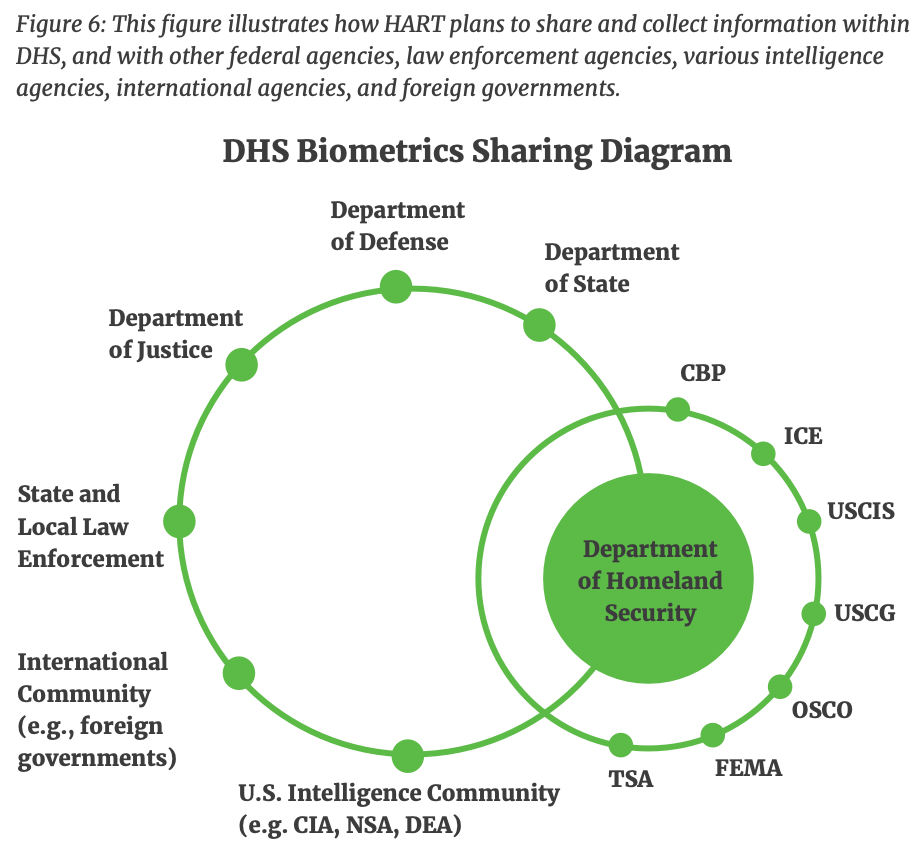
DHS intends for HART to be a one-stop shop, a “single authoritative biometric system” that can be accessed and used by international, federal, state, and local agencies. Information Sharing Access Agreements (ISAA) are one way that DHS executes data sharing agreements with other agencies, governments, and corporations. Data providers can determine which users have access to their data. The Privacy Impact Assessment goes into some detail about access for only one stage, Increment I of HART.
In addition to sharing information across DHS agencies, one of the key objectives behind HART is to increase “interoperability” with other agencies’ biometric systems, meaning that HART will interact with other databases in the United States and abroad. DHS will use information in HART to identify people who may turn up at ports of entry, border crossings and refugee camps, in civil or criminal records, through surveillance cameras in public, and even via social media usage. HART will be used in asylum cases and to make lists for raids, for arrests, and for deportations.
US federal agencies that will interact with HART
The short list below does not constitute a full and complete list of all the databases HART is expected to connect and interact with.
Department of Defense (DOD)
Automated Biometric Identification System (ABIS): DoD implemented the first ABIS in 2004 to track and identify “national security threats” by running biometric searches. It collects data from military and other intelligence sources. This system was built by military contractor Northrup Grumman. Individuals encountered during military operations may also end up in HART.
Department of Justice (DOJ)
FBI’s Next Generation Identification System (NGIS): NGIS is the largest biographic and biometric repository on U.S. citizens and noncitizens who have had contact with a criminal legal system. Maintained by the FBI, it includes information about arrests, convictions, outstanding warrants, and other criminal history along with fingerprint, pictures, face scans, palm prints, and other biometrics. It will be the second largest such database after HART.
Department of State (DOS)
Consolidated Consular Database (CCD): This is a database of real- time consular activity all over the world. This means that any agent can have access to sensitive personal information supplied to a consulate for a visa, immigration, or refugee processing.
What are some other databases that will interact with HART?
The short list below does not constitute a full and complete list of all the databases HART is expected to connect and interact with.
State, local, tribal, and territorial law enforcement agencies
These agencies will provide data to HART, and those that have entered into information sharing access agreements (ISAAs) with DHS for biometric identification and analysis services will be authorized HART users.
United Nations High Commissioner for Refugees (UNHCR)
DHS has signed an agreement with UNHCR to acquire sensitive information that it has collected from refugees.
Foreign Governments
Several foreign governments are expected to have various degrees of access to HART. This includes the Five Eyes/Migration Five Partners—Canada, the United Kingdom, Australia and New Zealand. DHS already has biometric data sharing agreements in place with Mexico, Guatemala, Honduras, El Salvador, Greece, Italy, the United Kingdom, Canada, New Zealand, and Australia. Additionally, a number of countries have authorized Criminal History Information Sharing (CHIS) agreements with DHS, to exchange criminal conviction information on people being deported from the United States. ICE has this type of agreement with Mexico, Honduras, Guatemala, the Dominican Republic, El Salvador, Jamaica, and the Bahamas. Mexico’s immigration authority, for example, through a series of agreements signed by DHS and the Government of Mexico, already submits “its collected biometric and biographic holdings, in bulk, to DHS […] on individuals whom they believe to be nationals of a third country.” The agreements enable the Mexican government to submit electronic fingerprint queries to the DHS’s fingerprint database, and all biometric and associated biographic information obtained by Mexico on migrants will be enrolled in the DHS fingerprint repository.
Why HART Must Be Stopped
HART promises a fantasy that a vastdata collection system powered by militarized technologies will provide security and safety. Instead, it will vastly expand the Department of Homeland Security’s surveillance capabilities and the immigration enforcement dragnet by yielding accurate lists of undocumented people, their undocumented families, and others deemed “undesirable.” HART will put BIPOC communities, including immigrant communities, at greater risk of profiling, arrest, and detention. Furthermore, HART is not designed to ensure accuracy nor protect people’s rights. As mentioned above, HART also puts enormous power to develop these technologies into the hands of corporate entities—first a military defense contractor, and now billionaire private equity investors—that are not concerned with the rights of communities but rather with maximizing profits.
HART is a black box with dangerous unknowns. DHS has actively prevented oversight of HART and related systems and ignored calls for transparency. DHS has shrouded the project in secrecy, despite the massive taxpayer investment. There has been limited government review and almost no public scrutiny. Very little is known about how DHS will collect, keep, or share information in HART with third parties, such as corporations, other government agencies, or other countries. Specifically, DHS refuses to share information about HART’s actual technologies, data collection mechanisms, the analytical tools, where the data is harvested, or whether the collection was authorized or consensual. We are also left in the dark about information sharing agreements between DHS immigration enforcement agencies, other federal, state, local, and foreign law enforcement agencies, and fusion centers as they relate to the development of the HART biometric database. It is unclear what information will ultimately be contained in HART, as DHS has indicated that the definition of biometrics can continue to expand. We already know that HART will include biometrics that have been shown to be unreliable such as facial recognition, biographic information, and subjective information on perceived relationship patterns. It may also include other biometrics in experimental stages such as voice prints, and biometrics like DNA collection that present serious
ethical concerns.
What we do know about HART raises grave concerns.
HART presents unacceptable threats
- Discriminatory Policing:
- HART is likely to exacerbate racial profiling and discriminatory policing practices. Reports show that certain groups—especially Black immigrants and undocumented workers—face more scrutiny and harsher treatment under current immigration laws.
- There has been evidence of police acting as a bridge to immigration enforcement, leading to higher deportation rates for specific communities.
- Surveillance Impact:
- Daily activities of individuals can be severely affected due to the constant monitoring enabled by HART. This might lead people to feel they cannot express their opinions freely or participate in political protests without the risk of being watched.
- Inaccurate Data Concerns:
- HART will contain a lot of personal data, but the quality and accuracy of this information are concerning. The DHS warns that the data collected can often be flawed, leading to wrongful actions against individuals based on these inaccuracies, such as wrongful arrests or deportations.
- Lack of Accountability:
- The system is designed in such a way that it is hard to track who is responsible for errors. Since third-party sources contribute data to HART, it complicates accountability. If a mistake occurs, it may be nearly impossible for affected individuals to find recourse or correct their information.
- Invasive Data Practices:
- HART collects data without individuals’ explicit consent, which raises ethical concerns about privacy. For instance, when applying for government services, people may unknowingly provide sensitive information that gets stored and potentially misused.
- Data Retention Issues:
- Information stored in HART could remain on file for up to 75 years, which raises fears that outdated or irrelevant data could continue to impact individuals long after its relevance has passed.
- Use of Experimental Technology:
- The program plans to utilize biometric matching technologies that are still in experimental stages. These technologies have shown biases, especially against people of color, thereby increasing the risk of false positives and wrongful actions.
The Need for Accountability
The introduction of HART exemplifies a significant shift towards more rigorous surveillance practices. This poses threats to individual freedoms and privacy, particularly among marginalized groups. It’s crucial for communities and lawmakers to come together to demand accountability from the DHS and to safeguard civil rights against what could become an invasive monitoring system. By raising awareness and resisting unchecked technological expansion, we can strive for justice and protect our civil liberties in an increasingly digital world.
Why These Concerns Matter in India
India presents a unique case because it already possesses one of the world’s largest biometric identity infrastructures through Unique Identification Authority of India’s Aadhaar program.
Aadhaar contains biometric and demographic information linked to over a billion residents. While Aadhaar was originally designed to improve service delivery and reduce fraud, debates about privacy and surveillance have continued for years.
1. Scale and Centralization
India’s digital ecosystem increasingly relies on identity verification for banking, telecommunications, welfare distribution, taxation, and various public services.
When biometric identity systems become central to everyday life, concerns arise about excessive state visibility into citizens’ activities.
2. Expansion of Facial Recognition
Several Indian states and law-enforcement agencies have experimented with facial recognition technologies.
If facial recognition systems become linked with large identity databases, authorities could potentially identify individuals across transportation hubs, public events, and urban surveillance networks.
Civil society groups have raised concerns that such capabilities could enable mass surveillance without sufficient legal safeguards.
3. Constitutional Right to Privacy
In the landmark Justice K.S. Puttaswamy v. Union of India decision, the Supreme Court of India recognized privacy as a fundamental constitutional right.
The judgment established that restrictions on privacy must meet standards of legality, necessity, and proportionality.
Large-scale biometric surveillance systems must therefore be evaluated against these constitutional principles.
4. Risks to Dissent and Democratic Participation
India is the world’s largest democracy, with frequent political mobilization, protests, and civic activism.
If biometric surveillance technologies are deployed extensively, critics fear they could be used to monitor political gatherings, identify participants, or create records of lawful dissent.
Even the perception of such monitoring could discourage citizens from exercising democratic freedoms.
5. Data Security Risks
Large biometric databases are attractive targets for cyberattacks and unauthorized access.
Unlike passwords, biometric identifiers cannot be changed if compromised. A security breach involving fingerprints, iris scans, or facial templates could have long-term consequences for affected individuals.
Ref:
- https://www.immigrantdefenseproject.org/wp-content/uploads/HART-Attack.pdf
- https://media.nilc.org/wp-content/uploads/2021/12/HART-factsheet-2021-11-10.pdf
Also Read: