


In a move that has sparked intense debate among educators, parents, and millions of aspirants, Union Education Minister Dharmendra Pradhan has announced that the National Eligibility-cum-Entrance Test (NEET-UG) will transition to a Computer-Based Test (CBT) format starting in 2027.
While the Ministry frames the decision as a modernization effort aligned with the “Digital India” vision, the announcement has been met with skepticism. Critics are questioning whether the sudden push for digitization is merely a reactionary measure to the systemic paper leaks that have plagued the current pen-and-paper system, or if it represents a long-term strategic shift.
The “Leak” Narrative: A Catalyst for Change?
For many observers, the timing is suspicious. The move to digital follows a period of extreme volatility in India’s examination ecosystem, which has seen over 70 instances of paper leaks and system compromises over the last seven years, impacting the futures of more than 1.7 crore aspirants.
“Many are asking: Was the paper leak a deliberate failure designed to justify the transition to an online format?” says one concerned citizen. While the government maintains that the shift is aimed at enhancing efficiency and transparency, the skepticism reflects a deep-seated loss of faith in the integrity of physical examination processes.
The Myth of Digital Immunity
The government’s belief that moving online will eliminate malpractice is being challenged by cybersecurity experts who point to the inherent risks of CBTs.
“Digital does not mean unhackable,” warns an IT security consultant. “While you eliminate the physical ‘leaked paper’ scenario, you open the door to a much more sophisticated range of threats.”
Evidence from global and national contexts suggests that moving online often changes the nature of the crime rather than eliminating it. Education officials point to the 2022 breach of the global platform Canvas—which affected 275 million records—as a cautionary tale of how large-scale digital testing infrastructures are primary targets for state-sponsored and criminal hacking syndicates.
The “Center Hijacking” Challenge
In India, the threat is increasingly decentralized. Investigations into previous CBTs have revealed a pattern of “Exam Center Hijacking.” In these instances, hackers do not need to breach the central, highly-fortified servers. Instead, syndicates use remote-access software, physical proxy servers, or hidden hardware installed at specific, compromised testing centers to allow remote “solvers” to complete the test in real-time.
“Replacing a sheet of paper with a computer screen isn’t a panacea,” says an education advocate. “The security of the exam will depend on the integrity of the individual testing centers, not just the code on the screen.”
Exam compromises generally fall into three categories: direct digital hacks/server breaches, insider leaks prior to testing, and physical tampering/system hijacking at exam centers.
Because exact statistics span countless global institutions, the impact is best illustrated by a few notable, large-scale examples:
- Global Online Platform Breaches: Major digital testing and education platforms are frequently targeted. For instance, a major cyberattack on the testing platform Canvas (utilised by over 8,000 schools and millions of students globally) resulted in a massive data breach by hackers, affecting up to 275 million records and forcing hundreds of institutions to postpone final exams.
- National-Level Leaks (India): In regions with highly competitive entrance or civil service exams, compromises are rampant. Investigations and reports have documented dozens of incidents—including over 70 instances of paper leaks and system compromises over a recent 7-year period—that severely affected the schedules and futures of over 1.7 crore (17 million) aspirants.
- Exam Center Hijacking: In many reported cases involving Computer-Based Tests (CBT), hackers do not directly penetrate the central testing servers. Instead, syndicates use remote-access software (or physical proxy servers and hidden cables installed at specific testing centers) to hack into individual computer terminals, allowing remote solvers to complete the exam for candidates in real-time.
As we move toward a digitized future, the primary objective remains clear: The technology must serve the student. Modernizing our examination process is essential, but it must be coupled with world-class security protocols that ensure the sanctity of every aspirant’s hard work remains protected.
Abhishek Singh, the Director General of the NTA, has stated that there was no leak of the NEET exam paper. While a PDF containing several questions from the exam was shared, he maintains that the entire paper was not compromised. He argues that even if 135 out of 180 questions matched those in the PDF, it does not constitute a leak according to their standards, which only recognize a leak if all 180 questions are identical. This stance has led to the NTA being nicknamed the “National Tampering Agency” by some.
This situation is not new; a similar incident occurred in 2024 when a NEET exam paper was leaked before the test. In that case, the paper was circulated widely, and individuals paid large sums to obtain it. As a result, some students received unexplained grace marks, leading to 67 students achieving a perfect score of 720. This caused significant outrage, prompting protests and even involvement from the Supreme Court, along with a CBI investigation.
Unfortunately, the outcome of the 2024 investigation was disappointing. While a few minor players were arrested, many were released on bail, and ultimately, no substantial changes were made to the system. The NTA remained intact, and no reforms were introduced to prevent future issues. Over the past two years, the situation has only deteriorated, leaving many to question the integrity of the examination process.
When questioned about the recent exam paper leak, Education Minister Dharmendra Pradhan evaded reporters, failing to provide any answers. Amidst the chaos, it was announced that a re-examination will take place, with the National Testing Agency assuring candidates that they will not need to re-register or pay additional fees. However, this raises a critical concern: who will address the mental and emotional strain that students face during this process?
Over 22 lakh students dedicated months of preparation, while families invested significant amounts in coaching and resources. Many students sacrificed their social lives, sleep, and mental well-being, only to see their efforts undermined by a system that allows corruption to flourish. The reality is that without meaningful reforms and accountability, these issues will persist, leading to repeated scandals every few years.
For students and parents feeling overwhelmed by the current situation, it’s important to remember that exams do not define your worth or future success. Achieving your goals is possible without passing these tests, and it’s crucial to maintain perspective during these challenging times. Focus on your well-being and resilience, as these qualities will serve you far better in life than any single examination.
Tamil Nadu Chief Minister Vijay urges Union Government to cancel NEET
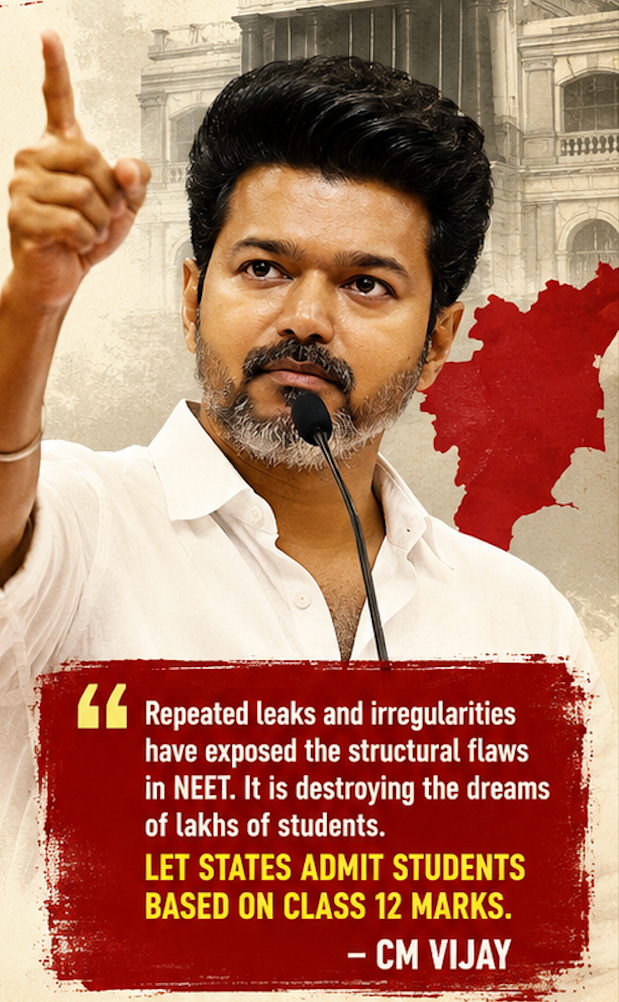
Tamil Nadu Chief Minister C. Joseph Vijay has urged the Union government to abolish NEET-based admissions for medical courses entirely.
He cited the recent paper leak as clear evidence of significant flaws in the national examination system.
Vijay proposed that states should be permitted to allocate all MBBS, BDS, and AYUSH seats based solely on Class 12 examination results.
His remarks followed the National Testing Agency’s cancellation of NEET-UG 2026, which took place on May 3 at over 5,400 centers nationwide.
More than 2.2 million candidates participated in the exam, including approximately 140,000 from Tamil Nadu.
Tamil Nadu opposes the National Eligibility-cum-Entrance Test (NEET) because the exam disproportionately disadvantages students from rural areas, government schools, and economically disadvantaged families by favoring those who can afford expensive private coaching. The state argues that this creates structural inequality, favoring standardized curricula over consistent, localized academic performance.
The key arguments driving Tamil Nadu’s ongoing opposition include:
- Syllabus Disconnect: NEET is predominantly based on the CBSE/NCERT syllabus, which creates a disadvantage for students who study under the Tamil Nadu State Board curriculum.
- Affordability of Coaching: The exam rewards students who have the economic resources to attend expensive, urban coaching centers rather than reflecting their genuine classroom merit. Data, including from the state’s A.K. Rajan Committee, showed a vast majority of successful NEET candidates had undertaken private coaching.
- Infringement on State Autonomy: Tamil Nadu argues that education is a state subject. A centralized national exam infringes upon the federal structure, taking away the state’s power to regulate admissions to its own medical colleges.
- Fairness of Class 12 Marks: The state posits that Class 12 board marks are a fairer, more inclusive metric, measuring two years of consistent, comprehensive effort rather than a single high-stakes test.
- Systemic Flaws and Paper Leaks: Tamil Nadu leaders have consistently reiterated their stance, particularly after recurring controversies, widespread irregularities, and the cancellation of exams.
- Student Mental Health: The high-stakes, pressure-cooker nature of NEET has been linked to severe stress and tragic student suicides in the state