

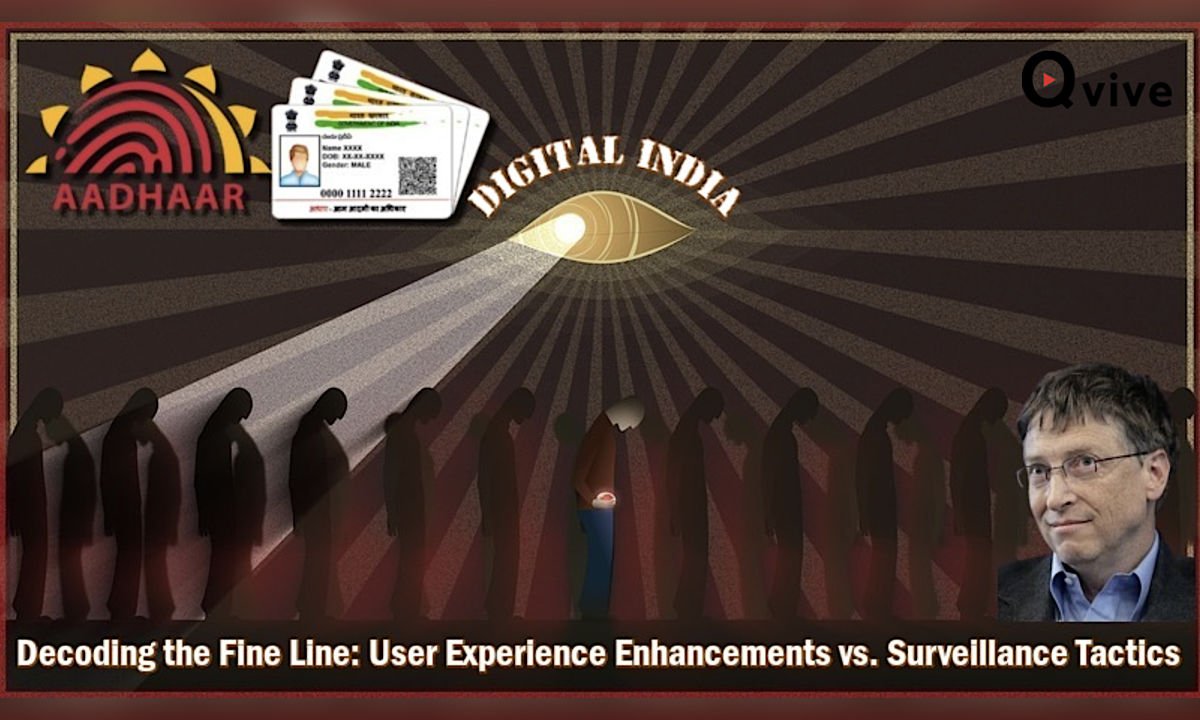
Bill Gates sees India as an experimental model for digital innovation, despite controversies surrounding the collection of public data through initiatives like UIDAI.
The announcement of the new Aadhaar rules set to be implemented from November 2025 has sparked controversy and raised questions about the role of Bill Gates in India’s digital identity system. Under these new rules, Aadhaar holders will have the ability to update their personal information online without providing any supporting documents. The UIDAI’s upgraded verification system will automatically cross-check users’ details with linked government databases such as PAN, passport, driving license, ration card, MGNREGA records, birth certificates, and school documents.
Explore the implications of the new Aadhaar rules set to be implemented from November 2025 and the possible influence of Bill Gates on the UIDAI system.
When Bill Gates praised India as an experimental model for digital innovation, specifically mentioning the UIDAI, he faced criticism from those concerned about the collection of vast amounts of personal public information. The UIDAI’s system collects data from various government databases, centralizing it to make monitoring easier for Bill Gates and his associates. This centralized approach has raised red flags about the potential misuse of personal information and the lack of transparency in the data collection process.
The Unique Identification Authority of India (UIDAI) has faced criticism regarding its Aadhaar system, with concerns raised about data breaches, exclusion, and the fundamental flaws in its de-duplication process. Despite these issues, Bill Gates and the Bill & Melinda Gates Foundation have been strong proponents of Aadhaar and similar digital identity initiatives, providing funding and advocating for their adoption globally.
The Aadhaar system, India’s national digital identity program, has been subject to numerous reports of abuse, including significant data leaks and instances of exclusion from essential services. Between February 2017 and May 2018 alone, nearly 40 isolated cases of breaches were reported, with sensitive information such as pregnancy data, religious and caste affiliations, and even bank details being compromised alongside Aadhaar numbers. Critics argue that the UIDAI has failed to uphold its vision and mission of preserving individual privacy, ensuring infrastructure security and reliability, and guaranteeing inclusion.
A significant concern revolves around the system’s de-duplication process, which aims to ensure the uniqueness of each individual’s identity. While the UIDAI claims to perform both demographic and biometric de-duplication, publicly available information on its practical implementation is scarce. A case study conducted by the UIDAI on a small dataset of 40,000 biometrics revealed that the number of comparisons needed to prove uniqueness is substantial. When scaled to India’s population of approximately 1.4 billion, the number of comparisons required would be astronomically high, estimated at around 9.8 × 10^17. Even with the quickest comparison protocols, this would translate to hundreds of years of comparison time, making real-time de-duplication virtually impossible.
Furthermore, the statistical nature of biometric matching means that a certain rate of false positives and false negatives is inherent. The UIDAI’s target False Positive Identification Rate (FPIR) of 0.0025% in its case study, while seemingly low, would result in an estimated 2.45×10^13 false positives when applied to the entire Indian population. This translates to approximately 17,500 false positives per person that would require manual resolution, highlighting a critical flaw in the system’s ability to guarantee uniqueness at scale. These issues have led to cases where individuals have been assigned multiple, supposedly “unique,” Aadhaar numbers.
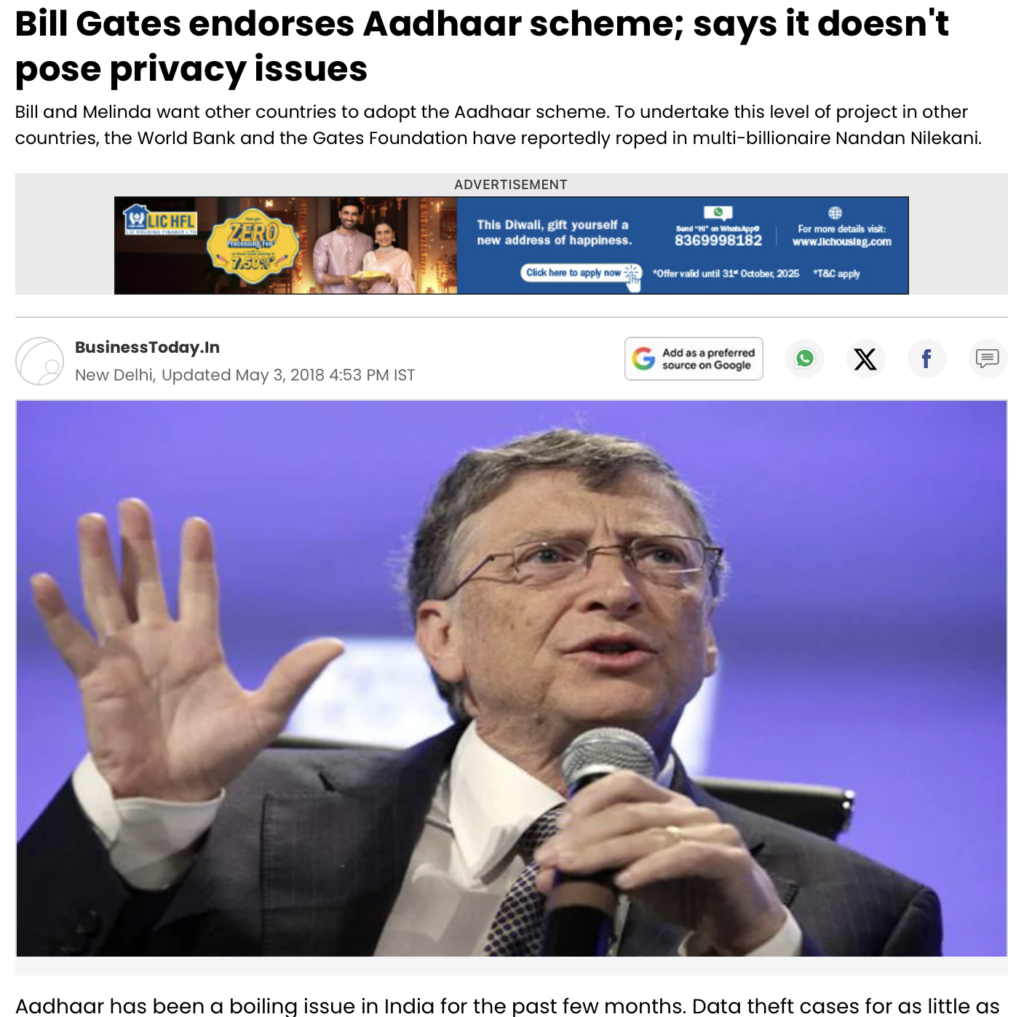
Despite these criticisms, Bill Gates has consistently endorsed the Aadhaar scheme, stating that it does not pose any privacy issues. He views Aadhaar as a “bio ID verification scheme” and believes that any privacy concerns stem from the individual applications that utilize Aadhaar, rather than the core technology itself. Gates has emphasized the high benefits of such basic ID systems, linking them to improved governance, economic growth, and the empowerment of people.
The Bill & Melinda Gates Foundation has actively supported the replication of the Aadhaar approach in other countries. The foundation has funded the World Bank to take this approach globally. Nandan Nilekani, the chief architect of Aadhaar, has also been consulting and assisting the World Bank on this project. This initiative aims to leverage the success of Aadhaar in India, where it has enrolled over a billion people and is considered the world’s largest biometric ID system.
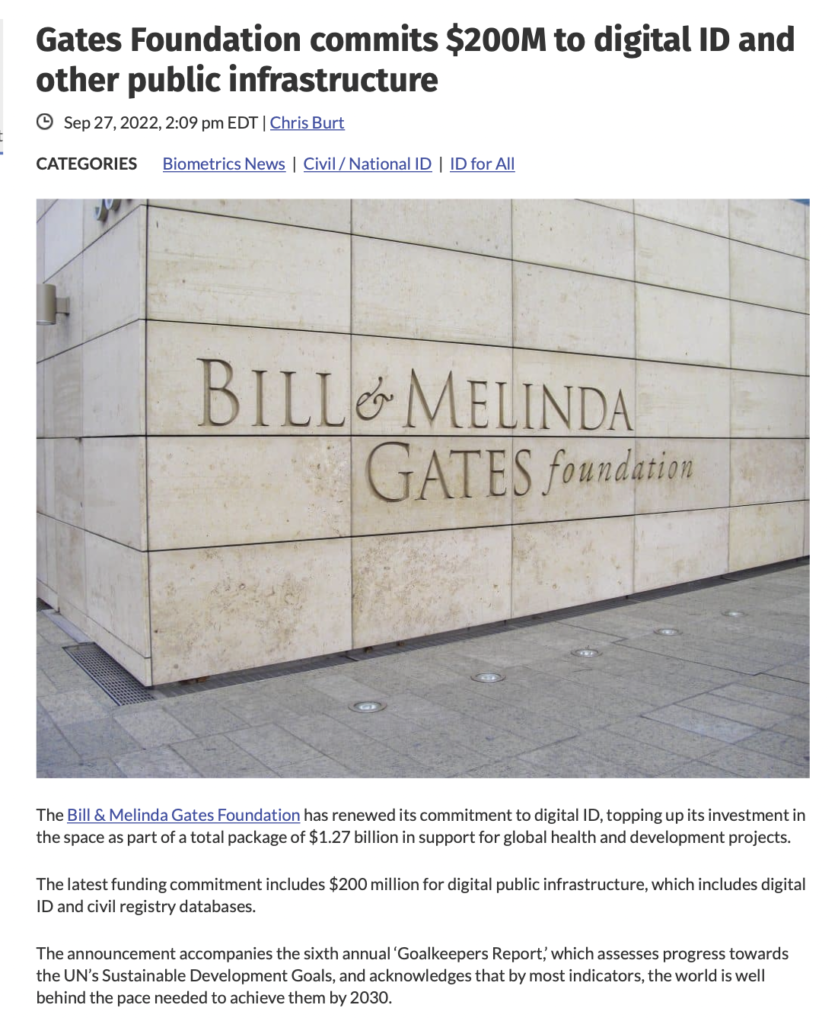
The Gates Foundation’s commitment to digital identity systems extends beyond Aadhaar. They are a major backer of the Modular Open Source Identity Platform (MOSIP), an open-source, customizable digital identity solution inspired by Aadhaar. MOSIP aims to provide a flexible and inclusive digital ID system that any country can adapt to its specific needs. The foundation has committed significant funding, including $200 million for digital public infrastructure, which encompasses digital ID and civil registry databases. This investment is part of a broader effort to support global health and development projects and to achieve universal legal identity by 2030, a goal set by the UN Sustainable Development Goals.
Through a deceptive approach, the foundation, aided by the government, has made it compulsory for people to accept that digital IDs are a powerful tool against poverty, enabling access to employment, education, banking, government programs, and healthcare for millions who lack legal identification.
MOSIP, developed by a team in India with Gates Foundation funding, has already seen adoption in 11 countries, with over 90 million people registered for MOSIP-based IDs in the Philippines, Ethiopia, and Morocco. The foundation sees digital ID systems as a critical component of digital public infrastructure, alongside digital payment and data exchange systems, which can help low- and middle-income countries accelerate development and lift people out of poverty (depopulation agenda 2030).
The Aadhaar system, India’s national digital biometric identity system, has faced significant criticism regarding its regulatory framework, particularly concerning data protection, privacy, and accountability. Despite its widespread adoption, several specific flaws have been identified in the latest Aadhaar regulations.
Lack of Comprehensive Data Protection and Privacy Legislation
One of the most critical flaws is the absence of comprehensive data protection and privacy legislation specifically tailored for the Aadhaar system. While draft legislation, such as the Privacy Bill of 2014, has been proposed, it has not been officially passed. The Aadhaar Act of 2016, which provides the statutory backing for the system, is not considered a comprehensive privacy law. It contains procedural directives but fails to implement the full data protections outlined in the Group of Experts’ report of 2012, which were based on internationally accepted Fair Information Practices (FIPs). This legislative gap leaves individuals vulnerable to potential misuse of their biometric and demographic data
Excessive Delegation and Lack of Accountability
Scholars have argued that the Aadhaar Act of 2016 excessively delegates critical policy decisions to the Unique Identification Authority of India (UIDAI), the agency administering Aadhaar. This includes the authority to define what constitutes biometric and demographic information by regulation, which critics argue should be a legislative function. This delegation violates the separation-of-powers theory and creates ambiguity over Aadhaar’s scope, potentially allowing the executive to expand data collection without sufficient legislative safeguards.
Furthermore, the legal framework lacks adequate accountability mechanisms for the UIDAI. The UIDAI serves a dual role as both a data administrator and a regulator, which creates conflicting responsibilities. For instance, while UIDAI maintains the security of the Central Identities Data Repository (CIDR), it is also the sole agency allowed to initiate criminal action against tampering with the CIDR. This presents a conflict of interest, as reporting an offense could expose the UIDAI’s own administrative inadequacies. The Act also lacks statutorily mandated accountability mechanisms like performance standards and audits, and a data breach notification principle, which would require informing victims when their data is compromised.
Mission Creep and Mandatory Usage
Despite initial assurances that Aadhaar enrollment would be voluntary and for limited purposes, there has been significant “mission creep,” leading to its de facto mandatory use for an ever-growing list of services. Initially intended for subsidies, Aadhaar is now required for filing taxes, applying for scholarships, booking rail tickets, and accessing various public-sector jobs and government benefits. While the Supreme Court of India has ruled that Aadhaar is not mandatory and benefits should not be denied for its absence, in practice, many services still turn away users without an Aadhaar number. This expansion of mandatory usage without commensurate privacy protections raises concerns about exclusion and potential discrimination, particularly for vulnerable populations.
Inadequate Consent Mechanisms
The concept of “Consent” within India’s existing privacy laws, such as the Information Technology Act of 2000 and its 2011 Rules, is not clearly defined or robust enough. While these rules acknowledge “Sensitive Personal Data or Information,” including biometric information, and require prior permission for disclosure, the definition of consent is vague, stating only that it “includes Consent given by any electronic mode of communication”. This falls short of the explicit and robust consent requirements seen in regulations like the EU’s GDPR, which specifically categorizes biometric data as sensitive and demands explicit consent for its processing.
Security Vulnerabilities and Data Breaches
The centralized nature of the Aadhaar database, the Central Identities Data Repository (CIDR), makes it an attractive target for cyberattacks and is susceptible to data breaches. There have been documented instances of inadvertent data leakages, where Aadhaar numbers and demographic data were erroneously posted online by government offices, retrievable through simple searches. Computer scientists have also raised doubts about Aadhaar’s security, and the UIDAI has indeed suffered several data breaches. The lack of a data breach notification principle in the Aadhaar Act means that individuals may not be informed when their data is compromised, hindering their ability to seek redress.
Insufficient Grievance Redressal Mechanisms
The current Aadhaar Act lacks clear and accessible grievance redressal mechanisms for individuals facing issues with the system. Regulations do not specify how to raise grievances or provide timelines for resolving issues. Furthermore, the limited distribution of UIDAI regional offices to only a few major cities hinders the ability of many residents, especially those in remote areas, to successfully address their concerns. There are also no minimum standards for regional offices’ behavior or performance standards to measure the effectiveness of grievance resolution.
Potential for Exclusion and Discrimination
The technical “failure to match” rates, where individuals cannot be matched to their digital biometric identifiers, have led to exclusion from essential services and benefits. For example, in some Indian states, a significant percentage of Aadhaar holders have experienced matching failures, resulting in them not receiving their entitled benefits, such as food or fuel. Critics also argue that the way Aadhaar data is stored has the potential to perpetuate caste identities, further exacerbating existing social inequalities.
These identified flaws highlight the urgent need for a more robust legal and regulatory framework for Aadhaar to ensure data protection, privacy, and accountability for India’s vast population.
As the debate continues over the new Aadhaar rules set to be implemented in November 2025, it is essential to scrutinize the motives behind these changes. Are these rules truly aimed at enhancing the user experience, or are they a means to gather more personal data for surveillance purposes? The implications of these rules on privacy and security cannot be underestimated, and it is crucial for policymakers to address these concerns adequately. Only time will tell whether these new Aadhaar rules are indeed a step towards digital innovation or a deceptive way of data collection.
Ref:
- Privacy, Biometrics, Aadhaar, India, Consent, GDPR, Identity, ID card, Digital identity. [ https://pmc.ncbi.nlm.nih.gov/articles/PMC5741784/ ]
- Emamian: India’s Aadhaar needs checks and balances. [ https://www.theregreview.org/2020/06/16/emamian-india-aadhaar-needs-checks-balances/ ]
- Problem. [ https://pmc.ncbi.nlm.nih.gov/articles/PMC7133485/ ]
- Aadhaar doesn’t pose any privacy issue: Bill Gates. [ https://timesofindia.indiatimes.com/business/india-business/aadhaar-doesn-t-pose-any-privacy-issue-gates/articleshow/64012833.cms ]
- MOSIP: Digital ID systems. [ https://www.gatesfoundation.org/ideas/articles/mosip-digital-id-systems ]
- Bill Gates endorses the Aadhaar scheme, says it doesn’t pose privacy issues. [ https://www.businesstoday.in/latest/world/story/bill-gates-endorses-aadhaar-scheme-says-it-doesnt-pose-privacy-issues-107772-2018-05-03]
- ID systems analysed: Aadhaar. [ http://privacyinternational.org/case-study/4698/id-systems-analysed-aadhaar ]
- Aadhaar doesn’t pose any privacy issue: Bill Gates. [ https://m.economictimes.com/news/politics-and-nation/aadhaar-doesnt-pose-any-privacy-issue-bill-gates/articleshow/64013082.cms ]
- Gates Foundation commits $200M to digital ID and other public infrastructure. [ https://www.biometricupdate.com/202209/gates-foundation-commits-200m-to-digital-id-and-other-public-infrastructure ]
Also read: