

Highlights:
- Privatization of hospitals increases death rates in the USA: Caution for India
- Privatization of Hospitals in India: a step towards private equity acquisitions?
- PMC’s policies and the role of private contractors
- Civic body services handed over to private agencies
- Adding to the woes of the privatization of health services is the poor health insurance system in the country
- Download: https://uho.org.in/nl/2025-09-26-newsletter.pdf [copy & paste the link]
Website: https://uho.org.in
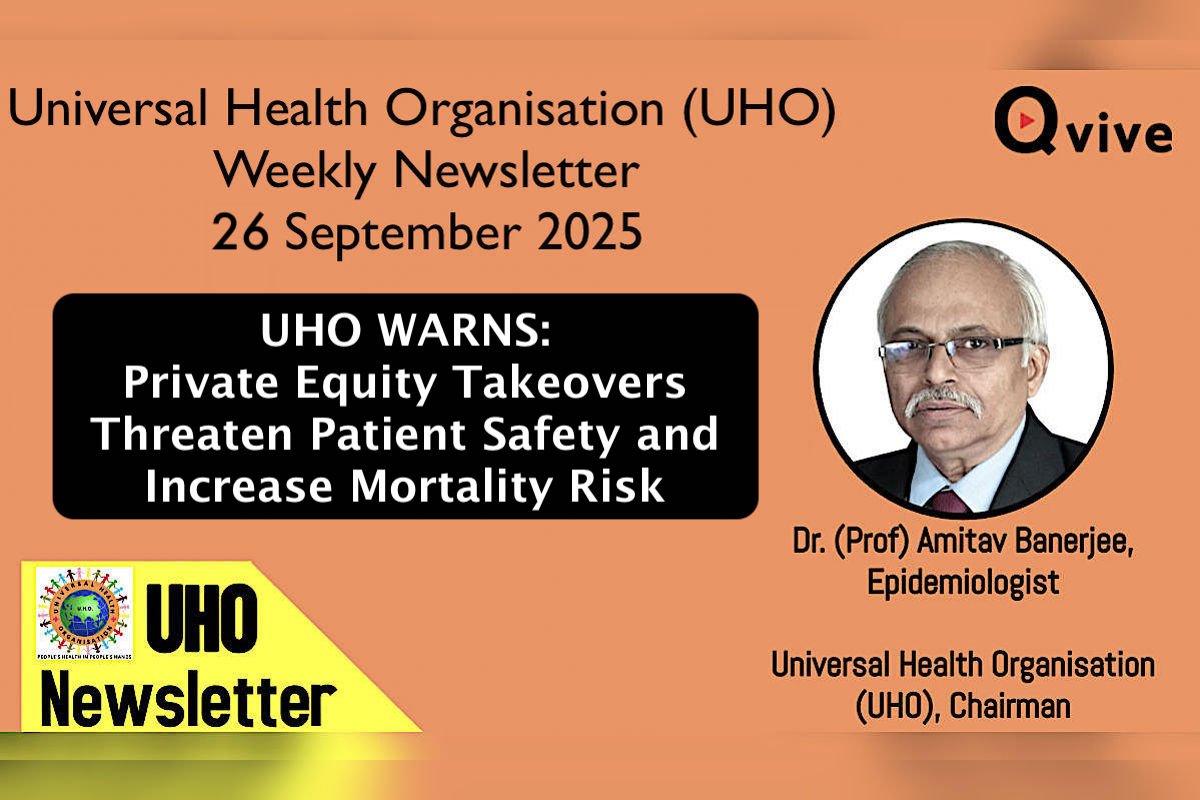
In the latest newsletter, Dr. Amitav Banerjee, Chairperson of the Universal Health Organisation (UHO), discusses alarming trends in the healthcare sector, particularly the increasing involvement of private equity firms in healthcare services, primarily originating in the United States and beginning to penetrate the Indian market.
Emergence of Private Equity in Healthcare
- Historically, healthcare has been regarded as a noble profession, primarily managed by physicians through private clinics or polyclinics.
- The progression towards privatization has led to the rise of corporate hospitals, where profit rather than patient care often drives operations.
- Now, private equity firms are beginning to take over both private and potentially government hospitals, introducing a new profit-seeking motive.
Consequences of Private Equity Acquisition
- A recent Harvard University study indicates that hospitals transitioning into private equity ownership engage in aggressive cost-cutting measures, which adversely affect patient care:
- Increased mortality rates and poor patient outcomes, particularly noted in emergency and ICU care.
- Significant reductions in staffing lead to heightened risks, especially in critical departments.
- A 10-20% rise in hospital infection rates, notably post-surgical infections, is attributed to a decrease in nursing staff.
Challenges in India
- The trend of privatization and the involvement of private equity firms is also being reported in India, particularly in cities like Pune:
- The Pune Municipal Corporation has outsourced essential services, including diagnostics, intensive care, and maternity services, to private entities.
- The outsourcing of services, originally funded by taxpayers, raises issues about increasing out-of-pocket expenditures and accessibility of healthcare for uninsured individuals.
Efficiency and Patient Care Issues
- Dr. Amitav notes a decline in efficiency in private hospitals, where consultants frequently rotate and lack accountability.
- The increase in unnecessary medical tests and procedures has been highlighted, with reports indicating that patients often undergo interventions not warranted by their conditions.
- The coordination between insurance companies and private hospitals is cited as problematic, leading to inflated insurance premiums and denials of claims for necessary procedures.
UHO Demands Immediate Regulatory Intervention to Halt Fraud and Reinforce Public Healthcare as a Citizen’s Birthright.
The report highlights that this unchecked commercialization is directly linked to the concurrent neglect and degradation of public health infrastructure, forcing vulnerable citizens into an exploitative private sector.
Findings and Exposures:
1. The Epidemic of Unnecessary Procedures: UHO investigations, including fieldwork documented in a recent newsletter and reports from members like Dr. Maya Valecha, confirm significant medical malpractices in the private sector.
- Ayushman Bharat Misuse: Evidence suggests that under the Ayushman Bharat scheme, private empanelled hospitals—particularly in areas like Ahmedabad, Gujarat—have performed medically unnecessary and aggressive procedures, such as cardiac stenting, leading to patient fatalities where no clinical indication for the intervention existed.
- Profit-Driven Medicalization: Private entities are increasingly ordering superfluous tests and interventions not for patient need, but to inflate bills, often in collusion with insurance providers.
2. Collusion and Premium Inflation: The UHO asserts that the current model creates a vicious cycle where insurance companies benefit from hospital over-investigation.
“Insurance premiums continue to climb precisely because private hospitals increase unwarranted investigations and procedures,” the report notes. “This setup is driven by profit, turning health insurance from a shield against catastrophe into a mechanism for premium escalation.”
3. Public Healthcare System Crumbling Under Neglect: The primary factor pushing citizens into this predatory environment is the deliberate weakening of the public healthcare system.
- Critical Understaffing: Government hospitals nationwide face severe neglect, with up to 30-40% of sanctioned vacancies consistently unfilled, making quality care inaccessible and driving away talented doctors.
- Sabotage by Private Interests: The UHO noted that public sector doctors often maintain private clinics, contributing to the perception of poor quality in government hospitals and subtly steering patients toward private care.
- Faculty Exodus: High-level public institutions are also suffering. UHO research indicates a major outflux, including the departure of 400-500 faculty members from AIIMS in the last two years alone, signifying a crisis at the highest level of public medical education and care.
4. Insurance Claims: A Bureaucratic Nightmare: The report confirms that for policyholders, health insurance is failing to act as a safety net, particularly during severe illness.
- Denied Major Claims: While minor claims are processed, major procedures face immense bureaucracy, red tape, and frequent denials, leaving families financially exposed.
- TPA and Middleman Abuse: The process is complicated by third-party intermediaries (TPAs) and advisors, who earn commissions and further complicate reimbursement.
- Cashless Delays: Input from UHO member Dr. Veena Raghava highlights frequent and critical delays in ‘cashless’ schemes between hospitals and insurers, undermining the intended benefit of immediate relief for the patient.
UHO Demands Action
The Universal Health Organisation strongly reiterates that free, quality healthcare is a fundamental birthright of every citizen of this country, guaranteeing a “right to life with dignity” without out-of-pocket expenditure.
The UHO calls for immediate intervention from the government (Ministry of Health and Family Welfare) and insurance regulators (IRDAI) to address this crisis:
- Immediate Regulatory Crackdown on Fraud: Launch comprehensive, external audits of private hospitals performing high-volume procedures under government schemes (like Ayushman Bharat) to identify and penalize instances of unnecessary intervention and inflation.
- Reinforce Public System: Implement urgent hiring drives to fill all vacant positions (30-40%) in government hospitals and medical colleges to rebuild public trust and capacity.
- Simplify and Enforce Insurance Claim Standards: Mandate strict timelines for claim approval and reimbursement for both minor and major procedures, and strengthen regulatory oversight of TPAs to reduce bureaucratic roadblocks and arbitrary denials.
- Prioritize Public Health Investment: Redirect resources to ensure that robust, quality public health systems reduce dependency on the costly and exploitative private sector.
The Impact of Health Insurance on Access to Care
- Current health insurance systems in India are criticized for their complexity and inefficiency:
- Claims for major procedures are often met with bureaucratic hurdles, creating significant frustration for patients.
- With increasing premiums and inadequate safety nets, health insurance is becoming less effective for providing necessary care.
Institutional Concerns and Workforce Issues
- A concerning statistic was shared regarding the exodus of faculty from AIIMS, with over 400-500 members leaving in recent years, indicating a deterioration of resources at top public health institutions.
- The overall sentiment suggests a gradual dilution of the public health infrastructure, with many citizens lacking access to adequate healthcare.
Dr. Amitav’s remarks underline the pressing need to critically evaluate the privatization trajectory of the healthcare system, advocating for public health as a fundamental right without out-of-pocket expenditures. The UHO serves as a watchdog to raise awareness of these critical issues, calling for contributions to support their mission and ensure health remains accessible to all citizens.
In conclusion, the ongoing privatization, especially the role of private equity in healthcare, poses significant risks to patient welfare, efficiency, and the overall integrity of public healthcare systems in India. The UHO continues to monitor these changes closely, emphasizing the importance of public health as a societal priority.
Also Read: