

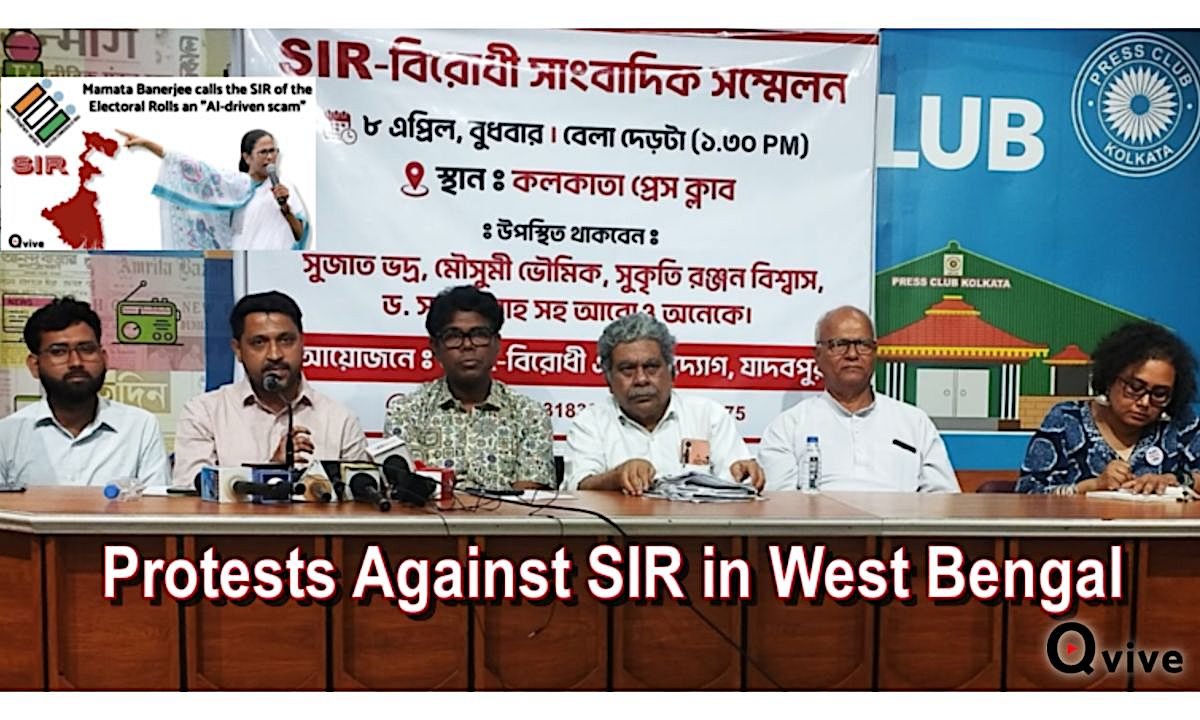
An urgent press conference at the Kolkata Press Club highlighted a serious issue in West Bengal concerning voting rights.
- A press conference titled “SIR-Birodhi Sangbadik Sammelan” (Anti-SIR Press Conference).
- Attendees: Includes Sujat Bhadra, Moushumi Bhowmik, Sukriti Ranjan Biswas, Dr. S. Mitra, and others.

A group named ‘SIR Birodhi Oikyo Udyog,’ which translates to “SIR Anti-Unity Movement.” The group held a press conference on April 8, 2026, to raise awareness and discuss their concerns about this issue.
Faridul Islam, a key figure in the anti-SIR (Special Intensive Revision) movement, made a shocking statement: if his and many others’ voting rights were not restored, he would consider “voluntary death.” This emotional declaration underscored the depth of frustration felt by those excluded from the voter list.
“All those people, including me, must either be given the right to vote, the right to vote must be given in this election. Otherwise, I am appealing for ‘voluntary death’, the Honorable President and the Supreme Court should give me the right to voluntary death, the order for voluntary death.” – Faridul Islam said while attending a press conference organized by the anti-SIR initiative, Jadavpur, at the Kolkata Press Club.
A Personal Story Signifying a Bigger Issue
Faridul Islam shared that among his extended family of 47, 7 members had lost their right to vote. He criticized the Election Commission of India for what he described as a “legalized illegality” through the SIR process. Faridul, known for his voice against previous government policies like the Citizenship Amendment Act, expressed that the current situation threatens the very essence of democracy and, in his view, reflects a form of state oppression. His willingness to sacrifice his life was designed to draw attention to the struggle against what he termed “state terrorism” and to rally support for change.
Concerns About Election Fairness
Sajidur Rahman from the Voting Rights Protection Forum echoed Faridul’s concerns, questioning the legitimacy of elections held when 9.1 million voters are excluded. Sajidur argued that marginalized groups—especially those who earn daily wages and lack internet access—may not even be aware that they have been removed from the voter list. He described the SIR process as secretive and unfair, effectively taking away the right to vote from those who are already vulnerable.
Legal Questions and Human Rights Issues
Human rights activist Sujata Bhadra raised alarming constitutional issues regarding the SIR process. She mentioned that even though the Supreme Court had heard challenges against it, no decision had yet been made. Sujata highlighted the absence of protective legal measures and warned that instead of promoting equal voting rights, the Election Commission appeared to facilitate exclusion, particularly impacting marginalized communities, notably Muslim women.
Broader Implications for Citizenship
Sukriti Ranjan Biswas emphasized that the SIR process violates the principle of universal suffrage. He noted that inconsistent citizenship laws had unfairly affected refugees, denying them recognition, even after long-term residence. Musician Mousumi Bhowmik drew parallels between the SIR process and immigration enforcement practices in other countries, suggesting it reflects a global trend towards more exclusionary definitions of citizenship.
Demands of the ‘Anti-SIR Unity Initiative’:
-
- During the press conference, the group outlined eight key demands:
- End of Misleading Campaigns: They called for the cessation of misleading advertising related to the electoral process.
- Stop of Citizenship Verification Processes: They demand immediate halting of the voter verification process, including those for Non-Resident Indians (NRIs).
- Reinstatement of Voter Names: They seek the reinstatement of all names removed from the voter list, especially those of citizens over the age of 18.
- Guaranteeing Voting Rights: An assurance that every citizen’s voting rights are upheld without discrimination.
- Thorough Investigations: They demand a comprehensive investigation into the deaths and suicides linked to the SIR voter registration process.
- Transparency in the Tribunal Process: They insist that tribunal processes must be transparent and accessible.
- Avoiding Unnecessary Delays: They call for the central authorities to refrain from imposing unnecessary delays on the voting process.
- Inclusion of Omitted Names: Their final demand is to ensure that all names excluded so far are reinstated without delay.
- During the press conference, the group outlined eight key demands:
A Call for Action
As the press conference wrapped up, organizers announced an anti-SIR march and hinted at possible hunger strikes if their demands weren’t met. This movement is not just about administrative error; it raises fundamental questions about democracy, the right to vote, and human rights in India.
Faridul Islam’s poignant ultimatum highlights the desperation and determination of those affected by voter exclusion. His plea resonates as a cry for justice and equality, serving as a powerful reminder that the struggle for voting rights is a vital part of a healthy democracy.
Ref:GroundXero
Also Read: