

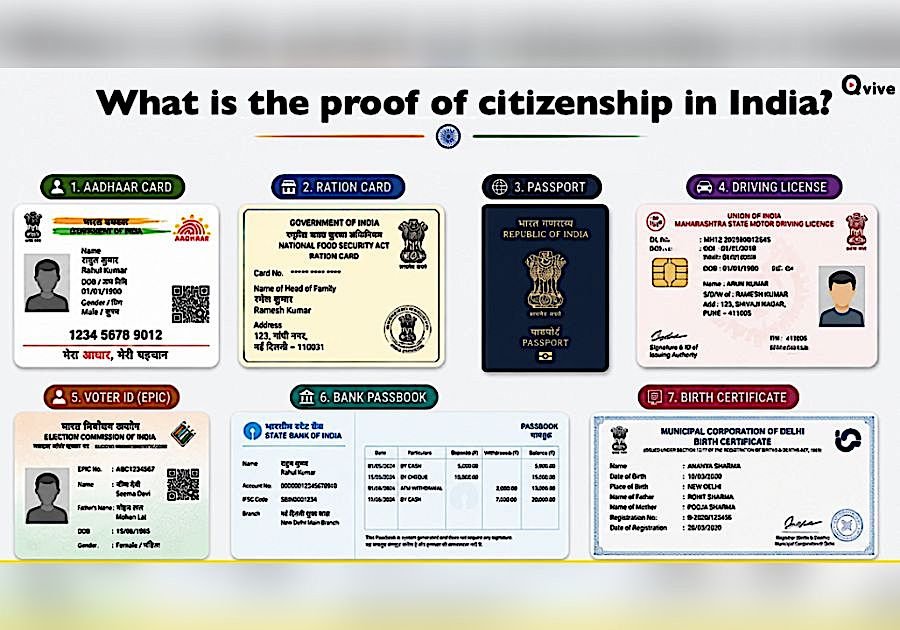
The recent clarification by the Ministry of External Affairs (MEA) that an Indian passport is “a travel document and not conclusive proof of citizenship” has triggered widespread public debate.
For generations, Indians have understood that obtaining a passport involved extensive police verification, identity checks, and scrutiny by multiple government agencies. It therefore came as a surprise to many citizens when the government clarified that a passport, despite being issued only after verification, is not regarded as conclusive legal proof of citizenship.
This debate raises a much larger constitutional and administrative question:
If an Indian passport is not conclusive proof of citizenship, what single document establishes that an ordinary person is an Indian citizen?
The Passport Paradox
An Indian passport is issued only after statutory procedures, document verification, police verification in most cases, and approval by passport authorities.
The passport itself identifies the holder’s nationality as “Indian.”
Internationally, foreign governments, immigration authorities, airlines, and consular officials treat an Indian passport as evidence that the holder is an Indian national.
Yet the recent MEA clarification states that a passport is primarily a travel document and not conclusive proof of citizenship.
This distinction may have legal significance in exceptional cases, but it has also created confusion among ordinary citizens who have long regarded the passport as the government’s highest identity document.
Aadhaar and the Digital Identity Question
India has invested enormous public resources in building Aadhaar as the world’s largest biometric identity system.
Citizens have submitted fingerprints, iris scans, facial photographs, demographic information, and other personal details to obtain Aadhaar.
However, the Aadhaar Act itself makes clear that Aadhaar is proof of identity, not proof of citizenship.
If Aadhaar is not proof of citizenship, and a passport is not conclusive proof of citizenship, many citizens naturally ask:
Why should the government collect extensive biometric information if it still does not provide a universally accepted document certifying citizenship?
This question also intersects with broader concerns about digital privacy, proportionality, and the purposes for which personal biometric data is collected and retained.
Citizenship Proof and Democratic Trust
In a constitutional democracy, the relationship between the State and the citizen is based on trust, rights, and due process. Citizenship is not merely an administrative label but the foundation of political participation, civil rights, and legal identity. When citizens are repeatedly required to prove their citizenship without clear, uniform standards, it can create uncertainty and place an unnecessary burden on individuals who have long lived, voted, and contributed to the nation.
Excessive documentation requirements risk shifting the burden of proof onto ordinary citizens, which may undermine confidence in democratic institutions. A democracy is strengthened when governance systems are transparent, consistent, and inclusive—ensuring that legitimate citizens are not placed under perpetual suspicion.
International Practice
Many countries expressly define citizenship in their constitutions or nationality laws.
Several countries also issue citizenship certificates to persons who acquire citizenship through naturalization or registration.
Passports around the world commonly identify the holder’s nationality, while citizenship is determined by domestic law.
The Indian Constitution clearly refers to “citizens of India” in Part II, and the Citizenship Act, 1955 governs how citizenship is acquired and lost.
Why the Indian Constitution Calls You a Citizen, but Your Passport Identifies You by Nationality
Constitution of India – Part II (Citizenship): Articles 5 to 11
Part II of the Constitution of India lays down the original constitutional provisions relating to citizenship at the commencement of the Constitution on 26 January 1950. It consists of Articles 5 to 11.
- India Code – Constitution of India: https://www.indiacode.nic.in
- Part II (Articles 5–11)
Article 5 – Citizenship at the Commencement of the Constitution
Article 5 provides that every person who had his or her domicile in the territory of India at the commencement of the Constitution was a citizen of India if any one of the following conditions was satisfied:
- The person was born in the territory of India; or
- Either parent was born in the territory of India; or
- The person had been ordinarily resident in India for at least five years immediately preceding the commencement of the Constitution.
This Article established who automatically became an Indian citizen on 26 January 1950.
Article 6 – Rights of Citizenship of Certain Persons Who Migrated from Pakistan
Article 6 dealt with persons who migrated from territories that became Pakistan before the Constitution came into force.
It granted citizenship to eligible migrants subject to conditions such as:
- Migration before 19 July 1948, or
- Migration after that date with registration by the prescribed authority.
This Article addressed the extraordinary circumstances arising from Partition.
Article 7 – Rights of Migrants to Pakistan
Article 7 dealt with persons who had migrated from India to Pakistan after 1 March 1947.
Generally, such persons were not considered citizens of India.
However, an exception was provided for persons who returned to India under a permit for resettlement or permanent return.
Article 8 – Citizenship of Persons of Indian Origin Residing Outside India
Article 8 recognized citizenship rights of persons of Indian origin living outside India.
A person could become an Indian citizen if:
- They or either parent or grandparent had been born in India (as defined under the Government of India Act, 1935), and
- They were ordinarily residing outside India, and
- They registered themselves as citizens at an Indian diplomatic or consular mission.
This provision protected members of the Indian diaspora.
Article 9 – Voluntary Acquisition of Foreign Citizenship
Article 9 provides that a person shall not be a citizen of India if he or she has voluntarily acquired the citizenship of another country.
India does not recognize dual citizenship in the legal sense.
Article 10 – Continuance of Citizenship
Article 10 states that every person who is or is deemed to be a citizen under Articles 5 to 9 shall continue to be a citizen of India subject to any law made by Parliament.
This ensures continuity while allowing Parliament to regulate citizenship.
Article 11 – Parliament’s Power to Regulate Citizenship
Article 11 gives Parliament the authority to make laws regarding:
- Acquisition of citizenship
- Termination of citizenship
- Renunciation of citizenship
- Any other matter relating to citizenship
Using this constitutional power, Parliament enacted the Citizenship Act, 1955, which remains the principal law governing Indian citizenship today.
Citizenship of India constitutional provisions
- Citizenship in India is governed by Articles 5 – 11 (Part II) of the Constitution.
- The Citizenship Act, 1955 is the legislation dealing with citizenship. This has been amended by the Citizenship (Amendment) Act 1986, the Citizenship (Amendment) Act 1992, the Citizenship (Amendment) Act 2003, and the Citizenship (Amendment) Act, 2005.
- Nationality in India mostly follows the jus sanguinis (citizenship by right of blood) and not jus soli (citizenship by right of birth within the territory).
Citizenship Act, 1955
Citizenship of India can be acquired in the following ways:
- Citizenship at the commencement of the Constitution
- Citizenship by birth
- Citizenship by descent
- Citizenship by registration
- Citizenship by naturalization
- By incorporation of territory (by the Government of India)
- People who were domiciled in India as on 26th November 1949 automatically became citizens of India by virtue of citizenship at the commencement of the Constitution.
- Persons who were born in India on or after 26th January 1950 but before 1st July 1987 are Indian citizens.
- A person born after 1st July 1987 is an Indian citizen if either of the parents was a citizen of India at the time of birth.
- Persons born after 3rd December 2004 are Indian citizens if both parents are Indian citizens or if one parent is an Indian citizen and the other is not an illegal migrant at the time of birth.
- Citizenship by birth is not applicable for children of foreign diplomatic personnel and those of enemy aliens.
Termination of Indian Citizenship
Termination of citizenship is possible in three ways according to the Act:
- Renunciation: If any citizen of India who is also a national of another country renounces his Indian citizenship through a declaration in the prescribed manner, he ceases to be an Indian citizen. When a male person ceases to be a citizen of India, every minor child of his also ceases to be a citizen of India. However, such a child may within one year after attaining full age become an Indian citizen by making a declaration of his intention to resume Indian citizenship.
- Termination: Indian citizenship can be terminated if a citizen knowingly or voluntarily adopts the citizenship of any foreign country.
- Deprivation: The government of India can deprive a person of his citizenship in some cases. But this is not applicable for all citizens. It is applicable only in the case of citizens who have acquired the citizenship by registration, naturalization, or only by Article 5 Clause (c) (which is citizenship at commencement for a domicile in India and who has ordinarily been a resident of India for not less than 5 years immediately preceding the commencement of the Constitution).
Persons of Indian Origin (PIO) Card
A person would be eligible for the PIO card if he:
- Is a person of Indian origin and is a citizen of any country except Pakistan, Sri Lanka, Nepal, Bangladesh, Bhutan, China or Afghanistan, or
- Has held an Indian passport at any other time or is the spouse of a citizen of India or a person of Indian origin.
PIO cardholders can enter India with the multiple entry feature for fifteen years. They do not need a separate visa.
Overseas Citizen of India (OCI) Card
- OCI Card is for foreign nationals who were eligible for Indian citizenship on 26th January 1950 or was an Indian citizen on or after that date.
- Citizens of Pakistan and Bangladesh are not eligible for OCI Card. An OCI cardholder does not have voting rights.
- OCI is not dual citizenship. OCI cardholders are not Indian citizens.
- The OCI Card is a multipurpose, multiple entry lifelong visa for visiting India.
- Persons with OCI Cards have equal rights as NRIs in terms of financial, educational, and economic matters. But they cannot acquire agricultural land in India.
Frequently Asked Questions related to Indian Citizenship
How can I get Indian citizenship?
Indian citizenship can be acquired by birth, descent, registration and naturalization. The conditions and procedure for acquisition of Indian citizenship is as per the provision of the Citizenship Act, 1955. Citizenship of India by naturalization can be acquired by a foreigner (not illegal migrant) who is ordinarily resident in India for 12 years (throughout the period of twelve months immediately preceding the date of application and for 11 years in the aggregate in the 14 years preceding the twelve months) and other qualifications as specified in Third Schedule to the Act.
What are the types of citizenship in India?
According to the Ministry of Home Affairs, there are four ways in which Indian citizenship can be acquired: birth, descent, registration and naturalisation. The provisions are listed under sections 3, 4, 5(1) and 5(4) of the Citizenship Act, 1955.
Does India allow dual citizenship?
The Constitution of India does not allow holding Indian citizenship and citizenship of a foreign country simultaneously. Based on the recommendation of the High-Level committee on Indian Diaspora, the Government of India decided to grant Overseas Citizenship of India (OCI).
Is NRC bill passed in India?
The National Register of Citizens (NRC) is a register of all Indian citizens whose creation is mandated by the 2003 amendment of the Citizenship Act, 1955. Its purpose is to document all the legal citizens of India so that the illegal immigrants can be identified and deported.
Grant of Passport as Evidence of Citizenship: Delhi High Court’s 2018 Perspective
Indian Passport
Issued only to Indian citizens. It explicitly states “Nationality: Indian” and serves as strong presumptive proof internationally and domestically.
The Delhi High Court, in a significant 2018 decision, recognized that the grant of an Indian passport to an individual is a relevant factor while examining claims of Indian citizenship. The Court observed that a passport is not an ordinary identity document; it is issued by the Government of India after a statutory process that includes verification of the applicant’s nationality and identity. Therefore, the fact that a person has been issued an Indian passport can constitute important evidence in support of a claim of Indian citizenship.
The Court’s reasoning is rooted in the legal character of a passport. Under the Passports Act, 1967, passports are ordinarily issued only to Indian citizens. Consequently, when the State grants a passport, it signifies an official recognition of the holder’s status as an Indian national.
In several passport-related cases decided by the Delhi High Court during 2018, the Court emphasized the importance of passport rights and observed that denial or non-renewal of a passport affects fundamental rights, including the right to travel abroad and personal liberty under Article 21 of the Constitution. The Court stressed that the authorities cannot arbitrarily deny passport facilities without lawful justification.
The Passport as a Tool: A passport serves as prima facie evidence of nationality and guarantees the right to travel and diplomatic protection under international law.
Further, the Regional Passport Office, Mumbai has stated that no matching records could be found for the above passport details. I've asked for the copy of the documents submitted during the application. The Ministry of External Affairs has apparently instructed the destruction… pic.twitter.com/s3KuodAzsQ
— Robin Zaccheus (@RobinZaccheus) June 25, 2026
Ref: https://www.livelaw.in/columns/which-documents-prove-indian-citizenship-153027
Also Read: