

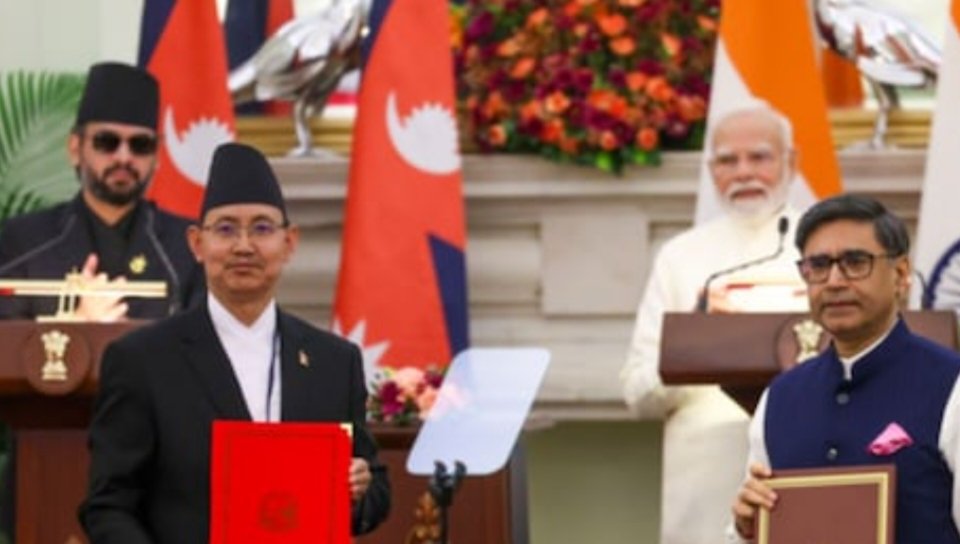
Prime Minister Narendra Modi and Nepal’s Prime Minister Balendra Shah on Monday announced several key initiatives to boost trade, connectivity, and energy cooperation between the two countries. According to a joint statement, the two countries placed special emphasis on enhancing cooperation in air connectivity, railway networks, petroleum infrastructure, and hydropower.
The two leaders reviewed ongoing discussions in the civil aviation sector and agreed to enhance connectivity. This includes making the current Kathmandu-Bhairahawa-Lucknow (B345) air route, which is currently one-way, a two-way route. Both sides will finalize the necessary technical procedures for this.
Announcing a new facility for Nepal’s transit trade, Prime Minister Modi said that Nepal will be provided additional sea access through the Deendayal Port (Kandla, Gujarat). Furthermore, once the necessary infrastructure is in place, the Paradip Port (Odisha) will also be opened to Nepal.
The joint statement stated that the two countries emphasized the importance of strengthening cross-border connectivity and border infrastructure. This initiative will advance new railway lines, bridges, Integrated Check Posts (ICPs), and petroleum pipeline projects.
The two Prime Ministers flagged off the Saryu-Kamala Express rail service, connecting Ayodhya and Janakpur. This rail service is expected to facilitate travel and promote religious and cultural tourism along the Ramayana Circuit and further strengthen India-Nepal’s historical ties.
The two countries also agreed to study the feasibility of other similar connectivity routes to develop Buddhist and Shiva-Shakti religious tourism circuits. In the area of rail connectivity, the two sides announced the completion of field location surveys for the proposed Raxaul-Kathmandu electrified broad-gauge railway line. They also agreed to cooperate in the development of Nepal’s East-West Railway project.
To further improve border connectivity, a new motorable bridge was inaugurated between Dharchula in India and Darchula in Nepal, strengthening road connectivity between western Nepal and India.
In the energy sector, both countries also prioritized petroleum infrastructure expansion. The leaders dedicated the second phase of the Motihari-Amlekhganj pipeline to the people of Nepal. The foundation stone for a petroleum terminal in Jhapa, Nepal, was also laid, and the need for early commencement of work on the Siliguri-Jhapa petroleum pipeline project was emphasized. Both countries also agreed to study the feasibility of constructing a gas pipeline between India and Nepal.
Furthermore, both sides expressed satisfaction with cooperation in the hydropower sector, noting that it was progressing in accordance with the India-Nepal Joint Energy Vision Document and the Long-Term Power Trade Agreement. Welcoming the active participation of Indian companies in Nepal’s hydropower sector, both countries emphasized the early completion of these projects.
On this occasion, the two Prime Ministers also laid the foundation stone of the 669 MW Lower Arun Hydroelectric Project.
Furthermore, the two leaders directed the early finalization of the Detailed Project Report (DPR) for the Pancheshwar Multipurpose Project and the early commencement of project implementation. They also agreed to expedite the DPR process for the Saptakoshi and Sunkoshi Multipurpose Projects, which would contribute to better utilization of water resources and flood management.
Both sides also welcomed the progress made in the formation of a joint venture (JV) for the high-capacity cross-border power transmission lines between Inaruwa-New Purnia and Dododhara-Bareilly in Nepal. In a significant announcement in the education sector, the two leaders agreed that India would establish the first overseas campus of an IIT in Nepal, which would provide a significant boost to Nepal’s higher education sector, as well as promote employment generation and skill development.