

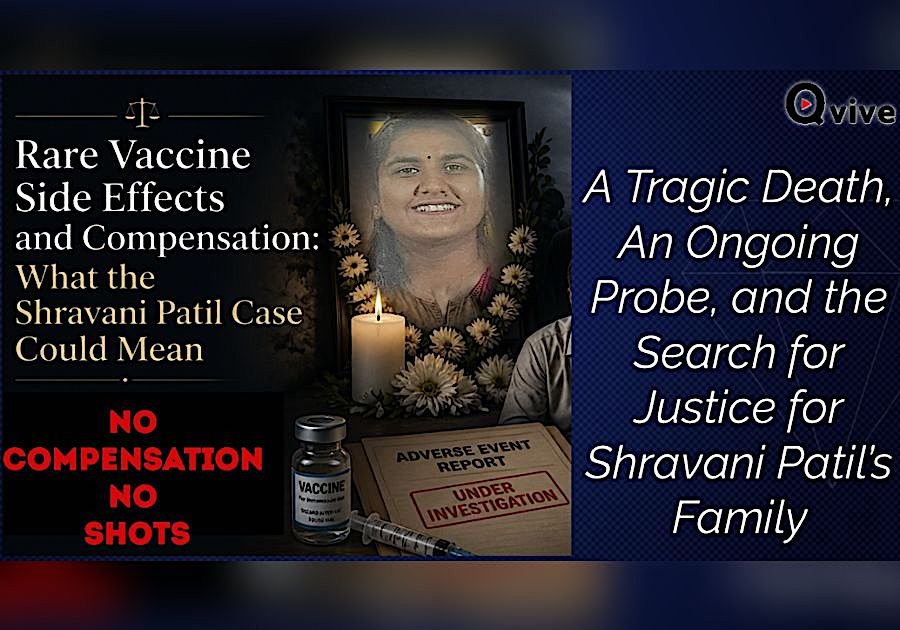
The tragic death of 17-year-old Shravani Anil Patil in Nashik has re ignited a national debate over India’s vaccine injury compensation system. The teenager collapsed shortly after receiving a Tetanus-Diphtheria (Td) booster dose at a municipal vaccination camp, prompting allegations from her family that the vaccine caused her death.
What Happened?
On June 23, 2026, Shravani Patil visited a vaccination camp at the Dakshinmukhi Hanuman Temple complex in Nashik’s Khutwadnagar area with her father, Anil Patil.
According to the family, shortly after receiving the Td vaccine, they started walking home when Shravani suddenly began bleeding from her nose and collapsed on the road. She was rushed to the district hospital but was declared dead.
Her family alleges that she was completely healthy before vaccination and believes the vaccine caused her death. They have demanded a thorough investigation and action against those responsible. The family also said health workers had personally visited their home and encourage them to get vaccinated, which is why she decided to accompany her father to the center.
The Nashik Municipal Corporation (NMC) and state health officials have launched a comprehensive inquiry into the incident.
After Nashik Tragedy, Public Asks: Who Pays for Rare Vaccine-Related Injuries?
India’s Long-Standing Compensation Gap
The Shravani Patil case has drawn attention to a major gap in India’s public health system.
During the Covid-19 vaccination programme, India administered more than 2.19 billion vaccine doses. Although adverse events were monitored through the Adverse Event Following Immunization (AEFI) surveillance programme, India did not establish a dedicated no-fault vaccine injury compensation fund.
As a result, families who believed vaccines had caused serious injuries or deaths often had to approach civil courts and prove negligence by government authorities or manufacturers—a costly and time-consuming legal process.
Public health experts have long argued that this system discourages genuine victims from seeking justice and undermines public confidence in immunization programmes.
Supreme Court Calls for Reform
Recognizing these concerns, the Supreme Court recently directed the Union Government to formulate a no-fault vaccine compensation framework.
The Court observed that citizens responding to government vaccination programmes should not have to spend years proving negligence in court before receiving financial assistance if an expert medical review establishes that a vaccine caused serious harm.
A no-fault compensation system would not require proof of negligence. Instead, compensation would depend on scientific evidence showing that vaccination was responsible for the injury or death.
Whether Shravani Patil’s family ultimately receives compensation?

Following the death of 17-year-old Shravani Anil Patil and the ongoing investigation into whether it qualifies as an Adverse Event Following Immunization (AEFI), some members of the public and advocacy groups have renewed calls for India to establish a dedicated no-fault vaccine injury compensation fund before expanding or conducting future large-scale vaccination drives.
Supporters of this demand argue that individuals who participate in government immunization programmes should have access to prompt financial support if they suffer a scientifically confirmed vaccine-related injury, without having to prove negligence through lengthy court proceedings. Some have also used slogans such as “No Compensation Fund, No Vaccination Drive”.
Compensation for All Vaccine Side Effects: Supreme Court Directs Relief for Affected Citizens — Additional Claims Permitted
The Supreme Court has clarified that compensation is payable to all citizens who have suffered any side effects following COVID vaccination, even in the absence of conclusive proof of direct causation.
The Court further recognised that affected individuals are entitled to pursue additional claims for damages under the law.
A Nagpur Court has already ordered criminal prosecution against Adar Poonawalla, the Serum Institute, and its directors and employees. Additionally, notices have been issued in three high-value civil compensation claims totalling ₹10,000 crore, ₹1 lakh crore, and ₹12 lakh crore.
₹1000 CRORE CLAIM – COURTS HAVE TAKEN COGNIZANCE. A major and unprecedented development has taken place where Dr Snehal Lunawat has filed a compensation claim of ₹1000 crores against Adar Poonawalla, Bill Gates, Serum Institute of India, and the Union of India, and the petition has already been admitted by the Division Bench of the Hon’ble High Court. This is not a mere allegation in public discourse. It is a matter of judicial record now under active consideration.
₹100 CRORE CLAIM IN VACCINE MURDER CASE – In another serious case, relating to the vaccine-related death (vaccine murder as alleged) of Hitesh Kadwe, a compensation claim of ₹100 crores has been filed by Smt. Kiran Yadav. This case directly raises the issue of:
• Liability for death post vaccination
• Accountability of authorities and involved entities
• Possible criminal culpability.
A WAVE OF LITIGATION IS BUILDING ACROSS INDIA.
Victims are not required to establish strict or direct causation between the vaccine and the adverse effect, thereby removing a major evidentiary burden that would otherwise defeat legitimate claims.
Any abnormal condition arising post-vaccination—such as severe and unexplained headache, neurological complications, joint pain, diabetes, paralysis, blood clotting disorders, heart attacks, cardiac arrest, vision impairment, hearing impairment, or any other unusual or sudden medical condition—acquires legal relevance within the framework of Adverse Events Following Immunization (AEFI) and cannot be dismissed merely on the ground that definitive or conclusive proof of causation is not available.
The burden, in such cases, shifts onto the State to ensure compensation, reflecting a no-fault liability regime grounded in constitutional principles of fairness and protection of life under Article 21.
On similar lines, the High Court, in Devilal v. State of M.P., 2017 SCC OnLine MP 2322, granted compensation of ₹25 lakh to a victim who developed paralysis following vaccination (polio vaccine). Notably, the Court extended relief even though the victim was unable to conclusively establish a direct causal link between the vaccine and the adverse condition, thereby reinforcing the principle that the absence of strict proof cannot be a ground to deny compensation in such cases.
Affected citizens may also initiate independent legal proceedings—both civil and criminal—against vaccine manufacturers, including Serum Institute and its directors such as Adar Poonawalla and Cyrus Poonawalla, among others, on allegations of suppression of serious side effects, including fatalities, as well as misrepresentation by portraying the vaccines as completely safe.
Importantly, there is no statutory upper limit on compensation, and affected individuals are entitled to seek full and proportionate damages corresponding to the harm suffered. In America (USA), compensation of Hundreds of crores was granted. In India, also, petitions with claims of Hundreds of crores are admitted. In addition, they may also pursue criminal prosecution and seek appropriate punishment against those found responsible.
Call to Citizens: Preserve Evidence Without Delay
Public organisations, including:
• Rashtriya Sanvidhan Raksha Samiti
• Indian Bar Association
• Awaken India Movement
have urged citizens to immediately collect, record, and preserve all relevant medical records, prescriptions, diagnostic reports, hospital documents, and expert opinions in cases where any abnormal health condition is observed post-vaccination.
Unlimited Legal Remedies: Beyond Government Compensation
Importantly, citizens are not confined to government compensation schemes. The law permits full-scale legal action against:
• Vaccine manufacturers
• Policy-makers
• Public officials
• Any entity involved in approval, promotion, or enforcement
Grounds for Legal Action May Include:
Alleged suppression of side effects
• Misrepresentation of safety
• Failure to disclose material risks
• Coercive or mandatory vaccination practices
• Continuation of policies despite emerging concerns
Legal Consequences and Personal Liability
Legal doctrine makes it clear that public office does not provide absolute immunity.
Where acts involve negligence, suppression, or abuse of authority:
• Officers may be directed to pay compensation personally
• Criminal prosecution may be initiated in appropriate cases
• Immunity may not apply where actions are arbitrary or mala fide
The principle of public accountability ensures that liability does not stop at the State level. Where harm arises from acts or omissions, affected individuals may proceed not only against institutions but also against responsible decision-makers.
In essence: authority carries responsibility—and misuse may attract personal liability.
Continue Reading..https://youngadvocatescouncil.com/compensation-for-all-vaccine-side-effects-supreme-court-directs-relief-for-affected-citizens-additional-claims-permitted/ (copy and paste the link)
Also Read: