

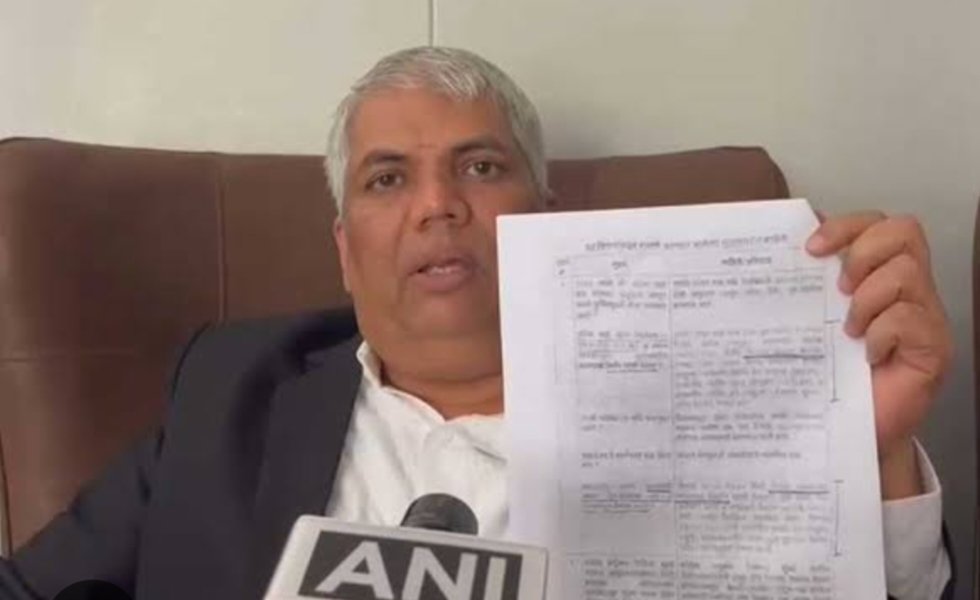
In the Disha Salian case, her father Satish Salian’s lawyer Nilesh Ojha has presented many contradictions and flaws in the records and statements of the Mumbai Police investigation before the Bombay High Court and CBI. Disha Salian’s father Satish Salian’s lawyer Nilesh Ojha told in an interview to Ashutosh Pathak, Editor-in-Chief of Qvive Media, that the way the then Mumbai Police Commissioner Paramvir Singh, in order to save Rhea Chakraborty, Aditya Thackeray, Dino Maria and other accused in exchange for illegal extortion, fabricated many false stories from the Mumbai Police to convert Disha Salian’s gangrape and murder case into suicide. But now, these false stories fabricated by them will not only save the other accused, but Paramveer Singh himself, who has been made an accused in the CBI FIR in the Disha Salian case, will also not be saved. In this interview, Nilesh Ojha strengthened his views with the example of several investigation records.
Reflecting the contradictions surrounding the post-mortem and the body, he made the following claims:
Date and Covid delay claim: According to Nilesh Ojha, Mumbai Police and SIT said in the affidavit that the post-mortem took place on June 11 and it was delayed due to the arrival of Covid test report. Ojha claims that police records contradict this claim and do not match reality.
Change in post-mortem instructions: According to Ojha, the letter written on June 9 only instructed to investigate the consumption of alcohol, while the letter written to the new doctor on June 11 talked about aspects like rape, injury and fall from height or murder.
He also strongly pointed out the difference in time and police presence.
ADR and time of police presence: As per Nilesh Ojha’s arguments, the time of police presence in the building (12:59 pm to 2:14 am) is shown to be before the time of Accidental Death Report (ADR) (2:25 pm/3:07 pm).
Delay in Panchnama and seizure: He has linked the delay of about 9 hours in Panchnama and late seizure of electronic devices on 17 June 2020 to the credibility of the investigation.
He raised questions on the records and statements of witnesses
Changes in diary and panchnama: Nilesh Ojha alleges that the police made repeated changes in the records, tampered with the pages of the station diary and manipulated the date of the mobile seizure panchnama.
Discrepancies in witness statements: He claimed to have contradictions between the statements of eyewitnesses and the police story of the time of the incident.
Section 174 vs FIR: Ojha also argued that investigating a complaint containing allegations of gang rape and murder only under Section 174 and not registering an FIR is against the legal process.
On the basis of these arguments and records, the Bombay High Court directed the CBI to register an FIR in the case and investigate, while the CBI investigation is progressing.