


“No Internet Means No Work, No Pay, No Food”

When the internet is shut down, I have no work, do not get paid, cannot withdraw any money from my account, and cannot even get food rations.
—H.K., 35, a Dalit woman with five children, Rajasthan, September 2022
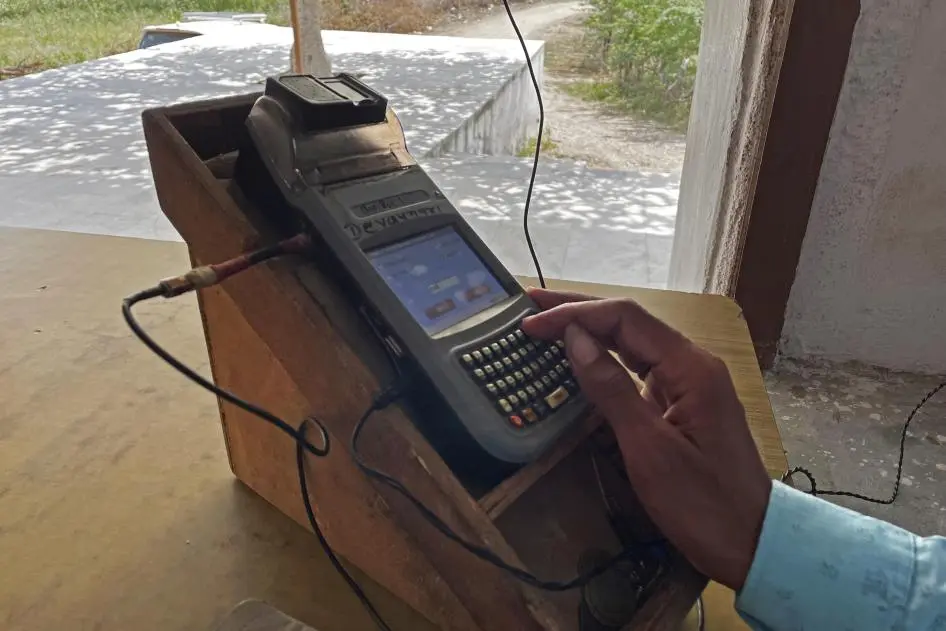
In 2017, as part of schemes to digitize the government’s social security system and ostensibly increase administrative efficiency, the government required all people eligible for subsidized food rations to link their ration card with Aadhaar—the country’s biometric identity system. This was upheld by the Supreme Court in 2018.
As a result, ration shops now require internet for Aadhaar authentication before providing food grains. R.K., who runs a shop under the public food distribution system, explained that when a customer comes, he uses an internet-linked machine to authenticate fingerprints with the biometric card. “The machine uses a SIM, similar to what we insert in a mobile phone, so when there is no internet, it doesn’t work,” he said, which prevents him from delivering the subsidized allocations.
While some services were gradually restored, mobile 4G internet access remained effectively down for over 500 days, until February 2021. Mobile internet is used by 96 percent of the population, and thus the shutdown impacted every aspect of daily life. As one journalist based in Srinagar, who asked not to be identified, told Human Rights Watch and Internet Freedom Foundation:
Just imagine the number of times you use the internet in a day. For entertainment, for information, for job applications, for education, to connect with your loved ones, for checking up on things, for ordering things, for travel, for ticketing, for studying—it’s for every aspect of life. You start to realize its importance when it is taken away from you.
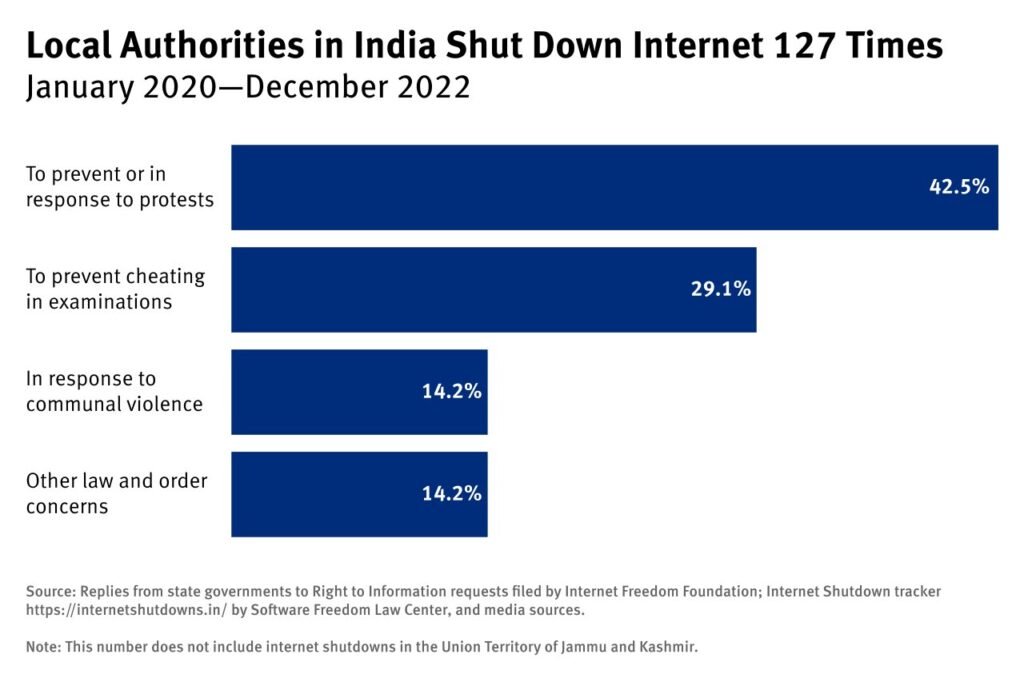
While the length of the 2019-2021 internet shutdown in Jammu and Kashmir was unprecedented, denying access to the internet has become a default policing tactic by Indian authorities, including to shut down protests or criticism of the government, and even to prevent cheating in school examinations. Since 2018, India has shut down the internet more often than any other country in the world. According to one estimate, India was responsible for the most shutdowns in 2022, for the fifth consecutive year, with 84 shutdowns out of 187 globally. While this report covers shutdowns up until December 2022, in March 2023, the entire state of Punjab had been placed under a three-day mobile internet blackout to track down a separatist leader. In May, the internet was completely blocked on both mobile and fixed line services in Manipur state for weeks following violent ethnic clashes.
India’s arbitrary internet shutdowns disproportionately hurt communities living with poverty that depend on the government’s social protection measures for food and livelihoods, Human Rights Watch and Internet Freedom Foundation said in a report released today. Since 2018, India has shut down the internet more than any other country in the world, undermining the government’s flagship “Digital India” program, which has made regular internet access vital for delivering key public services.
Transcript
Transcript
“The main element of “Digital India” is a digitally literate India, a capable India, a prosperous India…”
This is the vision of “Digital India.”
The “Digital India” project aims to use technology to deliver government programs and public services.
The internet is key to making this happen.
But Digital India faces one big challenge…Internet shutdowns.
Since 2018, India has shut down the internet more than any other country in the world.
State authorities have repeatedly cut off mobile internet.
These shutdowns impact most of the population in the affected area since 96% of India’s internet subscribers access it on their phones.
Without the internet, people can’t reach government food and work programs or conduct activities like banking.
“Digital India has become a way of life particularly for the poor, marginalized and for those in government.”
But it is poor and marginalized communities who are the most harmed during internet shutdowns, when government services get disrupted, affecting their human rights.
- Right to food
People can’t receive subsidized food grains if they are unable to authenticate their biometric IDs using the internet.
Internet blackouts in rural areas mean families could go hungry for days.
- Rights to employment and social security
The government’s rural income security program, NREGA, requires workers to mark their attendance online.
These women laborers have to upload a geo-tagged photo online to prove that they have showed up for work.
“Last month, we worked for 15 days but we only got paid for 12 days because the [inter]net did not work.” Community supervisor, NREGA
Indian authorities say they shut down the internet to maintain public order.
But we found authorities use internet shutdowns for various other reasons, including to curb peaceful protests and prevent cheating on school exams.
The government’s longest imposed blackout lasted for 550 days in Jammu and Kashmir.
There’s no evidence that internet shutdowns help maintain law and order.
Instead, they undermine free expression and act as a form of collective punishment that disproportionately impacts marginalized communities.
Indian authorities should end the shutdowns.
They should ensure that everyone has equal access to public services and social protection programs, even when the internet is not available.
Digital India should ensure that technology protects people’s livelihoods and rights.
India’s International Legal Obligations
The United Nations Human Rights Council passed a resolution in 2016 unequivocally condemning internet shutdowns and called upon all states to “refrain from and cease such measures.” UN human rights experts have said blanket internet shutdowns violate international human rights law and in 2021 the UN secretary-general noted the need to reinforce universal access to the internet by 2030 as a human right. He emphasized that the UN would work with governments, business, and civil society to find alternatives to disruptive blanket internet shutdowns.
In June 2022, India signed a statement along with G7 nations and four other countries, committing to ensure “an open, free, global, interoperable, reliable and secure internet.” As a signatory to the Resilience Democracies statement, India also resolved to protect “the freedom of expression and opinion online and offline and ensuring a free and independent media landscape through our work with relevant international initiatives.”
Access to the internet is widely recognized as an indispensable enabler of a broad range of human rights guaranteed in the International Covenant on Civil and Political Rights (ICCPR) and other human rights instruments to which India is a party. States have the obligation to respect and ensure the right to freedom of expression without distinction of any kind. Restrictions on the right to freedom of expression are only permissible when they are provided by law and are a necessary and proportionate response to a specific threat. Given their indiscriminate and widespread impacts, internet shutdowns rarely meet the proportionality test.
India’s Internet Shutdowns: Human Right Violation Or National Security Measure?
India has emerged as a leader in internet shutdowns. The growing technological powerhouse cuts off the internet more often than any other democracy in the world and accounts for over 67% of all blackouts globally.
In 2019 it cut off the internet in Jammu and Kashmir for over 168 days. One of the longest digital blackouts in a democratic country. It is also known to throttle internet speeds, ban websites and smartphone apps.
In 2020, the disruptions to internet access cost the Indian economy US$2.6 billion. But beyond economic losses, internet shutdowns are at odds with civil liberties. Why does the government shut down the web so frequently and at what cost to its citizens?
Source: Human Rights Watch, Youtube,
Also Read: