

Highlights:
- States raise alarm over surge in H1N1 cases: ICMR Chief says no cause for concern.
- Remdesivir sold in black during covid: We should beware of Tamiflu for H1N1 peak.
- MBBS Seat for sale for Rs 18 Lakhs in Government College despite low NEET scores.
- Paper leak in FDA inspector job exam held by Maharashtra PSC.
- Should we promote pharmacological protection from STD’s in place of safe behavior among GenZ?
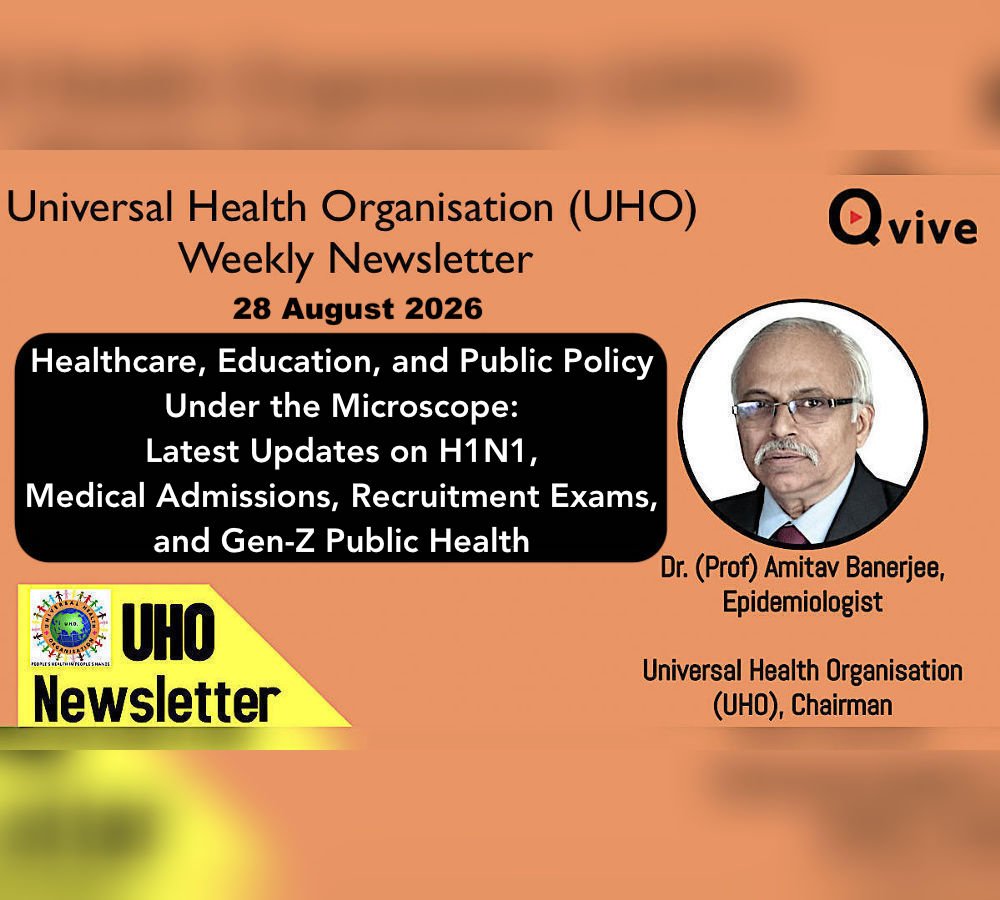
By Dr. Amitav Banerjee, Chairperson of the Universal Health Organisation (UHO)
States raise alarm over surge in H1N1 cases: ICMR Chief says no cause for concern.
Few states like Karnatka and Haryana have raised the alarm over surge in H1N1 influenza cases. It has crossed the 4000 mark in Karnatka, while Haryana has ordered 100% testing of Severe Acute Respiratory Infection (SARI) and 5% of those reporting with Influenza like Illness (ILU).
UHO expresses concerns that increase in testing will only result in increase in the case counts as there is no specific treatment for viral infections. Mostly patients need supportive care focused on the elderly and those with co-morbidities. Another important gap in the reports are no mention of infection fatality rates. Seasonal flus are self-limiting phenomena and public panic by such measures will lead to crowding of hospitals leading to lack of beds and ICUs for those serious patients who are in genuine need.
The ICMR Director General Dr Rajiv Behl has stated that while 98% of the influenza cases in the present spike is due to H1N1 most of the cases are mild and there is no cause for concern. ICMR has not released any official mortality figures.
Remdesivir sold in black during covid: We should beware of Tamiflu for H1N1 peak.
During the Covid-19 Pandemic, massive spike in demand led to the illegal black market sale of the antiviral drug Remdesivir at several times its official retail price. Subsequently, it was found Remdesivir had lot of side effects without any benefits.
UHO would like to caution that the same story should be repeated with Tamiflu in the wake of the H1N1 peak. This concern is based on a recent randomized controlled trial which show that treatment with oseltamivir is ineffective and highly likely to increase 90-day mortality in critically ill patients with influenza.
This study should have been undertaken decades ago before the drug was promoted during the 2009 H1N1 pandemic.
For more than two decades, Tamiflu has been a cornerstone of global pandemic planning.
Governments spent billions stockpiling it, the WHO placed it on its Essential Medicines List, and doctors routinely prescribed it to severely ill flu patients on the assumption that it could prevent complications and save lives.
But before this study, no randomised trial had compared Tamiflu with no antiviral in critically ill patients.
UHO recommends that if Tamiflu has to be used in India, it should be done cautiously with close monitoring of adverse effects. Ideally Indian research agencies should carry out their independent studies without any conflicts of interest instead of blindly following guidelines from the West.
MBBS Seat for sale for Rs 18 Lakhs in Government College despite low NEET scores.
The general public perception is that low NEET rank can get one a MBBS seat in private medical colleges by paying a high fees. It will shock many to know that by paying huge amounts one can secure a MBBS seat in a government medical college. Investigative journalists have uncovered this racket in some government medical colleges.
Government MBBS seats are allegedly being offered for up to ₹18 lakh, with admission agents claiming that NEET rank does not matter and promising seats in government medical colleges in West Bengal, Rajasthan and other states.
Four undercover reporters contacted more than 50 agents and college representatives across five states. Agents allegedly offered to arrange fake domicile documents and NRI sponsorships to secure admissions.
One agent, referred to as Agent 1, allegedly claimed links with 11 government medical colleges in West Bengal and offered a government medical college seat for ₹18 lakh regardless of rank. The agent also claimed that seats were booked in advance by paying colleges ₹4-5 crore.
Two undercover reporters approached Agent 1 posing as general-category candidates, claiming 325 and 540 marks in NEET and saying they could not secure government medical college seats at those scores.
Agent 1 allegedly offered admission through the West Bengal domicile quota, saying candidates could choose from a list of 11 government medical colleges and would have to wait until the second round of counselling.
The agent allegedly claimed that candidates from other states could qualify through the West Bengal quota by showing their mother as a state resident. The agent claimed that 2-3 decimals of land had already been purchased there and that the address could be used on the mother’s Aadhaar card.
The agent allegedly offered documents showing that the mother had been living in Bengal for 10 years, along with a ration card and electricity connection.
The alleged arrangement involved ₹18 lakh for the seat, followed by ₹1 lakh a year in fees. An NRI quota option was allegedly offered for ₹1.5 crore.
Another alleged admission route
Agent 2, a Patna-based admission agent, allegedly claimed connections with government colleges in West Bengal and Rajasthan and offered admissions in medical colleges in India, Nepal and Russia.
The agent allegedly claimed that a candidate with 430 marks could secure admission in a government medical college in Rajasthan through the NRI quota, charging ₹10 lakh for the arrangement and ₹5 lakh for preparing the papers.
Agent 2 also allegedly offered to arrange an NRI sponsor for money.
More than six agents in Patna were contacted, with alleged links to government medical colleges in Bengal, Rajasthan and several other states.
Domicile route under scrutiny
The investigation team travelled around 600 km from Patna to Darjeeling and visited North Bengal Medical College while posing as parents seeking admission for two siblings.
A college counsellor said students with low ranks could potentially secure admission in Bengal if they had the required domicile documents.
The counsellor said the requirement involved around 10 years of residence in West Bengal and that students who had not themselves lived continuously in the state could qualify if their mother or father was a resident.
The counsellor also said the college’s role was document verification through the department and that it could not accept or reject documents outside the rules.
More than 4,000 MBBS seats in Bengal
West Bengal has more than 4,000 MBBS seats across 25 government medical colleges, with around 85%, or more than 3,400 seats, under the state quota based on domicile.
According to the investigation, agents collect a candidate’s NEET score, rank, category, state of residence and preferred state for admission, then allegedly offer arrangements to establish eligibility under the West Bengal quota.
The alleged process includes:
- Preparing documents showing the student’s family as West Bengal residents
- Arranging address proof, voter ID and electricity connections
- Obtaining a domicile certificate
- Applying for counselling under the West Bengal state quota
- Filing applications through Form-B
- Arranging document verification through the agents’ network
- Collecting payments in installments
- The alleged ₹18 lakh domicile deal reportedly starts with a ₹2 lakh advance, followed by ₹2 lakh after document preparation and ₹2 lakh after document verification. The remaining amount is allegedly collected at admission.
- Risks for candidates
- Such practices can deprive eligible students of seats. If an admission secured through fraudulent documents is subsequently challenged, the student could potentially lose the money paid, the seat and the degree.
- The investigation also found agents allegedly offering admissions using fake NRI certificates.
UHO expresses serious concerns at this state of affairs. Merit in medical education which started getting compromised by increase in number of private medical colleges with very high fees beyond the means of meritorious students with modest means, is getting further compromised by underhand deals for seats in government medical colleges. The profit motive, i.e. medical profession as the money minting machine has to be done away with. The serious discussion on saving this vital sector from commercialisation is the only way forward.
Paper leak in FDA inspector job exam held by Maharashtra PSC.
Paper leaks for high profile MBBS exams like NEET make headlines. But that may be the tip of the iceberg. Good public health depends not only on doctors but other health workers in the field. One of the most crucial among them is food inspectors ensuring safe and standard quality food for all citizens.
Unfortunately, paper leak have come to surface in the Group-B recruitment examination for food inspectors conducted by the Maharashtra Public Service Commission (MPSC).
As reported in the Times of India, dated 27 Aug 2026, a Nandurbar man, embittered by the end of a relationship with his girlfriend, who had cleared this exam, revealed to the authorities about the alleged leak of the exam paper. The MPSC cancelled the examination which will be conducted afresh. Mumbai crime branch have arrested six persons. This included the man who had purchased the paper for his girlfriend and later complained to the authorities when their relationship ended. The others are officials of the MPSC and some private coaching centers.
We recommend strict measures to ensure punishment for officials and those responsible as food inspector’s job is vital to for public health. Those who clear this exam by unfair means would be vulnerable to corruption in this job.
Should we promote pharmacological protection from STD’s in place of safe behavior among GenZ?
First it was HPV vaccine pushed in unholy haste in spite of misadventure during its trials in 2009-10. Now it is the turn of pre-exposure prophylaxis (PEP) against HIV/AIDS among adolescents and adults.
The subject expert committee (SEC) of the Central Drugs Standard Control Organization (CDSCO) has decided to do away with trials of generic antivirals for PEP against HIV/AIDS in India this time to avoid any misadventures. It has recommended waiver of bioequivalence studies and clinical trials to manufacture generic injectable lenacapavir for PEP to reduce risk of sexually acquired HIV in adults and adolescents.
UHO expresses concerns that focus on pharmacological prevention of STD infections like HPV and HIV would make the young GenZ place complete trust before trials on these interventions leading to complacency about safe sexual behavior.
We recommend education for responsible and safe sexual behavior and rolling out these interventions after proper trials free from any conflicts of interests.
The weekly newsletters bring the updates on the science, battered and bruised during the pandemic, legal updates and impact of activism for a just society, across the world. These are small steps to promote Transparency, Empowerment and Accountability – the ethos of the UHO.
Announcement: Membership & endorsements to the UHO invited: https://uho.org.in/member.php
Watch the Hindi Version:
Also Read:
Universal Health Organisation (UHO) Weekly Newsletter – 21 AUGUST 2026