

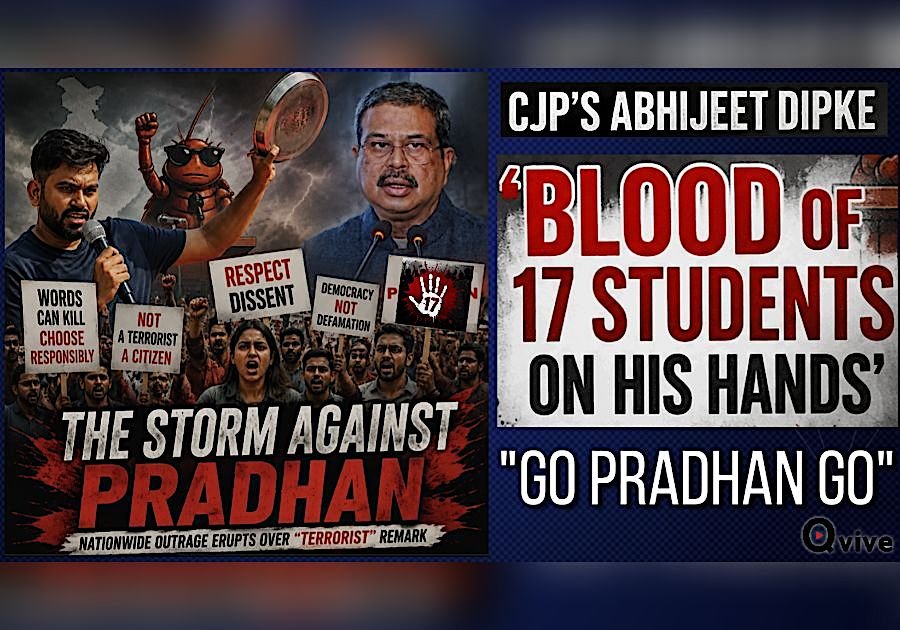
The whole controversy seemed to flare up more after Education Minister Dharmendra Pradhan’s remarks, where he called protesters a “B-team of terrorists.” That line was taken pretty hard by a lot of students, parents, activists and even supporters of the movement, who argued that peaceful demonstrators should not be labeled in such terms.
On social media, and also at protest grounds, many critics said these comments only added fuel to public frustration , instead of actually dealing with the questions people raised on exam integrity and who should be held responsible. At Jantar Mantar, protesters answered back with chants like “Go Pradhan Go,” and the organizers went further, accusing the government of brushing aside the opinions of youth who are looking for explanations about the education system.
Go Pradhan Go!
— Abhijeet Dipke (@abhijeet_dipke) June 23, 2026
Day 4 at Jantar Mantar! pic.twitter.com/v74Rxa2Ykw
For many participants the problem is no more just about exam controversies. They say the remarks show a wider sort of gap between those running policy and ordinary citizens, the ones insisting on accountability and transparency. The backlash basically turned this into a broader argument about democratic dissent, public confidence , and how students and families are treated when they speak up about what’s coming next for education in India.
The Demand: Immediate resignation of the Education Minister
The confrontation stems from recent comments made by Minister Dharmendra Pradhan, who labeled protesters as a “B-team of terrorists.” In response, Abhijeet Dipke stated, “Dharmendra Pradhan calls us terrorists. But the irony is that he is the one with the blood of more than 17 students on his hands.”
Dharmendra Pradhan calls us terrorist.
— Abhijeet Dipke (@abhijeet_dipke) June 23, 2026
But the irony is that he is the one with the blood of more than 17 students on his hands. pic.twitter.com/TpwmSwJfS9
Protest Highlights
Demonstrators have utilized creative and emotional methods to voice their dissent:
- Candlelight Vigils: Protesters have established a memorial shrine at Jantar Mantar for students who lost their lives.
- Thali Protests: The movement has seen participants banging thalis (plates) and chammach (spoons) to chant “Go Pradhan Go.”
- National Reach: While centered in Delhi, solidarity protests were held in other places too, including Pune, Bengaluru, Hyderabad, Amritsar, and Jaipur.
Time for Dharmendra Pradhan to step down as well. https://t.co/HqEYGmdJ8t
— Abhijeet Dipke (@abhijeet_dipke) June 23, 2026
What began as an online youth movement has evolved into one of the most discussed public demonstrations in India in 2026. At Delhi’s Jantar Mantar, protesters have gathered for several consecutive days demanding the resignation of Education Minister Dharmendra Pradhan over concerns surrounding examination management, alleged paper leaks, and broader questions about accountability within the education system.
The demonstrations are being led by the Cockroach Janta Party, a youth-driven movement founded by Abhijeet Dipke. What started as a social-media phenomenon has rapidly transformed into a visible street movement attracting attention from students, graduates, parents, activists, and supporters from multiple states.
Who participated in the activity?
According to media reports and eyewitness accounts, participants include:
- Students concerned about examination integrity and educational opportunities.
- Parents supporting demands for accountability.
- Families of at least some students who died by suicide amid examination-related stress have also engaged with the movement.
- Young graduates and job aspirants frustrated by educational and employment challenges.
- Social activists and civil-society supporters.
- Supporters from multiple Indian states.
- Farmer groups that have expressed solidarity with the movement.
Many participants describe the protest as being about transparency, responsibility, and confidence in public institutions rather than any single examination alone.
Also Read: