

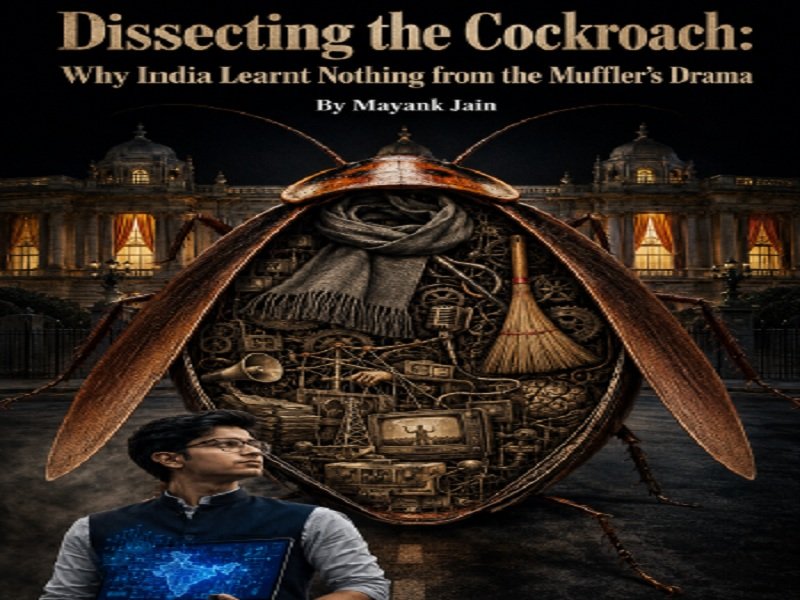
By Mayank Jain
In the first week of August 2026 Delhi’s streets filled with young people angry about examination leaks, disappearing jobs and a future that seemed to be slipping away. Their grievance was genuine. No student should spend years preparing for an examination only to discover that the paper may have been leaked or the selection process manipulated.
The mood soon changed. Barricades were broken, roads were blocked and people trying to reach offices, hospitals or examinations were stranded. Foreign nationals appeared among the protesters and questions arose about who was helping to organise the movement.
Arnab Goswami pointed to American citizens at Jantar Mantar and an alert issued by the US Embassy three days before the march. Republic Television expanded the theory to Pakistan, China, Bangladesh, Greta Thunberg, Jeremy Corbyn and John Cusack. Alt News described it as an elaborate but unproven “global toolkit” theory.
Arnab suggested that the proposed FCRA amendments supplied the motive. Tighter control over foreign contributions could restrict overseas funding to NGOs and missionary organisations accused of supporting religious conversions. According to him American intelligence and evangelical interests wanted those channels protected and used the agitation to pressure India. Republic also referred to US Secretary of State Marco Rubio’s reported meeting with the Missionaries of Charity in Kolkata. (Republic TV, broadcasts on the CJP agitation and FCRA amendments, July-August 2026)
Do Not Call This Generation Cockroaches
The agitation was marketed as a Gen Z revolution. But a few protesters using filthy language or breaking barricades cannot represent an entire generation. Walk into a technology office in Bengaluru, Hyderabad, Pune, Gurugram or Noida. Young Indians are writing software used in New York, London, Singapore and Tokyo. Many come from small towns and ordinary homes. Their parents may not understand what they are building but the world recognises their talent.
India added more than 52 lakh developers to GitHub in 2025. They accounted for over 14 per cent of all new developers joining the platform that year. GitHub expects India to become the world’s largest developer community by 2030 with more than 57 million developers. (GitHub, Octoverse 2025)
Aadit Palicha and Kaivalya Vohra were around eighteen when they began building Zepto. At an age when most young people are only beginning college they created a company that would eventually be valued at billions of dollars. D Gukesh became the youngest undisputed world chess champion at eighteen while R Praggnanandhaa became a grandmaster at twelve and later reached the Chess World Cup final.
This generation is building start-ups, developing artificial intelligence, contributing to global open-source projects and carrying India’s information-technology revolution forward. It is more likely to carry a laptop than a stone. A cockroach is the last thing it resembles.
The Muffler and the Broom
Arvind Kejriwal did not enter Delhi’s imagination as a conventional politician. He wore an inexpensive sweater, wrapped a muffler around his neck and travelled in a small car. He spoke about electricity bills, corruption and politicians living in large government houses. The muffler suggested that he shared the winter of the domestic worker waiting at a bus stop. The broom promised that political corruption would finally be swept into the open.
Years later the same man occupied a residence whose renovation cost several times its original estimate. Auditors recorded expensive curtains, marble, carpets, a television console, gym equipment and a minibar.
George Orwell described a similar transformation in Animal Farm. The animals remove the farmer but their leaders gradually enter his house and adopt his privileges. No single moment announces the betrayal. Each compromise is explained as necessary until the new rulers resemble the old ones.
In Delhi the broom remained on the party symbol and the muffler remained in public memory. The simplicity they once represented had disappeared.
Workers of All Lands, Drink! You Have Nothing to Lose but Your Liver
Delhi was still recovering from Covid. Families were mourning those they had lost while survivors struggled with poor health, unemployment and medical debts. Yet liquor shops began offering “buy one get one free” and discounts of 40-50 per cent. The schemes were stopped after overcrowding created law-and-order and public-health concerns. Smaller discounts were later permitted again.
One bottle was purchased and another was free. The liver would pay later.
The ED and CBI alleged that a “South Group” influenced the excise policy and paid kickbacks of ₹90-100 crore. The CAG estimated a revenue loss of ₹2,026 crore. Manish Sisodia and Arvind Kejriwal were arrested but a court later discharged them in the CBI case after finding serious weaknesses in the evidence.
The judicial finding must be respected. But the political question remains: why did a government elected on promises of schools, clinics and clean politics devote so much energy to redesigning the liquor trade?
The Bus That Never Arrived
At a Delhi bus stop a domestic worker waits after a long day. An elderly man repeatedly looks down the road. A woman becomes anxious as daylight fades. Free travel helps only when the bus arrives.
DTC’s accumulated losses reached ₹60,741 crore while its net worth fell to minus 58,757 crore. Between 2015-16 and 2022-23 the DTC fleet declined from 4,344 buses to 3,937. Only 300 electric buses were procured during this period despite an ageing fleet. The CAG also found that DTC lacked a proper long-term business plan. (CAG, Performance Audit on the Functioning of Delhi Transport Corporation, Report No. 4 of 2024)
Delhi advertised a transport revolution. The advertisement arrived on time. The bus often did not.
The Dry Tap and the Private Tanker: A Soviet Echo
During a Delhi summer a woman turns her tap. First comes air and then perhaps a few muddy drops. Soon a tanker enters the lane and residents rush towards it with buckets. Delhi needs approximately 1,200-1,260 MGD during peak summer but its capacity is around 1,000 MGD. Nearly 40-53 per cent of treated water is reportedly lost through leaking pipes, theft and illegal connections.
The Delhi Jal Board’s debt exceeded ₹73,000 crore. Its annual losses rose from ₹344 crore in 2019-20 to more than 1,196 crore in 2021-22. The CAG found failures in planning, distribution, sewage management, project execution and financial administration. (CAG, Performance Audit on the Functioning of Delhi Jal Board, Report No. 3 of 2025)
Where the public pipeline fails the private tanker prospers. The water disappears but the debt remains.
Where Ghost Patients Found Doctors Before the Living Did
The mohalla clinic was a humane idea. A labourer with a fever would not lose a day’s wage at a distant hospital. An elderly woman could obtain medicine near her home. But clinics faced shortages of doctors, medicines and equipment. Then came reports of ghost patients.
An Anti-Corruption Branch inquiry reportedly identified around 65,000 diagnostic tests as potentially fake or manipulated. The Union Home Ministry ordered a CBI inquiry and final findings are awaited. The irony was striking. A living patient could not always find a doctor while a patient who may never have existed could appear in official records. A signboard became healthcare. A renovated classroom became education. An advertisement became governance.
The Muffler’s Proletarian Palace: A Farmhouse for the Ruler and a Gulag for Maliwal?
The Chief Minister’s residence cost ₹33.66 crore against an initial estimate of ₹7.91 crore. The CAG listed ₹96-lakh curtains, ₹66.89-lakh marble and other luxuries. The apostle of austerity had entered Orwell’s farmhouse.
Behind those expensive curtains AAP MP Swati Maliwal alleged that a close aide of Arvind Kejriwal assaulted her. The courts will determine criminal responsibility but the irony is stark: a palace for the ruler allegedly became a gulag for his party’s woman MP.
The Body in the Drain
In February 2020 north-east Delhi burned. Fifty-three people were killed and homes, shops and places of worship were attacked. Intelligence Bureau officer Ankit Sharma disappeared on 25 February. His body was recovered from a drain the following day. In July 2026 a court convicted former AAP councillor Tahir Hussain and four others of his murder. They were sentenced to life imprisonment. This was not a television allegation. It was a judgment after trial. Political attention eventually moved elsewhere but Ankit Sharma’s family could not move on.
Delhi’s Free Bottle and Punjab’s Delayed Rescue
Marx called religion the opiate of the masses but rulers have often found alcohol equally useful. Under apartheid South Africa’s dop system farm workers were partly paid in liquor. Delhi offered similar encouragement through discounts and “buy one get one free” schemes.
In Punjab alcohol led many youngsters towards pills and heroin. AIIMS estimated over 2.3 lakh opioid-dependent people in 2015-16 while Punjab accounted for 58 per cent of India’s heroin seizures in 2025. Yet AAP’s major anti-drug campaign began only three years after it came to power and rehabilitation centres soon became overcrowded.
The message appeared hollow when Bhagwant Mann-despite promising to quit alcohol-continued to face controversies over drinking. Delhi offered the free bottle. Punjab’s families were left fighting the bottle, the pill and the needle.
Kejriwal’s Support and the Red Fort Violence
Kejriwal’s government openly supported the farmers’ agitation. It provided facilities at protest sites, joined the Bharat Bandh and refused to let Delhi’s stadiums be used as temporary jails. This went beyond humanitarian assistance. By politically embracing the agitation and celebrating its defiance AAP created a climate of moral and ideological legitimacy from which its most extreme elements also benefited.
Most farmers protested peacefully. On Republic Day however some groups broke the agreed routes, entered the Red Fort and reportedly left 394 police personnel injured. By then AAP’s political and logistical support had helped sustain an agitation that violent groups later hijacked.
The Colour of Revolutions
Georgia had its roses, Ukraine its orange scarves, Kyrgyzstan its tulips and Moldova its “Twitter Revolution”. Governments fell but corruption, oligarchs and weak institutions often survived under new arrangements.
Ukraine also showed how foreign political families could enter an oligarchic economy. Hunter Biden joined the board of Burisma despite having little experience in Ukraine or the energy sector. His remuneration created an appearance of influence while his father was US Vice-President.
A Republican-led Senate inquiry found that Hunter Biden benefited from his family name. It did not establish that Joe Biden changed American policy to protect Burisma. Later bribery allegations collapsed after the FBI informant behind them admitted fabricating the story.
The lesson is not that every protest is foreign-engineered. It is that weak political systems attract domestic opportunists, foreign interests and wealthy networks. Removing a ruler can take days. Building institutions that remain honest under every ruler can take a generation.
The Pigs at the Window
At the end of Animal Farm the animals look through a window. The pigs are eating and drinking with the humans they once promised to overthrow. Those standing outside can no longer tell one from the other.
That is what happens when public memory fails. The muffler begins as a symbol of shared hardship and ends inside a palace. The broom begins as a promise to clean the system and ends as a symbol protecting another establishment.
Meanwhile extremists, cartels, foreign interests and political opportunists wait inside the cracks. They do not create every weakness but they recognise it and make it wider.
India cannot defend itself merely by naming external enemies. It must repair its institutions. That means buses that arrive, water that flows, clinics with doctors and medicines, schools that teach, treatment for addiction and justice that does not stop at the palace gate.
The cockroaches marched with the mufflers because the earlier story had been allowed to fade. This time it must be told clearly and without forgetting the ordinary people who continue to pay the price.