

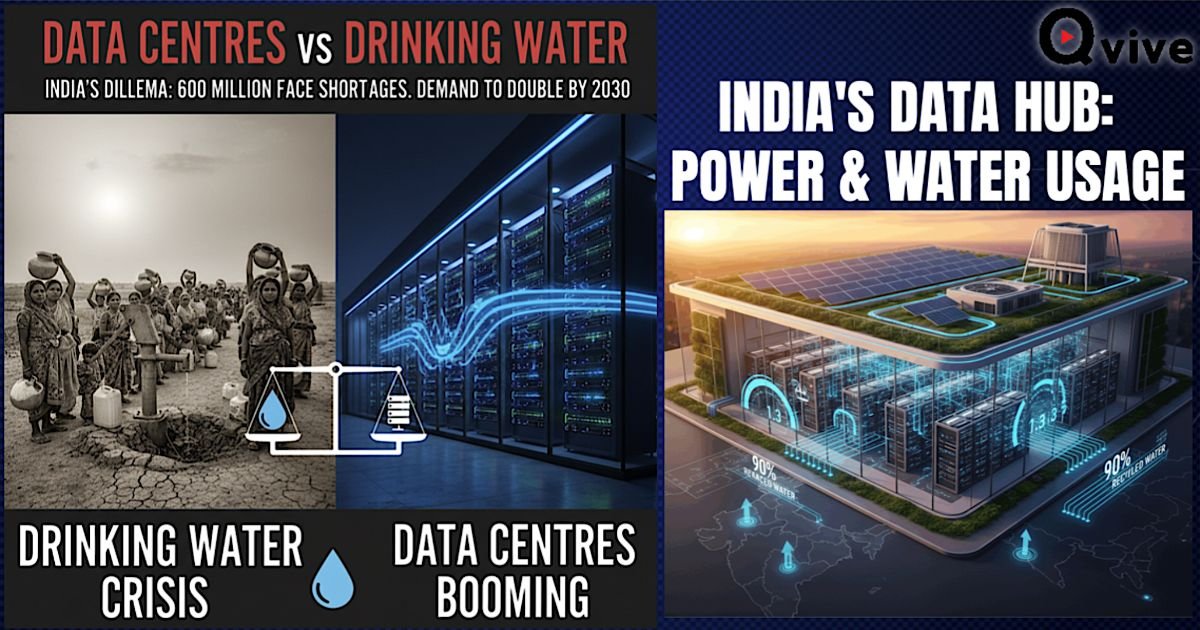
India faces an unprecedented water crisis, with roughly 600 million people experiencing acute shortages.
An industry representative says 95% of India’s submarine cable landing capacity is concentrated in Mumbai and Chennai.
India’s data center capacity is projected to rise from 1 gigawatt to 8 gigawats by 2030.
The report says annual global water footprint from AI data centers could cross 1,000 billion liters by 2028.
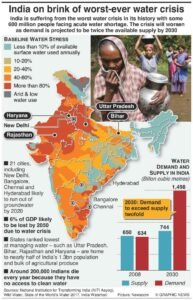
It also mentions that over 40% of Indian cities could run out of drinking water by 2030.

Navi Mumbai Resident Describes Severe Water Supply Cuts
For Shahana, moving to Navi Mumbai nearly two decades ago was supposed to mean a better quality of life. She wanted to get away from Mumbai’s traffic, noise and, importantly, its recurring water shortages.
Today, however, she says her residential complex is facing a new kind of water crisis.
Water cuts have become increasingly erratic. At times, residents go without water for more than 48 hours. On other days, the supply may last barely an hour in the evening, leaving families dependent on private tankers to meet basic needs.
Unable to get satisfactory answers about the repeated disruptions, Shahana began investigating the issue herself. What she found raised a much bigger question: could Navi Mumbai’s rapid expansion as a data-centre and AI hub be adding pressure to an already stressed water system?
The hidden water demand behind AI
Navi Mumbai has become an important location for India’s rapidly expanding data-centre industry. Large facilities house thousands of servers that operate continuously, processing everything from cloud applications to increasingly demanding artificial-intelligence workloads.
These machines generate enormous amounts of heat and have to be cooled around the clock. Depending on the cooling technology and local conditions, data centres can therefore have a significant water footprint.
Navi Mumbai’s growing water challenge
The concern becomes more significant when this expansion takes place in a city where demand for water is already rising.
Navi Mumbai’s own planning documents identify sewage recycling and reuse as an important way to create additional water resources. The Navi Mumbai Municipal Corporation has proposed tertiary treatment facilities so that treated sewage can be supplied to industrial users for non-drinking purposes, reducing dependence on municipal freshwater. Its development plan envisages recycling and reusing around 55 million litres per day through various projects.
That approach could become increasingly important as industries requiring large quantities of cooling water expand.
The issue is not simply whether a particular data centre uses water. The larger question is which quality of water it uses, where that water comes from, how much is consumed, and whether residents have adequate access to the same resource.
Why India is attracting data centres
India is emerging as a major destination for data-centre investment because of its enormous digital market, connectivity and growing demand for cloud computing and AI.
Mumbai is particularly important because it is a major international connectivity hub, while cities across the Mumbai–Pune–Hyderabad corridor offer strategic locations for digital infrastructure.
Navi Mumbai has consequently seen significant data-centre development. The facilities are part of a much larger national expansion that is expected to accelerate as businesses integrate AI into search, software, customer service, entertainment and other applications.
But the digital boom brings a physical reality with it: every server hall needs power, cooling and infrastructure.
Based on a report by NITI Aayog, the map highlights critical vulnerabilities across various regions.
The treated-water solution
There is a potential way to reduce the conflict between data-centre expansion and drinking-water security: stop using high-quality freshwater for applications that do not require it.
Treated wastewater, or reclaimed water, can potentially be used for industrial cooling where the necessary treatment and quality controls are in place.
Navi Mumbai’s planning documents explicitly identify treated sewage as an alternative source for industrial and other non-potable uses.
The report also highlights Control S as an example of a data-centre operator working toward the use of treated water for cooling. Such initiatives could provide a model for future facilities—but they need to become the norm rather than the exception.
The transparency problem
One of the biggest challenges is that the public often has little visibility into exactly how much water individual data centres consume.
Water consumption is not as visible as a factory chimney or a traffic jam. A data centre can sit behind secure walls while thousands of servers quietly operate day and night.
Yet without reliable disclosure, municipal authorities and residents cannot easily determine how much water is being allocated to the sector, how much is actually consumed, and how much could be saved through recycling.
Researchers have repeatedly called for greater transparency around AI’s water footprint because water consumption varies dramatically depending on the location, climate, cooling technology and electricity source.
A difficult question for Navi Mumbai
The debate should not be reduced to AI versus ordinary citizens.
Data centres bring investment, employment, digital infrastructure and economic opportunities. India also wants to establish itself as a global AI and technology powerhouse.
But development cannot ignore the resource constraints of the cities in which it takes place.
If residents are experiencing unpredictable water supply while new water-intensive infrastructure is being planned nearby, authorities need to provide clear answers.
How much water is available?
How much is being consumed by residential areas?
How much is being allocated to industry?
How much do individual data centres consume?
How much treated wastewater can be supplied instead of freshwater?
And, crucially, what happens during a severe shortage?
The bigger warning
India’s AI ambitions are colliding with a very old problem: water is finite.
The water footprint of AI is not uniform, and sensational claims about individual prompts can be misleading. But the broader concern is real. AI infrastructure is growing rapidly, and its environmental costs—including water and electricity demand—can become significant when millions of users and large computing facilities are considered together.
For Shahana, this is not an abstract environmental debate.
It is about turning on a tap and wondering whether water will come out.
As Navi Mumbai continues to attract data centres and AI infrastructure, the challenge for policymakers will be to ensure that the city’s digital future does not come at the expense of its most basic resource.
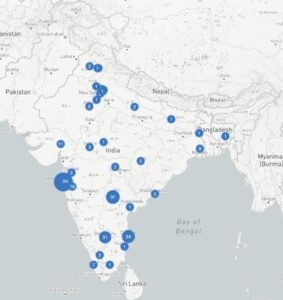
India’s data center industry is booming, with over 301 operational facilities managed by various operators.
Digital Census, Physical Footprint: What Is the Water & Power Cost of ORGI’s Data Centres?
Why isn’t the government disclosing the water and electricity consumption of the ORGI Data Centres? The public deserves to know!
How much tax revenue is India willing to sacrifice to become a global data-centre hub—and who bears the electricity, water and environmental costs of that expansion?
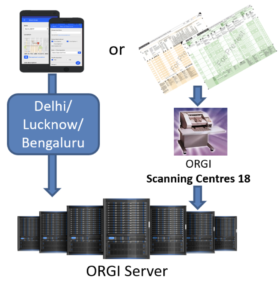
The Office of the Registrar General and Census Commissioner of India (ORGI) operates a primary National Data Centre (NDC) in Delhi, supported by two Disaster Recovery Sites (DRS) in Bengaluru and Lucknow.
These facilities are designated as Critical Information Infrastructure (CII) to safely host digital census applications, civil registration systems, and population statistics.
Core Locations
Main Facility (NDC):
Located at Shastri Park, Delhi (Block-3, DMRC IT Park), managing overall network operations and application hosting.
Disaster Recovery Site:
Located in Bengaluru, providing system redundancy and data backup.
Disaster Recovery Site:
Located in Lucknow, handling secondary load balancing and failover safety.
Resource and Environmental Pressures
Intense Power Demands:
Large-scale public data facilities draw continuous, high-density loads from the regional electrical grid, requiring heavy dependence on backup diesel generators during power fluctuations.
Electricity Consumption:
The exact megawatt (MW) usage or annual gigawatt-hours (GWh) are kept secret. Why? The public deserves to know! However, standard medium-to-large government enterprise data centers typically consume between 1 MW to 5 MW of continuous power capacity (translating to roughly 8,760 to 43,800 MWh annually), heavily dependent on a standard Power Usage Effectiveness (PUE) ratio targeting between 1.4 and 1.6.
Cooling and Water Footprint:
Maintaining optimal server temperatures requires intensive HVAC and cooling systems, placing ongoing stress on local municipal resources.
Water Consumption:
A standard enterprise-scale data facility utilizing evaporative cooling towers consumes roughly 25 million liters (25,000 kiloliters) of water per 1 MW of IT load annually, though modern installations increasingly transition to closed-loop or zero-water adiabatic systems.
Infrastructure Upgrades:
Rapidly evolving hardware and cybersecurity standards mean continuous, expensive capital investments are needed to prevent technological obsolescence.
Environmental cost:
More servers and cooling infrastructure can mean greater electricity consumption, emissions and electronic waste unless strict efficiency requirements are imposed.
A key policy question is whether the benefits—jobs, investment, infrastructure and tax revenues from associated activity—will outweigh the long-term cost of the tax concession.
The primary drawback of housing critical government infrastructure like the ORGI Data Centre network is high concentration risk, meaning that any major technical failure, cyber incident, or coordinated disruption at the main facility in Delhi can create nationwide bottlenecks for civil registration and census data processing.
Operational and Security Risks
Concentration Vulnerability:
Heavy reliance on the primary National Data Centre (NDC) in Delhi creates a single-point-of-failure psychological and operational target, even with disaster recovery sites.
High-Profile Target Status:
Designated as Critical Information Infrastructure (CII), making it an attractive target for advanced persistent threat (APT) cyberattacks and state-sponsored espionage.
Complex Failover Logistics:
Synchronizing massive demographic volumes across distant nodes (Delhi, Bengaluru, and Lucknow) risks data replication latency or transient discrepancies during peak census enumeration periods.

PUSH FOR DATA CENTRES IN INDIA
2026: Union Budget announced a 21-year tax holiday for foreign firms providing global cloud services using India-based data centres.
2024: India launched the IndiaAl Mission with an oulay of $1.2bn to procure GPUs.
2023: Digital Personal Data Protection Act established a framework governing data processing and localisation of data.
2022: Data centres were classified as infrastructure under the Harmonized Master List, improving access to institutional financing.
2020: India released a draft national data centre policy proposing incentives and dedicated economic zones to promote computing infrastructure.
2018: Reserve Bank of India mandated that financial data be stored within the country, driving early demand for domestic data centre infrastructure.
21 Years Tax-Free: Who Benefits From India’s Data-Centre Boom?
Adani Group — through AdaniConneX, it is investing heavily in hyperscale data-centre infrastructure and AI-ready capacity.
The Adani Group committed a $100 billion direct investment through AdaniConneX to build green-energy-powered, AI-ready data centre capacity across India by 2035. This initiative scales national operational capacity from 2 GW toward a 5 GW target, highlighted by a major $15 billion partnership with Google through 2030 for a massive hub in Visakhapatnam
Reliance Industries/Jio — Reliance is making major investments in AI and data-centre infrastructure, including a large facility in Jamnagar.
Reliance Industries and Meta announced a major partnership to build India’s first large-scale, AI-enabled data centre in Jamnagar, Gujarat. The 168 MW built-to-suit facility is scheduled for delivery within two years, with Reliance managing operations, renewable power, and network connectivity while Meta leases the capacity.
What was announced:
In the Union Budget 2026–27, Finance Minister NirmalaSitharaman proposed an income-tax holiday until 2047 for eligible foreign companies that provide cloud services to customers outside India using data-centre services located in India.
Duration:
The proposed benefit effectively covers Tax Year 2026–27 through 2046–47, making it a 21-year tax incentive.
Who can qualify:
The foreign company must provide cloud services globally and procure data-centre services from a specified data centre in India. The specified data centre must operate under an approved scheme and be notified by the Ministry of Electronics and Information Technology (MeitY).
Indian customers:
Foreign companies benefiting from the exemption must sell services to customers in India through an Indian reseller entity, with those domestic transactions taxed appropriately.
Related-party data centres:
Where the Indian data-centre provider is a related company, the Budget proposes a 15% safe-harbour margin on costs, intended to provide greater certainty around transfer pricing.
What counts as a data centre:
The Finance Bill defines data-centre services broadly to include physical infrastructure such as land, buildings, electrical systems, cooling, security, servers, storage, networking and related software and personnel.
While qualifying foreign cloud companies receive the major tax incentive, the physical ecosystem also benefits Indian data-centre operators, power providers, construction firms and infrastructure companies. At the same time, the public-policy debate should examine lost tax revenue, electricity demand, water use, land requirements and environmental costs.
WATCH: AOC confronts EPA on water pollution near Meta data centers
Rep. Alexandria Ocasio-Cortez confronts EPA Assistant Administrator for Water Jessica Kramer over the growing environmental and public health concerns tied to AI data center construction across the United States.
During a hearing before the Oversight and Investigations Subcommittee of the House Committee on Energy and Commerce, AOC questioned the EPA about drinking water safety, water shortages, and contamination concerns linked to massive data center developments.
After visiting Morgan County, Georgia, Rep. Ocasio-Cortez described how residents living near Meta’s new data center campus have experienced declining water pressure, damaged appliances, rising water bills, and severe changes in water quality. She presented jars of discolored drinking water during the hearing and called for federal investigations into the impact AI infrastructure projects are having on local communities.
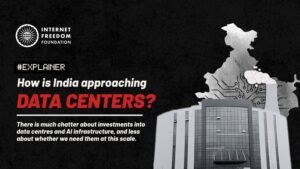
The Internet Freedom Foundation (IFF) has announced that it is filing multiple RTI (Right to Information) applications to obtain information from public authorities about data center investments, approvals, incentives, land allocation, environmental clearances, and related policy decisions in India
India’s $100 Billion Data Center Push:
India’s push for data centers offers economic benefits but raises complex issues about sustainability, regulation, and societal impacts of increased AI use.
Traditional vs. AI Data Centers
Traditional Data Centers:
Support various computing needs, like hosting websites or running business applications.
AI Data Centers:
Specifically designed to handle the unique requirements of AI technologies, enabling faster training of AI models.
The Push for Investment
Why the Hype?
Government entities and businesses in India are enthusiastic about investing in data centers because they believe AI is the future.
Major investments from companies like Reliance Jio and Adani Group signify a commitment to expanding data center capacity, aiming to meet increasing digital demands.
What concerns are associated with the rapid growth of data centers?
Environmental Impact:
Data centers consume a lot of electricity and water, which raises questions about sustainability. For example, in Ireland, data centers used as much electricity as every household combined.
Community Resistance:
Many local communities are voicing their opposition to new data centers, citing environmental damage and resource depletion as major issues.
Surveillance:
There are worries that the AI systems powered by these data centers often involve monitoring people’s activities, raising privacy concerns.
Investment Strategies
State-Level Incentives:
Local governments are creating policies to attract businesses. These often include tax breaks and discounts on land and utilities.
No National Regulations:
Currently, India does not have a unified framework for regulating data centers, leading to a focus on encouraging investment without comprehensive oversight.
What are the potential risks associated with the current investments in data centers?
Energy Dependency:
Many new data centers will rely on fossil fuels, which could undermine the shift toward renewable energy sources.
Water Stress:
As cities in India face water shortages, establishing water-intensive data centers can exacerbate the problem.
What are the main questions that need to be asked regarding investments in AI-driven data centers?
India must ask:
Do we truly want to incentivize AI technologies?
Will investing in AI training facilities actually contribute to the country’s growth?
India’s approach to promoting data centers is driven by a belief in a digital future powered by AI. However, vigilance regarding environmental sustainability, community concerns, and real demand is essential.
At present, IFF has not published the individual RTI applications or responses related to this data center project.
Also Read:
Protecting the Public: Lessons from Florida’s Data Center Regulations