

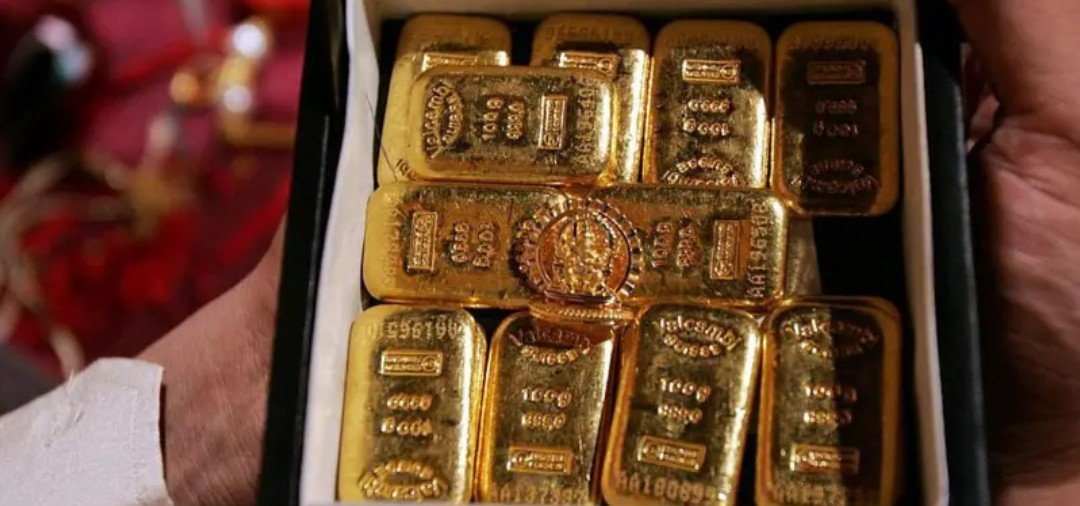
Prime Minister Narendra Modi, during his visit to Telangana in May this year, made several appeals to the nation at an event held in Secunderabad, the most prominent of which was to refrain from purchasing gold for a year.
In India, a country where gold is deeply associated with tradition, savings, and family celebrations, PM Modi’s appeal seemed quite unconvincing. Opposition political parties then began to criticize PM Modi to gain public support. However, PM Modi did not respond to their criticism, instead continuing with his established strategy. And now, this strategy appears to be paying off. Gold prices have fallen in the country, and now, with the reduced aggression from the Ukraine-Russia war and the Iran-US-Israel war, the international price of gold has also declined. Consequently, the gold purchased by the Indian government is directly increasing the national foreign exchange reserves, as gold accounts for 16 to 17% of the gold. At the same time, due to the reduction in gold purchases by the people of India, fewer dollars are being withdrawn from our reserves, resulting in a decrease in gold imports for Indian jewelry. This is also increasing our foreign exchange reserves in a way. Overall, Modi’s appeal to the people of India not to buy gold is now bearing fruit. Now, people can buy gold at the reduced price and wear it as jewelry and sleep peacefully.
In fact, PM Modi’s appeal was driven by a major economic concern: the escalating global energy crisis due to the Iran war. This crisis was also having a significant impact on India. India’s foreign exchange reserves were under increasing pressure, and the rupee’s weakness against the dollar was rapidly increasing. India’s major political parties began frequently criticizing PM Modi over the rupee’s declining strength against the dollar. PM Modi even mentioned this in his Independence Day speech from the ramparts of the Red Fort.
This is all a matter of the supply chain. If the supply chain continues to be in crisis, no matter how many measures we take, the difficulties only increase. Therefore, putting the country first, it was crucial to overcome this supply chain crisis. To achieve this, it became essential to increase the country’s gold and foreign exchange reserves. Gold and the dollar are crucial to maintaining supply chains from various countries during supply chain crises. The entire world currently relies on these two assets. However, many countries, including India, no longer rely on the dollar. In this context, the importance of gold as a foreign exchange reserve increases further.
Gold is a significant component of domestic savings and expenditure in India, making it one of the largest markets in the world. According to Professor Sundaravalli, head of the India Gold Policy Center at the Indian Institute of Management, Ahmedabad, India imports 600 to 700 tons of gold annually and exports are very low, so this gold has accumulated in homes.
According to her, Indian households hold a large amount of gold. Estimates vary, but it is generally believed to be 25,000 to 27,000 tons.
India consumes approximately 700–800 tons of gold annually, but domestic production is only around 1–2 tons. This means that India imports more than 90% of its gold needs.
According to the World Gold Council, India held approximately 880 tonnes of official gold as of February 2026. India ranks ninth in the world in this respect. India is ahead of the United States, Germany, the International Monetary Fund, Italy, France, Russia, China, and Switzerland.
Unlike many other commodities, gold imports do not directly contribute to large-scale industrial production. Nevertheless, they require significant dollar expenditure, increasing India’s current account deficit and putting pressure on foreign exchange reserves.
This concern is further exacerbated by high crude oil prices, as India relies on imports for approximately 80 to 85 percent of its oil needs. It is important to note that the Iran war led to a sharp increase in crude oil prices, with prices per barrel rising from $75 to $110.
Amid rising energy and fertilizer costs due to the Middle East conflict, policymakers are focusing on controlling non-essential imports that drive up import bills. Gold accounts for approximately 9% of India’s total import bill, second only to crude oil.
From an economic perspective, gold and crude oil share a significant similarity for India; both are imported in large quantities and paid for in US dollars.
This means that when crude oil prices rise sharply and gold imports remain high, India needs significantly more dollars to pay for these imports.
This increases demand for the dollar in the currency market and puts pressure on the rupee. This is why the rupee has depreciated by 5% against the dollar so far this year and is near its lowest level.
Economists don’t view gold as a typical consumer good because, while oil is essential for transportation, power, and industrial activities, gold imports are considered discretionary spending or an investment option.
When countries purchase large quantities of gold or jewelry, they have to spend more dollars to import gold. This increases the current account deficit (CAD). The current account deficit represents the difference between imports and exports.
A widening CAD often weakens the rupee, as a country spends more foreign exchange than it earns. This is why governments often become cautious about gold imports during these circumstances.
India has previously taken steps to discourage excessive gold imports during times of economic stress. In the past, governments have increased import duties on gold and promoted options such as sovereign gold bonds and exchange-traded funds (ETFs). All these measures are intended to reduce pressure on foreign exchange reserves and stabilize the rupee.
When the aggression of the war between Ukraine and Russia and the war between Iran and America and Israel has reduced and the prices of gold have come down a bit in the international market, then the Indian government has also become duty bound to take advantage of this opportunity and it is determined to enrich its foreign exchange reserves further by buying gold from the international market so that in future if the horrors of war increase further or the supply chain is affected due to any other reason, then India, by resorting to other options from its strong rich foreign exchange reserves, will not only ensure shortage of daily use items for the people of India but will also not allow any unreasonable price hike so that no kind of chaos is created among the people in those circumstances.