

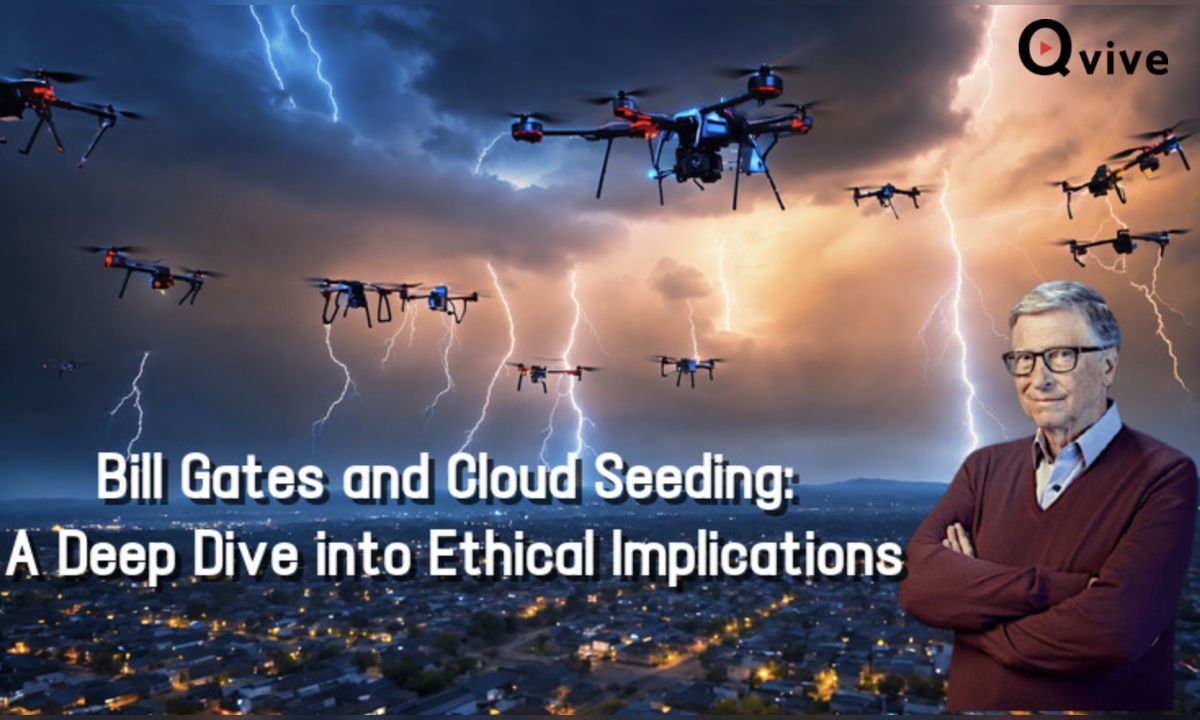
Bill Gates has said artificial intelligence will accelerate innovation and make it easier to combat climate change – but also warned it must be “used by people with good intent”.
Governments around the globe have spent a significant amount of money on cloud seeding for the last twenty years. Cloud seeding – the controversial weather modification practice aimed at precipitation enhancement – is debated scientifically for its effectiveness. The lack of clear results is exacerbated by the fact that there are grave questions about the wisdom of human involvement in the weather—questions that are escalating as the debate continues in order to integrate AI into the already tense business.
The cloud seed is a substance that scatters silver iodide, otherwise dry ice, into the uppermost parts of the cloud, with the theoretical aim of supporting precipitation. Localized meteorological surveys showing increased rainfall are frequently mentioned by advocates, yet reviewers and various independent systematic bodies argue that such increases are often within the limits of inherent variability and incredibly difficult to quantify solely for the purpose of seeding efforts.

Environmental Ripple Effects
Beyond the systematic ambiguity, there is a growing problem of exceeding the environmental footprint of cloud seeding. While silver iodide is generally considered to be harmless in small doses, its continuous dispersion over large areas for over a decade has prompted concern about accretion on earth and water structures. Ecologists are at the pinnacle of their ability to have long-term impacts on local ecosystems, water quality, and biodiversity, impacts that are largely unobserved and unknown.
The very act of manipulating the weather, even in combination with a narrow achievement, may be seen by a couple as an arrogant overreach, threatening to disrupt a delicate atmosphere that kindness barely grasps.
Why AI When Basic Success Eludes Us?
The high failure rate of Artificial Intelligence (AI) projects in businesses is a widely acknowledged challenge, with various reports indicating that a significant majority do not achieve their intended goals. While exact percentages vary across studies and over time, the consensus points to a substantial number of AI initiatives failing to deliver measurable returns or reach production.

Estimates for AI project failure rates generally hover around 80%, though some studies suggest even higher figures, particularly for generative AI pilots. A recent report by the Rand Corporation indicates that approximately 80% of AI projects in businesses fail, a rate twice that of non-AI information technology projects. This figure represents an improvement from past estimates, which suggested that 87% of AI projects never progressed beyond the proof-of-concept stage. However, a more recent MIT NANDA study, “The GenAI Divide: State of AI in Business 2025,” found an even more striking failure rate for generative AI (GenAI) enterprise pilots, reporting that 95% deliver zero measurable return. This study, which analyzed over 300 initiatives, 52 organizational interviews, and 153 senior leader surveys, highlighted a funnel of failure: 80% of organizations explore AI tools, 60% evaluate enterprise solutions, 20% launch pilots, but only 5% reach production with measurable impact. Gartner also reports that, on average, only 48% of AI projects make it into production, and predicts that 30% of GenAI projects will be abandoned after proof of concept by the end of 2025 due to issues like poor data quality, inadequate risk controls, escalating costs, or unclear business value.
The first cloud seeding project using drones and AI to generate artificial rain in Jaipur did not go as planned as a critical GPS malfunctioned, forcing authorities to halt the experiment which aimed at reviving the historic but dried up Ramgarh Dam in.
Several interconnected factors contribute to these high failure rates, often categorized as execution failures rather than technological shortcomings.
Root Causes of AI Project Failure
1. Data-Related Challenges: A predominant reason for AI project failure is the inadequacy of data. AI systems are heavily reliant on high-quality, relevant, and accessible data for training and effective operation.
- Lack of AI-Ready Data: Many organizations possess vast amounts of data, but it is often not in a format or quality suitable for AI. This “AI-ready” data requires specific characteristics, including being dynamic, contextual, fit for purpose, representative, and compliant with evolving governance and privacy standards.
- Data Quality and Cleanliness: Inconsistent formats, missing values, errors, and incomplete data derail model training and lead to unreliable predictions. Organizations often struggle with data that is incomplete, inconsistent, or riddled with errors, leading to flawed AI models.
- Data Availability and Accessibility: Data silos, privacy concerns, and regulatory restrictions can limit access to the necessary volume and variety of data required to train effective AI models.
- Data Governance: The absence of robust data governance frameworks leads to issues such as data breaches, non-compliance, and ethical concerns, all of which can derail AI projects.
- Bias in Training Data: Historical data often reflects existing biases and inequities, which AI systems can then perpetuate and amplify at scale, leading to unfair or unreliable outcomes.
2. Misunderstanding and Miscommunication of Project Goals: A significant cause of failure is a lack of clarity regarding the problem AI is intended to solve.
- Unrealistic Expectations: Companies often expect immediate, transformative results without acknowledging the time, resources, and iterative development required for successful AI deployment. This can lead to premature project cancellations when AI systems don’t deliver instant ROI.
- Focus on Technology Over Problem: Many projects prioritize using the “latest and greatest” AI technology rather than focusing on solving real business problems for their intended users.
- Misaligned Stakeholders: Misunderstandings and miscommunications about the intent and purpose of the project between technical staff and industry stakeholders are common reasons for failure.
3. Lack of Organizational Readiness and Infrastructure: Organizations often jump into AI without adequately preparing their foundational structures and capabilities.
- Inadequate Infrastructure: Many organizations lack the necessary infrastructure to manage their data effectively and deploy completed AI models, increasing the likelihood of project failure. Legacy data warehouses, for instance, are often unsuited for the real-time, diverse data flows that modern AI requires.
- Skill Gaps: Companies frequently lack the specialized expertise needed to design, implement, and maintain AI systems effectively, both in technical capabilities and in business understanding of AI’s limitations and appropriate use cases.
- Governance and Oversight Gaps: Without proper governance structures, AI projects can operate in organizational silos, lacking the oversight needed for sustainable success, including risk management, compliance monitoring, and performance tracking.
4. Application to Unsuitable Problems: Sometimes, AI is applied to problems that are too difficult for current AI capabilities to solve effectively, or to problems where AI does not offer a significant advantage over existing solutions. The MIT study found that companies often misidentify which business challenges are suitable for AI solutions, applying AI to problems that don’t require it or offer minimal business impact.
Scientists and ethicists are sounding the alarm:
The advocates for AI in weather change say that advanced algorithms could improve seeding. The algorithms could predict outcomes with more accuracy; they could also manage the complex logistics. The critics say that AI, especially for a domain as chaotic as weather, could increase uncertainties. The AI could introduce new risks.
“If we can’t definitively prove cloud seeding works, let alone predict all its ecological ripple effects, to then layer opaque AI algorithms on top of that is a recipe for unforeseen disaster,” warns Dr. Hanson. “AI relies heavily on data. What happens when that data is incomplete, biased, or doesn’t account for complex, non-linear atmospheric interactions? The potential for algorithmic errors leading to unintended, large-scale environmental consequences is immense.”
They are contemplating using a powerful but flawed tool—AI, which we know has significant loopholes in its decision-making, data biases, and lack of transparency—to manage an already imperfect and environmentally risky process. It’s like using a faulty autopilot to fly a plane we know has shaky engineering.
The core concerns with AI-driven cloud seeding include:
- Algorithmic Bias: An AI model trained on incomplete or historically biased weather data could systematically target certain regions over others, exacerbating existing water inequalities.
The Black Box Problem: When an AI decision on seeding leads to dramatic flooding or a drought in a nearby area, then who takes the responsibility? The intricate nature of AI systems can sometimes make it very hard to find the reasoning behind a certain decision.
Unpredictable Outcomes: The atmosphere is known to be a chaotic system. If AI were to be put in charge of making decisions and carrying out operations, which it can do much faster than a human, this could lead to unforeseen and domino-like negative effects that we cannot anticipate.
As the effects of climate change on drought become more severe, the need for technological solutions will consequently escalate. A large number of experts, however, are of the view that the decision to use AI-assisted cloud seeding is not a step forward but a risky move which is basically layering one set of uncertainties on top of another—the failure of one technology upon the collapse of another.
The extreme weather that India is experiencing this time might be because of experimental AI cloud seeding.
Ref:
- The Challenges of Chemical Process Optimization. [ https://www.sciencedirect.com/journal/chemical-engineering-journal ]
- Ethical Challenges of Artificial Intelligence. [ https://plato.stanford.edu/entries/ethics-ai/ ]
- Agency for Toxic Substances and Disease Registry. Persistent Organic Pollutants (POPs). [ https://www.atsdr.cdc.gov/toxfaqs/tfacts103.pdf]
- Turning Failure into the Foundation for AI Success. [https://casmi.northwestern.edu/news/articles/2024/turning-failure-into-the-foundation-for-ai-success.html]
- The Root Causes of Failure for Artificial Intelligence Projects and How They Can Succeed: Avoiding the Anti-Patterns of AI. [ https://www.rand.org/pubs/research_reports/RRA2680-1.html]
- The Divide. [https://loris.ai/blog/mit-study-95-of-ai-projects-fail/]
- The Surprising Reason Most AI Projects Fail – And How to Avoid It at Your Enterprise. [https://www.informatica.com/blogs/the-surprising-reason-most-ai-projects-fail-and-how-to-avoid-it-at-your-enterprise.html]
- The Surprising Reason Most AI Projects Fail – And How to Avoid It at Your Enterprise. [ https://www.informatica.com/blogs/the-surprising-reason-most-ai-projects-fail-and-how-to-avoid-it-at-your-enterprise.html]
- 80% of AI Projects Fail – Why? And What Can We Do About It? [ https://www.ihlservices.com/news/analyst-corner/2024/10/80-of-ai-projects-fail-why-and-what-can-we-do-about-it/ ]
- 70% of AI Projects Fail, But Not for the Reason You Think. [ https://www.turningdataintowisdom.com/70-of-ai-projects-fail-but-not-for-the-reason-you-think/]
- A groundbreaking MIT study recently sent shockwaves through the business world, revealing that 95% of AI pilot projects fail to deliver measurable financial returns. [ https://www.cloudfactory.com/blog/6-hard-truths-behind-mits-ai-finding]
Also Read: