

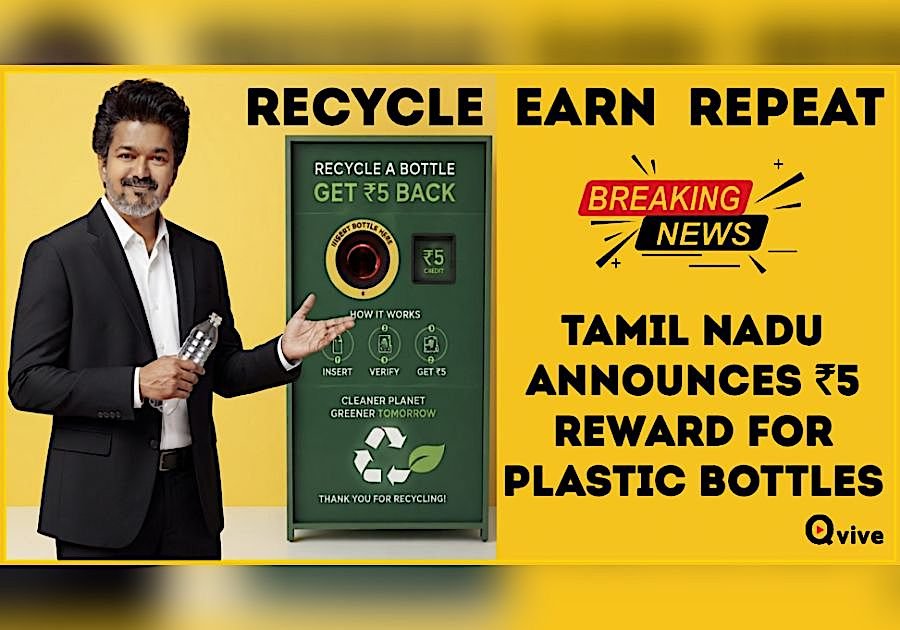
In a major step towards cutting down plastic pollution and improving the efficiency of recycling, the Tamil Nadu government has put out an announcement: ₹5 cashback for every eligible plastic bottle that gets returned through specific recycling, (reverse vending) machines.
With the program, citizens can hand over eligible plastic bottles to automated recycling machines placed in public areas. Once the bottle is checked and verified by the system, the user gets a ₹5 cashback, so more folks are drawn to recycle instead of just tossing plastic waste aside.
This initiative is basically meant to reduce plastic litter around public spaces boost PET bottle recycling rates support a circular economy by making sure used plastic is collected, then processed for recycling and get more public participation through a straightforward financial incentive
Reverse vending machines will spot which bottles qualify, they also compact them and route them for recycling. This helps improve the overall quality of the recyclable plastic, while also lowering the amount of waste that slips into landfills or waterways. Reward based recycling schemes like this have already been tried in multiple cities across India and in other countries, largely to improve recycling outcomes.
Several Indian cities have introduced reward-based recycling schemes using Reverse Vending Machines (RVMs) that offer incentives such as cash, coupons, green points, free services, or digital rewards for returning plastic bottles.
|
City |
Reward Offered |
|
Bengaluru (Karnataka) |
₹1 per plastic bottle through RVMs under the Karnataka State Pollution Control Board initiative. |
|
Hubballi (Karnataka) |
Pilot project that rewarded users ₹1 per bottle before statewide expansion. |
|
Tiruchirappalli (Tamil Nadu) |
Users could choose free drinking water or 10 minutes of mobile charging for each bottle deposited. |
|
Greater Noida (Uttar Pradesh) |
Coupons from brands such as Swiggy, Domino’s, and Zing Bus for recycling PET bottles and cans. |
|
Patna (Bihar) |
“Green Points,” coupons, and incentives redeemable for merchandise or rewards. |
|
Bhopal (Madhya Pradesh) |
Digital reward system through PET bottle reverse vending machines launched with support from UNDP and Hindustan Coca-Cola Beverages. |
|
Surat (Gujarat) |
Reverse vending machine installed at Udhna Railway Station to encourage recycling and public participation. |
|
Mysuru (Karnataka) |
Trial RVM rewarded users with ₹1 per eligible plastic bottle. |
Common rewards used across these cities
- Cash incentives (₹1–₹5 per bottle, depending on the scheme)
- Digital cashback
- Green points
- Shopping coupons
- Food delivery vouchers
- Bus ticket discounts
- Free drinking water
- Free mobile charging
- Redeemable merchandise made from recycled plastic
Why this matters
- Encourages citizens to recycle regularly.
- Helps keep streets, parks, beaches, and tourist spots cleaner.
- Supports sustainable waste management.
- Reduces environmental pollution caused by single-use plastic bottles.
How to receive the ₹5 cashback
- Locate a Reverse Vending Machine (RVM)
- These machines are installed at locations such as metro stations, bus terminals, shopping malls, government offices, and other public places.
- Bring an eligible plastic bottle
- The bottle should generally be an accepted PET plastic beverage bottle.
- The machine scans the bottle to verify that it is eligible.
- Enter your mobile number or scan a QR code (if prompted)
- Some machines require users to enter their mobile number.
- Others may ask users to scan a QR code or use a mobile app before depositing the bottle.
- Insert the bottle into the machine
- The machine verifies the bottle and accepts it.
- It then crushes or stores the bottle for recycling.
- Receive the ₹5 cashback
- After successful verification, the ₹5 is expected to be transferred digitally, such as through UPI or another linked payment method, depending on the machine’s configuration. Some earlier RVMs also issued discount coupons instead of cash.
Important notes
- Only eligible bottles will qualify for the cashback.
- The bottle should be empty and in a condition that allows the barcode or other identifying features to be scanned.
- The exact eligibility criteria (such as bottle size, brand, and maximum number of bottles per person per day) may vary based on the government’s implementation guidelines.
- Earlier reverse vending machines in Tamil Nadu primarily rewarded users with discount coupons. The new initiative replaces or supplements those rewards with a ₹5 cashback for eligible bottles.
At the time of writing, the Tamil Nadu government has not yet released a comprehensive public SOP detailing every operational aspect (such as daily limits, eligible bottle sizes, or the exact UPI payment workflow). Those details are expected to be clarified in the official implementation guidelines.
Glass Liquor Bottles: Under the automated TASMAC bottle-return system, customers receive ₹10 for every empty liquor bottle returned at official AI-enabled collection machines.
A trial AI-enabled reverse vending machine (RVM) was installed at a TASMAC outlet in Chennai to encourage glass bottle recycling.
- The machine was introduced on a pilot basis at a TASMAC shop in Chennai.
- Customers who returned empty liquor bottles through the machine received ₹10 per eligible bottle.
- The machine uses artificial intelligence (AI) and image recognition to identify and verify eligible bottles.
- Once verified, the machine accepts the bottle for recycling.
- The initiative aims to:
- Reduce glass bottle waste.
- Increase bottle collection and recycling.
- Encourage customers to return bottles instead of discarding them.
- Support a circular economy by sending collected bottles for recycling.
How the process works
- Purchase liquor from the participating TASMAC outlet.
- Keep the empty bottle intact.
- Insert the bottle into the AI-enabled reverse vending machine.
- The machine scans and verifies the bottle.
- If the bottle is eligible, the user receives ₹10 (the exact payment method depends on the pilot implementation).
- The collected bottles are stored and later sent for recycling.
Also Read:
People First: Vijay Government Scraps ₹20,000 Crore Smart Meter Project
NEET-UG to Go Digital by 2027: A Security Upgrade or a Strategic Pivot Toward ‘Digital India’?