

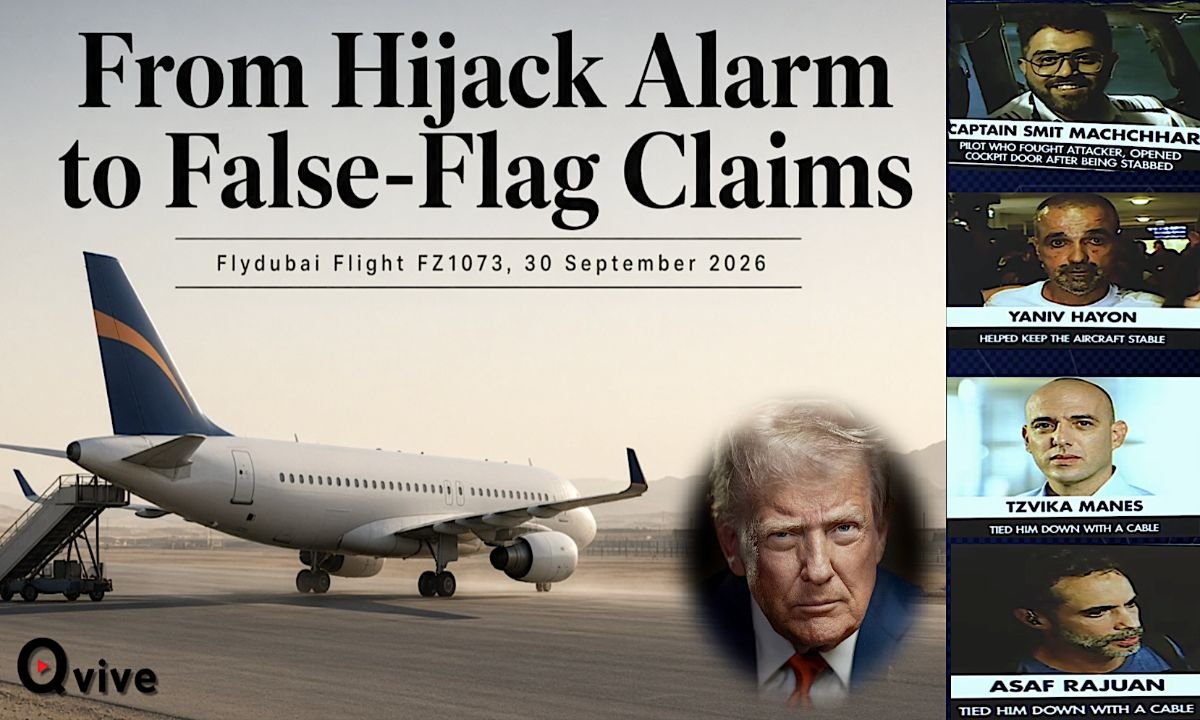
Trump Says Netanyahu Told Him an Israeli Plumber Saved a Flydubai Plane
Trump said Israeli Prime Minister Benjamin Netanyahu told him that an Israeli plumber helped save a Flydubai plane during an emergency.
According to Trump’s account, the plumber entered the cockpit and took control of the aircraft after the pilot was incapacitated.
Trump said the plumber had no flying experience, but had watched the TV series Air Disasters.
Trump repeatedly acknowledged that he could not verify the story, saying, “I don’t know if it’s true.”
He described it as the story he received from Netanyahu (“Bibi”).
Netanyahu Warned of a Pre-Election Attack One Day Before the Flydubai Crisis — Coincidence or Something More?
September 29: Netanyahu publicly said Israel had indications that its “enemies” would try to attack ahead of the October 27 election. He did not identify the alleged threat or provide details publicly.
Later that night: Netanyahu briefed opposition leader Yair Lapid. Lapid subsequently said that nothing resembling the next morning’s aviation incident was mentioned in that briefing.
September 30: Flydubai FZ1073 experienced the cockpit attack and diverted to Tabuk, Saudi Arabia. Netanyahu subsequently described the incident as an attempted attack in which the co-pilot attacked the captain.
Video Ref: Twitter
HERO PILOT: Captain Smit Machchhar’s Old Interview Takes on a Chilling New Meaning
Captain Smit Machchhar was reportedly attacked by his co-pilot during Flydubai Flight FZ1073, a flight carrying 174 people from Dubai to Tel Aviv.
According to reporting, Machchhar was seriously injured during the cockpit attack but managed to open the cockpit door, allowing passengers and others to intervene. The aircraft subsequently made an emergency landing in Tabuk, Saudi Arabia.
Now an older interview with Machchhar is attracting renewed attention.
In the interview, recorded about a year before the incident, Machchhar discussed the importance of cabin crew during an emergency. His message was simple: when something goes wrong, pilots need the people around them to work together.
“When things are going wrong, you need them.”
At the time, it was an ordinary observation about teamwork between pilots and cabin crew.
After what reportedly happened aboard FZ1073, however, the clip feels remarkably relevant.
The incident appears to have demonstrated exactly the kind of teamwork Machchhar had been talking about: a cockpit emergency, an injured captain, passengers and crew responding, and additional pilots eventually becoming involved in bringing the aircraft under control.
But one important distinction matters.
The viral claim that Machchhar simply “fought off the co-pilot and saved 174 people” compresses a complicated sequence of events into one dramatic sentence. Reporting indicates that multiple people played different roles during the emergency, and investigators are still establishing the precise timeline.
That makes the old interview interesting—not because it proves the incident was somehow predicted, but because Machchhar had previously spoken publicly about the importance of relying on cabin crew and others when an aviation emergency occurs.
One year later, those words are being viewed in a very different light.
“When things are going wrong, you need them.”
Those words now carry a very different meaning.
Video Ref: Twitter
Flydubai Co-Pilot and the Omani Pilot Question

- The co-pilot of Flydubai Flight FZ1073 has reportedly been identified as Hammam al-Hammami, an Omani national.
- Oman does not have diplomatic relations with Israel.
- Israel has security restrictions concerning pilots from countries that do not have diplomatic relations with Israel, including Oman.
- This raises a major question: How was an Omani national allowed to serve as co-pilot on a Flydubai flight traveling to Tel Aviv?
- Flydubai is a UAE airline, and the UAE established diplomatic relations with Israel through the Abraham Accords.
- However, the UAE’s relationship with Israel does not automatically change Oman’s relationship with Israel.
- Israeli media have reported that airlines were expected to ensure that pilots from countries without diplomatic relations with Israel were not assigned to Israel-bound flights.
- But reports also say that dozens of Omani pilots may have previously flown into Tel Aviv, suggesting that the restriction may not have been consistently enforced.
- This means the issue could be a security-screening or enforcement loophole, rather than proof that the flight itself was unauthorized.
What actually happened on the Dubai–Tel Aviv flight — and why “false flag” claims appeared
The incident in question was Flydubai Flight FZ1073, which departed Dubai for Tel Aviv on September 30, 2026. It developed into a serious cockpit emergency and was diverted to Tabuk, Saudi Arabia, where it landed safely. The investigation is still ongoing, so some of the most dramatic claims circulating online should be treated as allegations rather than established facts. flydubai
According to flight-tracking data and reporting:
- FZ1073 departed Dubai at about 03:05 UTC.
- During the flight, a violent incident occurred in the cockpit involving the two pilots.
- The aircraft experienced a very rapid loss of altitude—reports based on flight data put the descent at roughly 14,000–17,000 feet in a short period.
- The aircraft first transmitted 7700, the general emergency code, and subsequently 7500, the internationally recognized code for unlawful interference/hijacking.
- The aircraft diverted toward Tabuk, Saudi Arabia, rather than continuing to Tel Aviv.
- Passengers and crew intervened after the cockpit door became accessible.
- The aircraft eventually landed safely in Tabuk, with passengers and crew accounted for.
Why people are suspicious: the genuine gaps
- Incomplete cockpit timeline: The precise sequence inside the flight deck (who moved the controls, when the door opened, exact altitude changes) has not been fully reconstructed in public.
- Unclear motive: Investigators have not publicly confirmed whether this was ideologically driven, a personal crisis, or something else.
- Unusual flight data: The very steep, rapid descent and emergency codes (7700 then 7500) have prompted technical questions from aviation observers about control inputs and automation.
- Conflicting or partial accounts: Early reports varied on whether it was a “fight,” a “stabbing,” a “hijack attempt,” or a “terror attack,” which created room for contradictory narratives.
- Multi‑jurisdiction investigation: UAE, Saudi Arabia, Israel, and Oman are all involved, which slows public disclosures and allows different political interpretations.
- Sensitive regional backdrop: The flight was Dubai → Tel Aviv during heightened Israel–Iran–Gulf tensions, making any aviation incident instantly political.
The knife question: how could a blade reach the cockpit?
This is the single biggest security puzzle and a major driver of doubt:
- Post‑9/11 rules strictly limit blades in carry‑on baggage and especially in the cockpit.
- Officials have not publicly specified:
- The exact type of blade (pocketknife, multi‑tool, catering knife, etc.).
- Whether it belonged to the co‑pilot, the airline, or someone else.
- How it passed Dubai airport security or whether it was already onboard.
- Possibilities investigators must consider include:
- A small folding knife concealed on the co‑pilot’s person or in crew baggage that evaded screening.
- An airline‑issued tool or meal‑service item with a blade that was improperly allowed in the flight deck.
- A procedural or insider‑threat failure at DXB security.
Until a preliminary safety/security report clarifies the weapon and its path, this gap will continue to be exploited by conspiracy narratives.
Cockpit recording systems: cameras, audio, and footage
Commercial jets like the Boeing 737 MAX 8 (the aircraft type for FZ1073) typically have:
- Cockpit Voice Recorder (CVR): Records audio in the flight deck (pilots’ voices, alarms, some ambient sounds) for the last 2+ hours.
- Flight Data Recorder (FDR): Logs hundreds of parameters (altitude, speed, control inputs, autopilot status, etc.).
Alex Jones / Infowars
Highlighted passenger videos of the “aftermath” and argued they show the interiors of two different aircraft, concluding “somebody’s lying.”
THEY CAN’T EVEN STAGE A PROPER FALSE FLAG!” The Official Story In Both The RAF Botched Terror Attack AND The FlyDubai Cockpit Attack Have Completely Unraveled!
Across The Board, From Respected Military And Intelligence Officials To Airline Pilots And Elected Leaders…This Doesn’t Pass The Smell Test.
BOTTOM LINE— WE ARE ENTERING THE SEASON OF FALSE FLAGS!!
https://x.com/RealAlexJones/status/2105787266807509043?s=20
Redacted (Clayton Morris channel)
The September 30 segment with Col. Daniel Davis, “Something Is VERY Wrong With This Israeli Hijacking Story,” questions the timing (hours after a Netanyahu warning about pre-election attacks) and the account that Israeli passengers, including off-duty pilots, stopped the attacker and helped land the plane.
Also Read: