

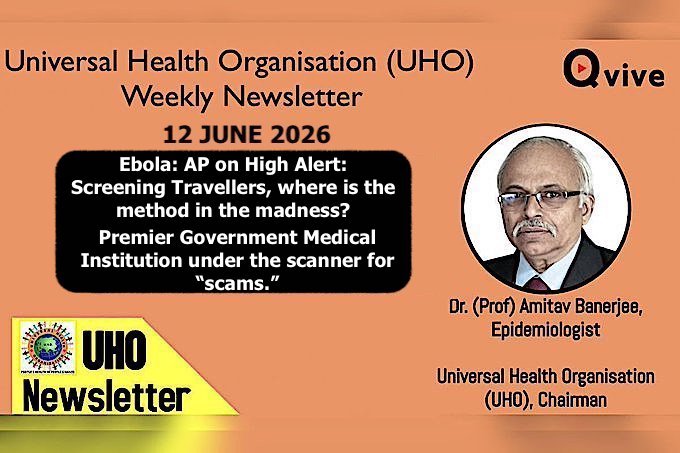
Highlights:
- Ebola: AP on High Alert: Screening Travellers, where is the method in the madness?
- Rise in unattended deaths: indicator of lack of access to healthcare by the majority.
- Premier Government Medical Institution under the scanner for “scams.”
Website: https://uho.org.in
By Dr. Amitav Banerjee, Chairperson of the Universal Health Organisation (UHO)
Ebola: AP on High Alert: Screening Travellers, where is the method in the madness?
While the situation of Ebola in the Democratic Republic of Congo (DRC) remains more or less same, at around 100 – 125 deaths so far since the declaration of Public Health Emergency of International Concern (PHEIC) on 17 May 2026, efforts are on to keep it in the news.
Andhra Pradesh has declared high alert and intensified screening of international travellers according to a report dated 10 June 2026 in ETHealthworld. However, there is no method in this madness. While the centre has advised citizens to avoid non-essential travel to the endemic areas like DRC, Uganda and Sudan, the state has gone one step further and issued directives which are neither based on science or common sense.
Special surveillance is being carried out on passengers arriving from abroad, with screening tests carried out at Gannavarum Airport. However, these is being carried out only on 3 days a week, Tuesdays, Thursdays and Saturdays. Is the selection of these days based on astrology, numerology or pure whim? Another inexplicable measure is screening limited to travellers coming from Singapore and Haj. Neither Singapore or Mecca is endemic for the Ebola virus disease.
We are concerned that science was not followed during the last pandemic and it is again being neglected. Only goal seems to be to keep the level of public panic high. The infection is transmitted by exchange of body fluids from a sick person and not by casual contact or interaction.
Rise in unattended deaths: indicator of lack of access to healthcare by the majority.
India is attracting medical tourists from the developed world for affordable and accessible state of art medical treatment. On the other hand, it is a grim irony that the majority in India do not have access to basic health care, in spite of various schemes by the government. A recent report in the ETHealthworld confirms this.
According to a government survey, deaths without medical attention in 2024 doubled to 45.5% from 2018 figures when it was 18%.This category includes patients who received no medical attention or received care from untrained people.
There is also a rural-urban divide, the unattended deaths being higher in the rural areas at 48.9% compared to urban areas where it was 36.1%.
The increasing tread of poor access to health care reflected in more than doubling of deaths unattended by medical personnel over the past five years is striking in the face of various insurance schemes, public health programs and expansion of hospital infrastructure, medical colleges and medical seats.
UHO calls for an urgent course correction. We need more quality primary and secondary health care instead of concentrating high end tertiary medical services in big cities and metros beyond the reach of the common citizen.
Premier Government Medical Institution under the scanner for “scams.”
As reported by the Hindustan Times, the prestigious King George Medical College (KGMC) (now University), has come under a cloud for various irregularities.
From a cancer drug scam in the urology department to questionable stent implants in cardiology and an active broker nexus in ophthalmology, the hospital is grappling with systemic failures that allegedly allowed transactions worth lakhs to bypass multiple layers of scrutiny.
While disciplinary action has been initiated against certain employees in individual cases, documents and official records reviewed by HT raise a broader question: how did transactions involving lakhs of rupees, medical procedures and procurement decisions pass through multiple layers of scrutiny without triggering red flags?
“We are taking strict action in these cases. Suspensions have been done and further probe will be conducted to ensure such acts are not repeated,” said deputy chief minister Brajesh Pathak. He added: “Action will continue and I have written to university authorities to ensure that every aspect of any fraud is checked and the guilty are identified.”
KGMU vice-chancellor Prof Soniya Nityanand said she is committed to impartiality and will not spare anyone found responsible for wrongdoing.
The most significant concerns have emerged from the alleged multi-crore cancer medicine scam linked to the Asadhya Yojana in the urology department.
According to KGMU officials, the department had been procuring medicines worth around ₹10 lakh every month under the Asadhya Yojana, which provides free treatment to economically weaker patients suffering from serious illnesses. However, expenditure under the scheme witnessed an unusual spike earlier this year, rising three to four times above the normal level.
Officials said medicine purchases touched nearly ₹45 lakh last month alone, raising suspicion within the university administration. Scrutiny of records allegedly revealed repeated procurement of expensive medicines, including cancer drugs, protein supplements and iron supplements, in the names of nearly 40 patients who may be deceased or not on record.
On Wednesday, KGMC ordered a high-level inquiry into allegations that five stents were implanted in a single patient at the Lari Cardiology department. A five-member committee has been tasked with examining whether the procedure was medically justified and consistent with established clinical protocols.
The inquiry has also been expanded to review treatment records of around 15 patients who underwent stent implantation or other cardiac interventions under the Ayushman Bharat scheme, amid concerns that similar irregularities may have occurred in additional cases.
Fresh findings have emerged in the probe into allegations that patients in KGMU’s ophthalmology department are being directed to purchase medicines and cataract lenses from private shops.
Investigators found that a doctor in the department performed 244 cataract surgeries over the past six months, but only one surgery was conducted under the Ayushman Bharat scheme. Records examined by the inquiry team showed that all remaining procedures were carried out on a paid basis.
The controversies have surfaced despite substantial public expenditure on patient care and procurement. According to sources, KGMU has an annual budget allocation of approximately ₹288 crore for medicines and surgical consumables. An additional ₹50 crore has been allocated to the university’s main store for welfare schemes, including Ayushman Bharat, Asadhya Yojana and other government-funded patient assistance programmes.
UHO expresses concerns on the irregularities of such a vast scale in one of the country’s premier Medical College Hospital which is supposed to care for the healthcare needs of the common citizen. The bigger question is whether this is just the tip of the iceberg? If a premier institution is under a cloud of scams, can the situation be any better in other government hospitals and health centres throughout the country.
We suggest that all public hospitals and health centres should maintain a totally transparent account system. It is public money. How much money available, how many patients treated, how much money spent for what, etc. If this can be done on a black board in PHC, the website can be managed in a bigger hospital. Department wise digital boards can be displayed. Use your IT expertise for a better purpose. Whosoever in the public wants to check can check it. Such public display itself can be a deterrent. Public should have open access when their money is being used. RTI is lengthy, knowledge post facto is no solution.
Is it any wonder that the proportion of deaths without access to healthcare has more than doubled in the period 2020 to 2024 as reported earlier in spite of government spending and ambitious schemes?
Also, more research is needed on the rise in coronary heart diseases which leads to the demand for stents. Stent is not a solution in India which is seeing rise in magnitude of coronary heart disease. Where many above 50 tend to develop microvascular disease and just stenting bigger vessels leaving microcirculation as it is is not a solution.
The weekly newsletters bring the updates on the science, battered and bruised during the pandemic, legal updates and impact of activism for a just society, across the world. These are small steps to promote Transparency, Empowerment and Accountability – the ethos of the UHO.
Announcement: Membership & endorsements to the UHO invited: https://uho.org.in/member.php
Also Read: