


The protest movement led by the Cockroach Janata Party (CJP) at Jantar Mantar has evolved into a significant flashpoint in Indian political discourse, particularly regarding the accountability of the Ministry of Education. On the elevent h day of the demonstration, the atmosphere was charged with renewed intensity as founder Abhijeet Dipke addressed the gathering, directly confronting the inflammatory rhetoric employed by government officials.

The escalation of tensions followed remarks by Union Education Minister Dharmendra Pradhan, who characterized the protesters as a “B-team of terrorists,” and subsequent comments by BJP National President Nitin Nabin, who reportedly labeled the activists as “virus and cockroach people,” threatening that his party workers would “teach them a lesson.” These statements have been widely condemned by students and civil society members as an attempt to delegitimize peaceful dissent. In a powerful rebuttal, Abhijeet rejected these characterizations, framing the CJP’s mission as a necessary intervention for systemic reform. “We are not the virus,” Abhijeet declared to the crowd. “We are the vaccine—the antivirus—for the virus named BJP that has infected this country and the virus named Dharmendra Pradhan that has infected this education system.”
The CJP movement, which originated as an online response to perceived administrative apathy, has successfully mobilized thousands, demanding transparency in the wake of the NEET-UG paper leak and irregularities in the CBSE’s On-Screen Marking system. As the movement continues to gain momentum, the demand for the resignation of the Education Minister remains the central pillar of the protest, with organizers warning that the agitation will expand nationwide if their demands for accountability are not met within the stipulated timeframe.
Abhijeet questioned the implications of calls to “teach a lesson” to protesters, expressing concern that such rhetoric could encourage hostility toward demonstrators. He pointed to reports of violence at the protest site, and he alleged that the people behind it were not really brought to task, then he asked whether there had been enough police action. In his view, these comments came out of the movement’s insistence on accountability but also on safeguarding the right to peaceful protest.
At the end, he underlined how youth have historically driven social and political change. Abhijeet said students and young citizens are the nation’s largest stakeholders, because they inherit what comes next, the future. He then referenced worries around examinations like NEET, CBSE, and CUET , saying there should be more openness, more fairness, and proper accountability in the education system. The whole address framed the CJP protest not only as a reaction to examination controversies, but as a wider push for educational reform, democratic participation and respect for what young people are saying.
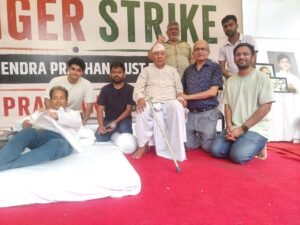
The protest has gained national attention with the participation of activist Sonam Wangchuk, who joined the movement through a hunger strike, further amplifying demands for educational accountability and administrative reforms.

Senior advocate and activist Prashant Bhushan joined the ongoing Cockroach Janta Party (CJP) protest at Jantar Mantar in New Delhi to demand the resignation of Union Education Minister Dharmendra Pradhan over paper leaks and exam irregularities. He attended the demonstration in solidarity with the youth-led movement and activist Sonam Wangchuk, sharing the stage with 101-year-old freedom fighter Pandit Ramkishan to advocate for accountability in the education system.
Also Read:
The Storm Against Dharmendra Pradhan: Nationwide Outrage Erupts Over “Terrorist” Remark