

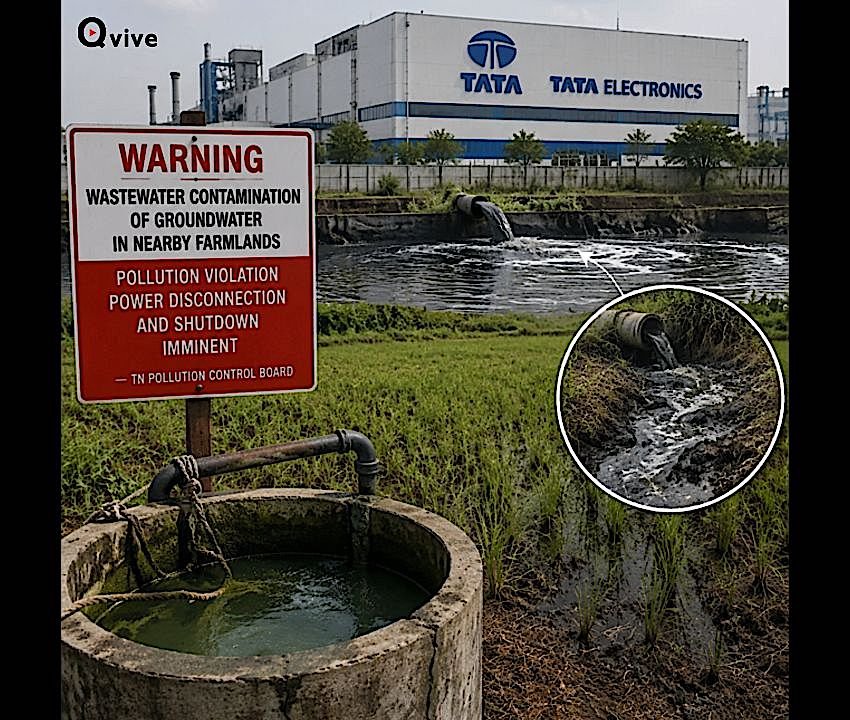
The rapid expansion of India’s manufacturing sector, particularly in the electronics domain, has brought significant economic growth but also heightened scrutiny regarding environmental compliance. Recently, the Tata Electronics facility in Hosur, Tamil Nadu—a critical hub for the production of iPhone components—has become the subject of intense regulatory investigation.The Tamil Nadu Pollution Control Board (TNPCB) has alleged that wastewater discharge from the plant has led to the contamination of groundwater in adjacent agricultural lands, sparking a standoff between the industrial giant and local environmental regulators.
Following months of complaints from local farmers regarding the quality of water in their open wells, the TNPCB conducted five separate inspections between December 2025 and May 2026.The regulatory findings, detailed in a notice dated May 25, 2026, suggest that wastewater was discharged into a rainwater harvesting pond within the facility premises.The board alleges that this pond subsequently overflowed, causing effluent to seep into the groundwater supply used by neighboring farms.The pollution board has warned that it may initiate closure proceedings and disconnect the power supply to the facility unless Tata Electronics provides a satisfactory explanation for these alleged violations and addresses the lack of corrective actions following a previous warning issued in December 2025.
In response to these allegations, Tata Electronics has maintained its commitment to environmental stewardship and regulatory compliance.The company stated that it commissioned an independent analysis through an accredited laboratory, which concluded that the facility is in full compliance with all environmental norms.While the company has submitted a formal response to the pollution authorities, the situation highlights the ongoing challenges of balancing large-scale industrial manufacturing with the protection of local natural resources. As India aims to capture a larger share of the global electronics supply chain, the outcome of this investigation serves as a critical case study on the enforcement of environmental standards in the country’s burgeoning industrial corridors.
Based on the factory’s electronics manufacturing process (producing iPhone back panels and components), the likely toxins of concern would typically include:
| Category | Potential Toxins in Electronics Manufacturing Wastewater |
|---|---|
| Heavy Metals | Copper, nickel, chromium, lead (common in metal plating/component manufacturing) |
| Solvents/VOCs | Organic solvents used in cleaning and coating processes |
| Other | Potentially cyanides, acids/bases from metal processing |
From Textile Dyeing to Electronics Manufacturing: Industrial Wastewater, Groundwater Contamination, and Environmental Accountability in India
Historically, the textile and dyeing industries have been the most frequent contributors to groundwater degradation, particularly in clusters like Tiruppur, Tamil Nadu, where the discharge of untreated effluents has rendered vast tracts of farmland infertile. Similarly, the tanning industry (leather processing) has faced severe regulatory crackdowns, most notably in the Kanpur region of Uttar Pradesh, where chromium-laden wastewater has historically contaminated the Ganges basin and local aquifers.Furthermore, the pharmaceutical and chemical manufacturing sectors have been cited for discharging hazardous effluents that exceed the permissible limits for Total Dissolved Solids (TDS) and Chemical Oxygen Demand (COD), leading to long-term soil toxicity.Automotive manufacturing plants, such as the case involving Mercedes-Benz in 2024, have also faced disciplinary actions for lapses in wastewater management that threatened local environmental compliance.
The landscape of electronics manufacturing in India has expanded rapidly, driven by the “Make in India” initiative and global supply chain diversification. Major global and domestic players have established significant production footprints across the country.
Key electronics manufacturing facilities in India include:
- Foxconn (Hon Hai Precision Industry): Operates multiple large-scale assembly plants, most notably in Sriperumbudur, Tamil Nadu, which serves as a primary hub for iPhone assembly.
- Tata Electronics: A critical player that has established a major facility in Hosur, Tamil Nadu, for manufacturing iPhone components such as back panels, and has also acquired Wistron’s facility in the Narasapura Industrial Area, Karnataka.
- Pegatron: Maintains significant iPhone assembly operations in the Mahindra World City, Chennai, Tamil Nadu.
- Samsung Electronics: Operates one of the world’s largest mobile phone manufacturing factories in Noida, Uttar Pradesh, which serves as a major export and domestic hub.
- Dixon Technologies: A leading Indian contract manufacturer with multiple facilities across Noida, Dehradun, and Tirupati, producing a wide range of consumer electronics including televisions, washing machines, and smartphones.
- Flex (formerly Flextronics): Operates large manufacturing campuses in Sriperumbudur, Tamil Nadu, focusing on diverse electronics sectors including automotive, medical, and consumer devices.
The concentration of these plants in industrial corridors like Sriperumbudur and Hosur is a result of strategic state-level industrial policies aimed at fostering an electronics ecosystem.
In India, specifically at the Noida facility, Samsung has been subject to various environmental audits and public interest litigation concerning the discharge of industrial effluents. Academic research into the electronics sector indicates that the manufacturing process—which involves complex chemical etching, cleaning, and plating—generates wastewater containing heavy metals and volatile organic compounds. When these facilities fail to maintain rigorous Zero Liquid Discharge (ZLD) protocols, the risk of groundwater contamination in surrounding agricultural zones increases significantly, potentially leading to the accumulation of toxins in the soil.
Beyond the Pipe: Why Zero Liquid Discharge Is Not Zero Pollution

Scaleban-Image
Zero Liquid Discharge (ZLD) is often presented as the “gold standard” for industrial wastewater management because no liquid effluent leaves the site. However, it has significant technical, economic, and environmental drawbacks.
1. Very High Capital Cost
A conventional wastewater treatment plant may involve:
- Equalization tanks
- Biological treatment
- Clarifiers
- Filters
A ZLD system adds:
- Reverse Osmosis (RO)
- Multiple-Effect Evaporators (MEE)
- Brine Concentrators
- Crystallizers
- Salt handling systems
These additions can make a ZLD plant several times more expensive than conventional treatment.
2. High Energy Consumption
The biggest drawback is energy use.
RO requires:
- High-pressure pumps
Evaporators require:
- Large amounts of steam or electricity
Crystallizers require:
- Additional thermal energy
The final 5–10% of water recovery is usually the most energy-intensive.
Wastewater
    ↓
RO (moderate energy)
    ↓
Evaporator (high energy)
    ↓
Crystallizer (very high energy)
In some cases, the carbon footprint of ZLD can become substantial.
3. Expensive Operation and Maintenance
Operating costs include:
- Electricity
- Steam
- Membrane replacement
- Chemicals
- Skilled operators
- Maintenance shutdowns
Poorly maintained systems often experience:
- Scaling
- Fouling
- Reduced recovery
4. Solid Waste Generation
ZLD eliminates liquid waste but creates solid waste.
Examples:
- Salt crystals
- Chemical sludge
- Heavy-metal residues
These solids still require disposal.
No liquid discharge
        ≠
No waste generation
The pollution problem is shifted from liquid waste to solid waste management.
5. Membrane Fouling
RO membranes can become clogged by:
- Silica
- Calcium
- Organics
- Biological growth
- Suspended solids
Consequences:
- Lower water recovery
- Higher operating pressure
- More frequent replacement
6. Scaling in Evaporators
Dissolved salts can deposit on heat-transfer surfaces.
Common scale-formers:
- Calcium sulfate
- Calcium carbonate
- Silica
Results:
- Lower efficiency
- More downtime
- Increased maintenance cost
7. Complex Operation
ZLD is not a “set and forget” system.
Operators must continuously monitor:
- pH
- TDS
- Flow rates
- Recovery rates
- Scaling tendencies
A small operational mistake can affect the entire system.
8. Reliability Challenges
If:
- Power fails,
- Steam supply is interrupted,
- Evaporators break down,
the plant may rapidly run out of storage capacity.
This can create operational emergencies.
Many industrial pollution incidents occur not because the treatment technology is absent, but because:
- Storage tanks overflow,
- Pipelines leak,
- Emergency bypasses are used,
- Stormwater systems are overwhelmed.
9. Difficult for Highly Variable Wastewater
Industries with fluctuating wastewater quality can challenge ZLD systems.
Examples:
- Batch chemical plants
- Pharmaceutical plants
- Specialty chemical manufacturers
Sudden changes in:
- Salinity
- Organic load
- Chemical composition
can destabilize treatment performance.
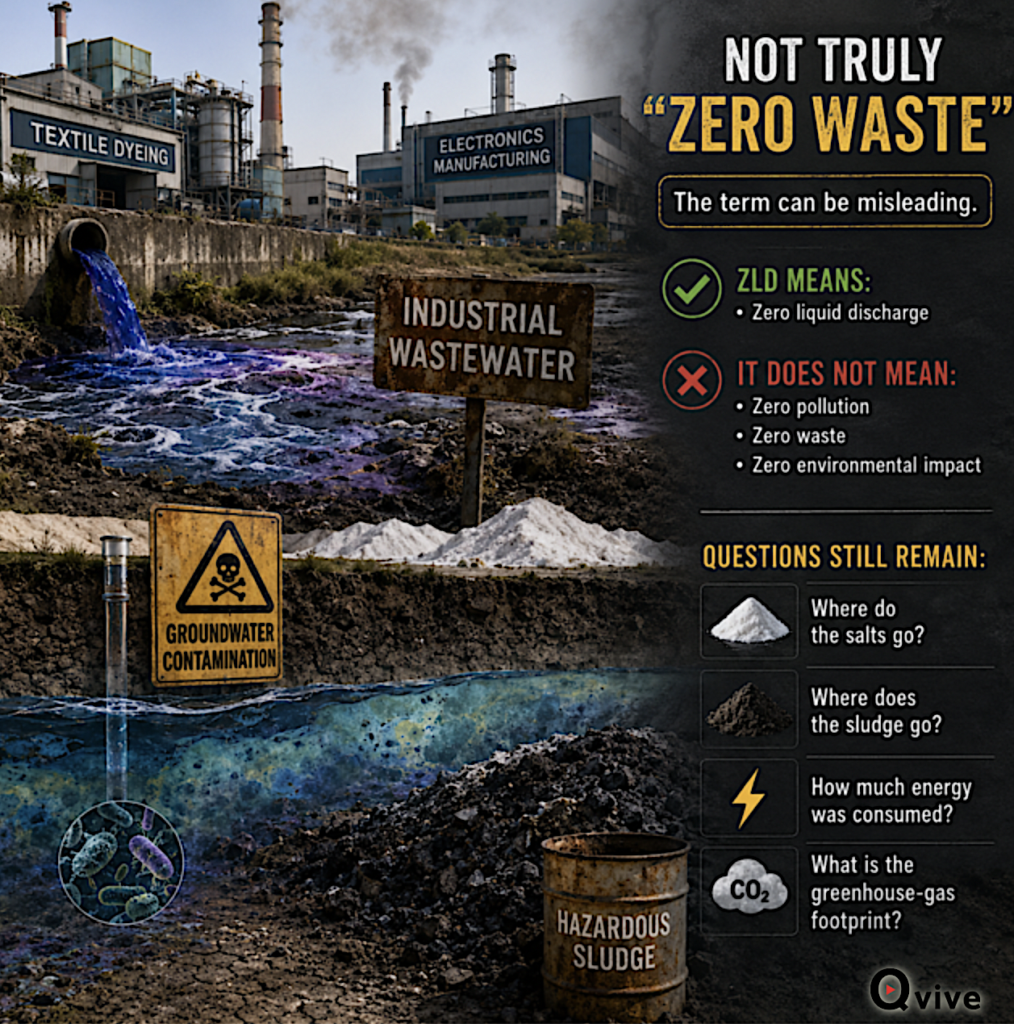
10. Not Truly “Zero Waste”
The term can be misleading.
ZLD means:
- Zero liquid discharge
It does not mean:
- Zero pollution
- Zero waste
- Zero environmental impact
Questions still remain:
- Where do the salts go?
- Where does the sludge go?
- How much energy was consumed?
- What is the greenhouse-gas footprint?
11. Water-Recovery Limits
Although many ZLD systems achieve 90–99% water recovery, reaching higher recovery becomes increasingly difficult.
The concentration of dissolved solids rises dramatically near the end of the process, increasing:
- Scaling risk
- Corrosion risk
- Energy demand
12. Groundwater Contamination Can Still Occur
A common misconception is:
“If a factory has ZLD, groundwater contamination is impossible.”
In reality, contamination can still occur through:
- Leaking storage ponds
- Cracked equalization tanks
- Pipe failures
- Chemical-storage leaks
- Overflow during heavy rainfall
- Improper handling of salt and sludge
So regulators inspect not only the RO and evaporators, but also the entire water-management infrastructure.
In practice, many environmental engineers view ZLD as a water-conservation and compliance technology, not a perfect pollution-elimination technology. The environmental outcome depends heavily on how well the entire system—not just the RO and evaporator units—is designed, operated, and monitored.
Also Read: