

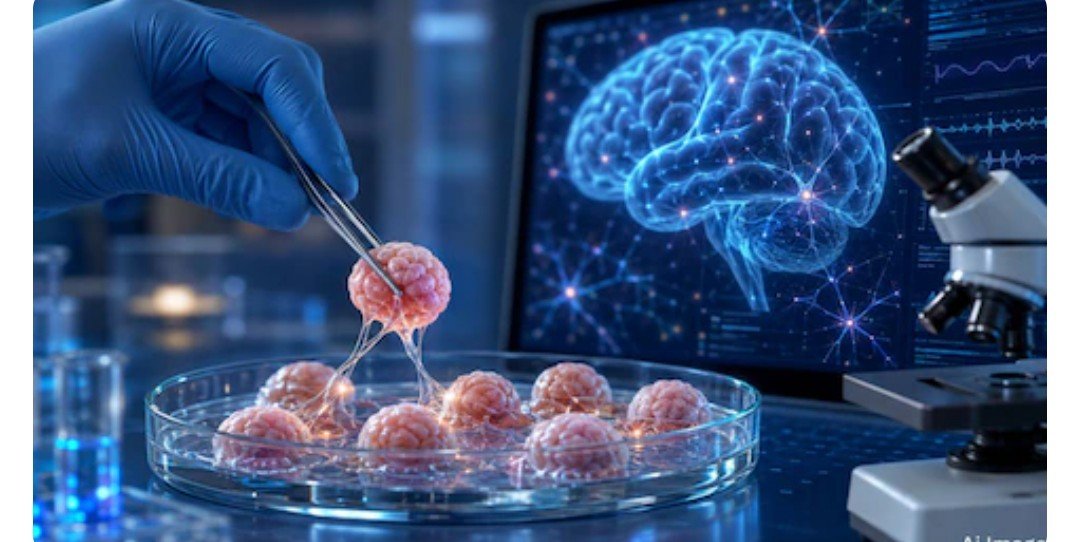
Can you imagine that a tiny cell from your skin could be used to create a part of a human brain in the lab? It may sound astonishing, but it’s now becoming a reality. Scientists are developing tiny, living brains from human cells in the lab, called brain organoids or mini human brains. The most astonishing thing about these mini brains is that these tiny pieces in a scientific dish aren’t just lifeless cells; they communicate with each other using electrical signals, respond, and even learn to play video games!
Researchers are reprogramming human cells into induced pluripotent stem cells. These cells are then directed to develop into neurons, the brain’s basic functional cells. Given the right conditions, these cells organize themselves into 3D structures called mini-brains. These mini-brains aren’t as complex as real human brains, but they replicate many of the functions of a developing human brain.
These organoids aren’t just models of the brain, but rather neural tissue made from living, human cells. As neurons develop within the organoids, they form networks and communicate with each other through electrical signals. Scientists can detect these signals and stimulate them by applying external electrical signals.
Simply put, scientists aren’t just creating a cluster of cells in the lab, but are watching a living neural network grow and respond.
Scientists have two primary reasons for developing these mini-brains:
Research on diseases like Alzheimer’s and autism
Diseases that are difficult and challenging to research in the human brain can be easily understood using these organoids.
Drug testing
Drugs that work in animals don’t necessarily work in humans. With the help of mini-brains, scientists can accurately test drugs on human tissue. This will reduce the reliance on animal testing.
The US National Institutes of Health has made a significant investment in this sector. In September 2025, the NIH announced $87 million for a Standardized Organoid Modeling Center, which will initially focus on brain models, after modeling the liver, lungs, heart, and intestines. In March 2026, additional funding of over $150 million was announced to promote human-based research.
Whether these mini-brains are active or not
There’s no direct answer yet. Scientists currently don’t have a test that can tell whether a brain organoid is active. Electrical activity or response to stimuli doesn’t necessarily mean that the organism is experiencing consciousness.
A report in Nature in July 2026 warned that people who donate their tissue for medical research are unaware that their cells could be used to create biological computing. This raises the question of whether donors will have any rights over biological computers created from their own cells.
AI currently uses silicon chips, software, and artificial neural networks, but now a group of researchers is working on the Organoid Intelligence (OI) project. This field was proposed in the journal Frontiers in 2023. Its goal is not to eliminate AI, but to create a new type of computing system by combining living neural tissue with electronics. Living neurons attempt to learn with very little energy and very little data.
This research is being conducted in advanced labs in Australia and the United States. A team of researchers at Cortical Labs, a Melbourne-based biotech startup, has developed the DishBrain project, where neurons are being connected to a chip and trained in video games like Pong and Doom.
In addition, a research team at Johns Hopkins University in the United States is working on organoid intelligence technology, which can create biocomputers from human brain cells. These mini-brains and human-based research models are being largely funded by the NIH Standardized Organoid Modeling Center in the United States.