

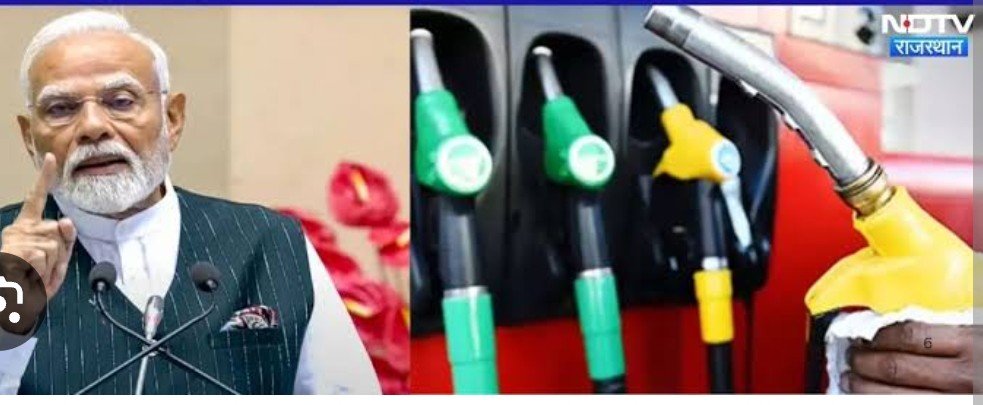
Following the conclusion of the second and final phase of voting in West Bengal on April 29th, the political heat generated by the accusations and counter-accusations leveled by various political parties regarding the ongoing assembly elections in four states and one union territory has subsided. The intense heat generated by the sun’s rays over the past few days has also dissipated due to the rain and hailstorms that have occurred in large parts of the country, and the weather has become pleasant. But now, people across the country are grappling with a different kind of heat: the heat of a possible increase in petrol, diesel, and gas prices after the elections. However, Narendra Modi’s government hasn’t yet fueled the fire by raising the prices of petrol, diesel, and gas. It has only fueled the fire by increasing the price of commercial and industrial gas cylinders by a little over ₹900.
News is coming from political sources that as soon as the election process ends, i.e. after the counting of votes is announced and the Election Commission declares the voting process complete, the government is going to increase the price of petrol and diesel by 4 to 5 rupees per liter and the price of domestic gas by 40 to 50 rupees. Citing the difficulties in the movement of crude oil and gas ships through the Strait of Hormuz due to the fighting in the Middle East and the price increase in the international market due to this war, Narendra Modi’s government is talking about a slight increase in the prices of petrol, diesel and domestic gas. To create an atmosphere for this, it is quoting sources, i.e., its leaders, spokespersons, and some other ministers who are not in charge of this department, and is trying to make this slight increase mandatory in India as compared to the price increase in Pakistan and other countries.
In such a situation, the question arises: if Prime Minister Narendra Modi’s government could postpone the hike during the ongoing assembly elections in four states and one union territory, can it not postpone it even after the election process is over? In reality, Narendra Modi’s government didn’t completely postpone it even during the elections; it still increased the prices of premium petrol and diesel by two to two and a half rupees, and industrial and commercial LPG gas was unavailable except through black marketing. It is a different matter that it then used this tactic to mislead people and divert attention from the price hikes on premium brands of diesel and petrol. During every election campaign, senior BJP leaders, including Home Minister Amit Shah and Prime Minister Narendra Modi, cited the examples of domestic gas prices and regular petrol and diesel prices, claiming that despite the Middle East conflict, there has been no increase in petrol, diesel, and gas prices in India. Opposition political party leaders, too busy campaigning, failed to make an issue of the price hike imposed by Prime Minister Narendra Modi’s government on premium brands of petrol and diesel. While the public may not see it because of the apparent misdirection, the price hike was already having an impact, as transporters increased freight rates and traders also raised the prices of goods.
Prime Minister Narendra Modi and other BJP leaders cite the example of previous Congress Prime Ministers to justify their stance on various issues. However, they fail to cite any such examples regarding the potential increase in the price of petrol, diesel, and domestic gas. Instead, they cite the Middle East war and the increase in petroleum prices in various countries. They do this because they need to mislead the public. Therefore, citing the example of the former Congress Prime Minister would only lead to their own implication. In fact, before Narendra Modi became Prime Minister, when the Congress government was led by Manmohan Singh, the price of crude oil in the international market had reached $148 per barrel, yet even then, the maximum price of petrol at Indian petrol pumps was ₹70 per liter. During Manmohan Singh’s tenure as Prime Minister, the average international price of crude oil was $120 per barrel, but the price of petrol in India never exceeded ₹70 per liter during his tenure. When Narendra Modi assumed the Prime Ministership, the price of crude oil in the international market began to fall significantly, falling to $35 to $45 per barrel. Prime Minister Narendra Modi, at that time, called himself a lucky Prime Minister for India. Despite this, the government led by him did not reduce the prices of petrol and diesel, but instead kept them stable by increasing excise duty. Furthermore, when the price of crude oil in the international market increased, the prices of petrol and diesel in India were also increased, and at one point, petrol in India reached ₹114 per liter. Seeing public anger over this petrol and diesel price hike, Prime Minister Narendra Modi’s government reduced the price of petrol to ₹99 per liter when state assembly elections approached. And petrol remains at this rate in India even today. In some states, the price is slightly higher or lower due to sales tax. Despite the Middle East conflict, the international price of crude oil is still $116 per barrel, which is lower than the average of $120 per barrel during Prime Minister Manmohan Singh’s tenure. However, the price of petrol in the Indian market is still ₹29 higher than the price during his tenure.
Now, if we discuss the impact of the potential price increase in petrol, diesel, and domestic gas by Prime Minister Narendra Modi’s government on the livelihood of the people of India, it seems to be a dangerous sign. Considering the smallest family unit of a couple and their two children, we find that even meeting the minimum needs will require a significant additional amount for the people of India. It is generally observed that for every rupee increase in the price of petrol and diesel, transporters and traders together increase the price of goods by at least the same amount per kilogram. A normal person requires 2000 to 2500 calories for a successful life. They meet this requirement through carbohydrates, protein, fat, and minerals. To meet this carbohydrate requirement, each person needs a minimum of 300 grams of rice, wheat, or millet flour per day. For a family of four, this requirement increases to 1200 grams per day and 36 kilograms per month. If the price of petrol and diesel increases by four to five rupees, a family will need an additional 144 to 180 rupees to meet this minimum requirement. Similarly, if pulses are used as vegetarian food instead of meat to meet protein needs, then 12 kilograms of pulses per person per month will be required, at the rate of 100 grams per day per person, and this will require an additional 48 to 60 rupees. To meet the mineral requirement, a family would need to consume 300 grams of vegetables per person per day, resulting in a total of 36 kilograms of vegetables, which would require an additional expenditure of ₹144 to ₹180. To meet the minimum fat requirement, 300 grams of oil, ghee, milk, and yogurt per person per day would be needed, resulting in a monthly expenditure of 36 kilograms of these items, which would require an additional expenditure of ₹144 to ₹180. Adding this additional expenditure, a potential increase of ₹4 in petrol and diesel prices would result in an additional ₹480, and a ₹5 increase in prices would result in an additional ₹600. Adding in the potential increase of ₹40 to ₹50 in cooking gas, the total would increase to between ₹530 and ₹650. More than 80% of India’s population lives below the poverty line, and the government provides a maximum income certificate of ₹72,000 per year. Consequently, the monthly income of such a family is less than ₹6,000. This amount is already insufficient to meet their minimum food needs. In such a scenario, Prime Minister Narendra Modi’s government has announced a potential increase of ₹4 to ₹5 in petrol and diesel prices, and a ₹40 to ₹50 increase in the price of domestic gas, forcing such families to live on half-meals, as they have no means to increase their income.
Regarding the potential price hikes for petrol, diesel, and domestic gas, GST collections have been the highest during Prime Minister Narendra Modi’s tenure. India’s highest-ever monthly GST collection was recorded in April 2026. According to data released on May 1, 2026, gross GST collections in April 2026 reached a record high of ₹2.43 lakh crore. If Prime Minister Narendra Modi so wishes, he can provide relief to the public from potential increases in petrol, diesel, and domestic gas prices by transferring some of this amount to the petroleum company, a subsidiary of the Indian government. If nothing else, if the excise duty on crude oil, which was increased to stabilize its price when the international price was $35 to $50 per barrel, were also rolled back to its previous level, the potential increase in the price of petrol, diesel, and domestic gas could be avoided.