
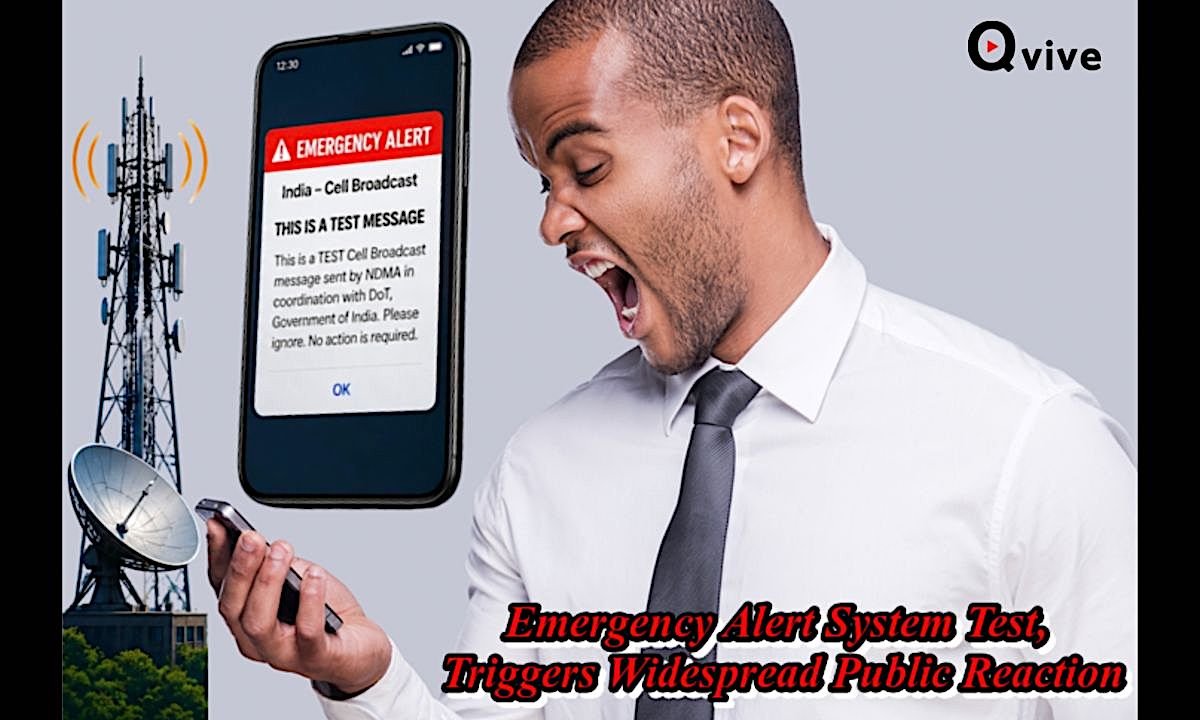
On May 2, 2026, the Indian government, through the National Disaster Management Authority (NDMA), conducted a nationwide test of its indigenous Cell Broadcast Alert System. While intended to establish a robust, geo-targeted emergency notification network, the high-volume, jarring nature of the alerts has triggered significant public backlash, raising urgent questions regarding digital consent, personal privacy, and the health implications of forced notification systems.
The Technology Behind the Broadcast Developed in collaboration with the Centre for Development of Telematics (C-DOT), the system is designed to bypass standard subscriber authentication. By functioning similarly to radio signals, the technology allows the device’s modem to detect cell towers and receive broadcasts directly, even without a SIM card and can, in some instances, leverage satellite integration. While this ensures rapid delivery during national emergencies, the mechanism effectively bypasses user-controlled notification settings, ensuring the alert is delivered at maximum volume regardless of user preference.

Digital Violation and Consent
The core of the public backlash centers on the issue of consent. Because the alerts are built into the backbone of cellular network protocols, users cannot opt-out of the notification.
For many, the experience felt less like a safety measure and more like a “digital violation.” On social media platforms, users expressed frustration over the unsolicited nature of the intrusion, with many labeling the high-volume, jarring vibrations as an unnecessary overreach into their private electronic devices.
https://www.instagram.com/reel/DX1q6E9sQYL/ (copy and paste the link)
https://www.instagram.com/reel/DX04pqqK5h3/
https://www.instagram.com/reel/DX029_xRmmT/
https://www.instagram.com/reel/DX1GxcKslxv/
https://www.instagram.com/reel/DX1MXtUh1gC/
https://www.instagram.com/reel/DX1CdkUOAD2/
https://www.instagram.com/reel/DX04Io0tXNm/
Health Impacts on Vulnerable Populations
- Cardiac Patients: Doctors warn that the sudden, intense emotional shock caused by the piercing alert can result in a rapid spike in blood pressure and heart rate. For those with compromised heart health, such an unexpected stressor can constrict blood vessels and potentially trigger arrhythmia or cardiac events.
- Anxiety and Mental Health: For individuals managing anxiety disorders, the lack of distinction between a “test” and a legitimate, life-threatening emergency can lead to debilitating panic attacks and a profound sense of impending doom.
Studies suggest that roughly 32.9% of the population experiences heightened anxiety during these tests, with data indicating that women and infants are affected by the sudden sensory overload.
A Global Debate on Surveillance
Bill Gates has consistently argued that the world remains unprepared for a future pandemic and urgently needs a robust, permanent Global Early Warning System.

Prominent figures, including Robert F. Kennedy Jr., have voiced skepticism regarding the mass integration of satellite-based monitoring systems, citing concerns over the scope of global surveillance and the potential for a “total monitor” environment.
False alarms
- On January 13, 2018, a false alert of an inbound missile to Hawaii was mistakenly issued through EAS and WEA by the Hawaii Emergency Management Agency, as the result of an employee error during a routine internal system test.

Erroneous alert sent to the state of Hawaii in 2018. - On March 2, 2021, as part of a scheduled tornado drill, emergency alerts simulating a tornado warning were issued by the NWS in Kansas City for Missouri and Kansas. However, while the alert issued via the EAS did contain notices disclaiming that it was a test message, an actual tornado warning message was mistakenly issued via WEA due to a miscommunication surrounding the protocols for the drill.
- On January 9, 2025, an erroneous evacuation alert was sent to cellphones across Los Angeles County, sparking panic across a region of millions where wildfires were occurring. The alert was supposed to target residents in the area of the West Hills neighborhood, which was threatened by the 1,000 acre Kenneth fire. Instead, cellphones across Los Angeles County received the alert. The county is the most populous in the nation, with 9.6 million people, though it was not immediately clear how many residents had received an alert.
- On July 26, 2025, a shelter-in-place warning for Deerfield Township, Ohio due to a SWAT standoff was accidentally sent to the entirety of the Greater Cincinnati area and parts of Southern Dayton.
.jpg)

Testing errors

- On April 20, 2023, at 4:45 a.m. ET, a routine early-morning test of the EAS by the Florida Division of Emergency Management for television stations was accidentally delivered via WEA as well, leading to many residents being woken up early. The error drew the ire of Governor Ron DeSantis, who described the accident as a “completely inappropriate use of this system”; the state briefly rescinded its contract with Everbridge to provide alerting services, but reinstated them shortly afterward.
Also Read:
Breaking News – Indian Government Sending SMS Alerts| Emergency Alerts
There may be a connection between RFID chip and the Coronavirus vaccine