

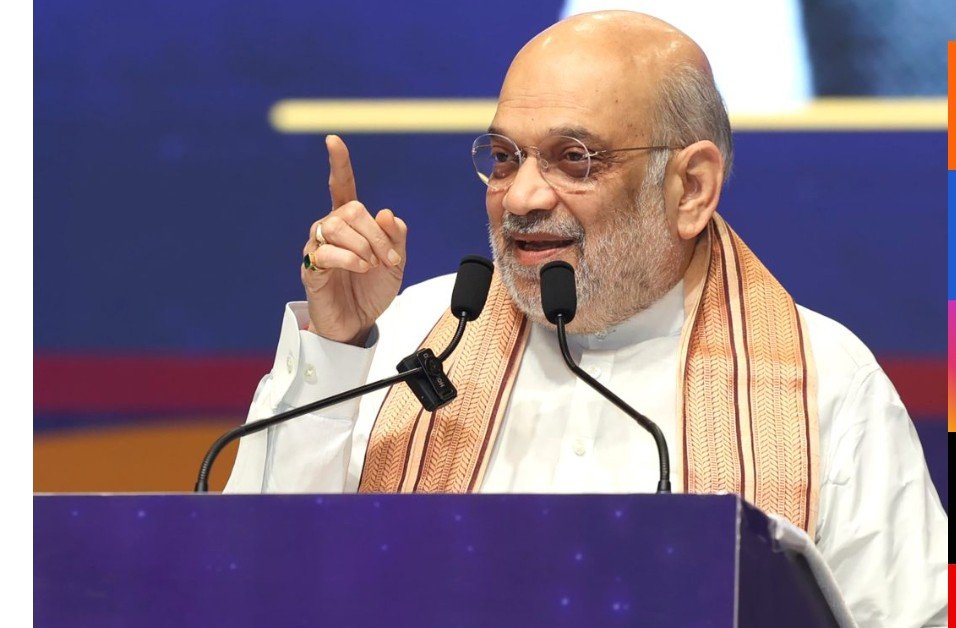
Union Home Minister Amit Shah on Friday stressed the need for a united global effort against drugs, saying it is not just a law and order issue but a serious threat to society and the future of future generations.
The Home Minister delivered an address on the topic “Drugs: A Borderless Threat, a Collective Responsibility” at the annual lecture series of the Research and Analysis Wing (RAW), India’s premier agency for gathering and analyzing intelligence from abroad.
Amit Shah said that under the leadership of Prime Minister Narendra Modi, India has set a national goal of a “drug-free India” by the year 2047. He said that Indian security agencies have prepared a roadmap to eliminate drug cartels and are working rapidly towards this end.
The Home Minister said that India is pursuing a “zero tolerance” policy towards drugs. He clarified that India will ensure that not even a gram of narcotics enters the country, nor is India used as a transit route.
Amit Shah said that treating drug trafficking solely as a police or law and order issue is not enough, as it has long-term impacts on society and future generations.
He said that drug revenues are being used to fuel terrorism and organized crime, while the lasting adverse effects on the human body are not receiving the necessary attention.
The Home Minister said that responsible countries around the world must work together in the fight against drugs. He said that if joint efforts are not made now, the losses will be extremely difficult to recover in the coming years.
He stressed the need for a uniform global legal framework to curb drug trafficking. According to him, until there is global consensus on the definition of controlled substances and the penal standards for trafficking, drug gangs will continue to exploit the policy weaknesses of various countries.
Underlining the need for international cooperation, Amit Shah said that real-time intelligence sharing is crucial for interfering with drug trafficking and arresting or extraditing traffickers.
He noted that in the past two years, India, with the cooperation of friendly countries, has successfully repatriated more than 40 international criminals. However, he emphasized that more extensive efforts are needed in this direction.
Under Operation RAGEPILL, the Narcotics Control Bureau (NCB) has seized a large consignment of the “jihadi drug” called “Captagon” for the first time in the country, from Gujarat and Delhi. This consignment is valued at approximately ₹182 crore in the international market. Furthermore, a massive cocaine consignment worth ₹1,745 crore was also seized in Mumbai under Operation WHITE STRIKE.
It is considered extremely dangerous for the country for the following reasons:
Terrorism and violence: Captagon is called a “jihadi drug” because terrorists (like ISIS) use it for their fighters. After consuming this drug, hunger, thirst, and fatigue are completely eliminated, and a person becomes cruel and violent.
Brainwashing and addiction of youth: Agents of terrorist organizations first make innocent youth addicted to this drug and later brainwash them into joining their nefarious designs (terrorism).
Economic and social security of the country: India is often used as a transit corridor by smugglers to send these dangerous drugs to Gulf countries. This not only ruins the future of youth but also poses a significant threat to the national security of the country.