

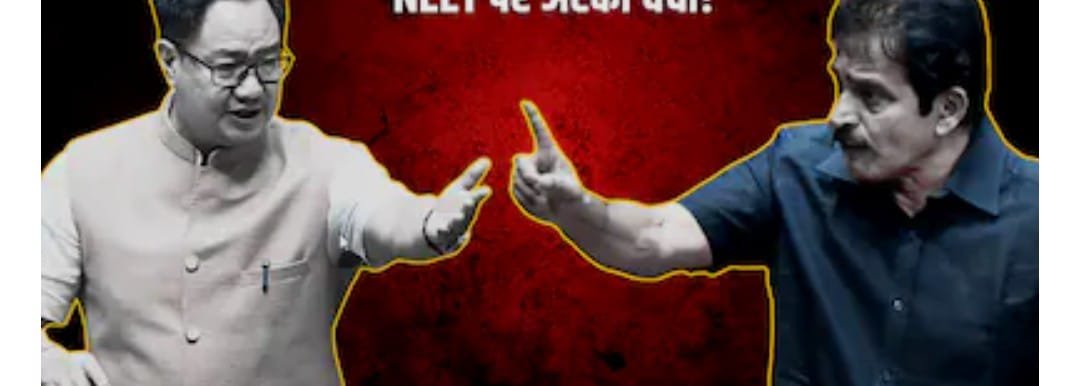
The demand for NEET paper leak and resignation of Education Minister Dharmendra Pradhan is now gaining momentum. While the protest has been going on at Jantar Mantar for 25 days, now its echo has started being heard in the Parliament too. Opposition parties including Congress want to discuss this issue. The government is also ready for discussion. However, Congress says that it wants to discuss through an adjournment motion.
Congress MP KC Venugopal demanded Dharmendra Pradhan’s resignation and an ‘adjournment motion’ to be approved to discuss the paper leak and the alleged police brutality on July 20. He said that when the entire country is feeling the pain of students, all other business of the House should be stopped and this issue should be on top for Parliament.
Venugopal demanded that the opposition want to discuss the issue through an ‘adjournment motion’. He refused discussion under Rule 193.
At the same time, Parliamentary Affairs Minister Kiren Rijiju said that the government is ready to discuss the issue of NEET paper leak in Parliament. He said that the time and duration of the discussion will be decided after talks with all the parties.
There is a rulebook for how the functioning of Parliament will be conducted. The rules are also written in it, through which a demand for discussion on any issue can be made in the Parliament.
In Parliament, if someone wants to discuss an issue for only half an hour, then there is rule 55 for that. Under this rule, a member can start a discussion for half an hour.
Under this rule, a notice has to be given three days before the discussion, in which the reason for that discussion has to be explained. The Speaker can allow or reject that notice if he wishes. During the discussion, a maximum of 4 other MPs can ask questions.
There is also rule 193 for discussion in Parliament. Under this, any MP can start a discussion on a matter related to public interest. For this, a notice has to be given to the Speaker, in which the information about that subject and the reasons for raising it are given.
The MP raises the matter in Parliament and then other MPs discuss it. At the end of the discussion the concerned minister replies.
Apart from this rule, there is also Rule 184, under which an issue is raised in the form of a proposal. It is discussed and after the minister’s reply, the proposal is voted on.
Congress has made it clear that it does not want discussion under Rule 193, because there will be only discussion in it and ministers will answer.
The opposition says that the discussion should be done through an adjournment motion. Under Rules 56, 57 and Rule 58, discussion can be done through an adjournment motion. When an adjournment motion comes, all the work of the Parliament is stopped and only that issue is discussed.
Rule 56 says that an adjournment motion can be brought with the permission of the Speaker of the House. Under Rule 57, it is necessary to give notice of adjournment motion before 10 am. If the notice is given after 10 am, then it will be discussed the next day.
At the same time, Rule 58 mentions those 8 conditions, only on the fulfillment of which any issue can be discussed by bringing an adjournment motion. These 8 conditions are as follows:-
More than one adjournment motion cannot be brought on the same matter in the same session.
Through the adjournment motion, only the issue for which it has been brought will be discussed.
The proposal will be limited to a recent incident or matter.
Question of privilege will not be raised in the adjournment motion.
The motion will not allow re-discussion of a matter that has already been discussed in the same session.
Such issues will not be raised on which time has already been fixed for discussion.
The proposal will not be related to any case which is pending in any court.
No matter will be raised for which separate notice is required under the Constitution or these rules.
Before the discussion, MPs give notice of adjournment motion to the Speaker. According to the PRS report, if the adjournment motion is accepted then the House is adjourned after voting.
The passing of the adjournment motion means that strong disagreement is being expressed with the policies of the government. However, this does not mean that the government fell.
In the last 10-12 years, the opposition has demanded discussion through adjournment motion several times. However, till now the discussion was held only once through adjournment motion. In August 2015, an adjournment motion was brought to discuss the Lalit Modi controversy. After discussion, when voting took place on this proposal, it was rejected by voice vote.