

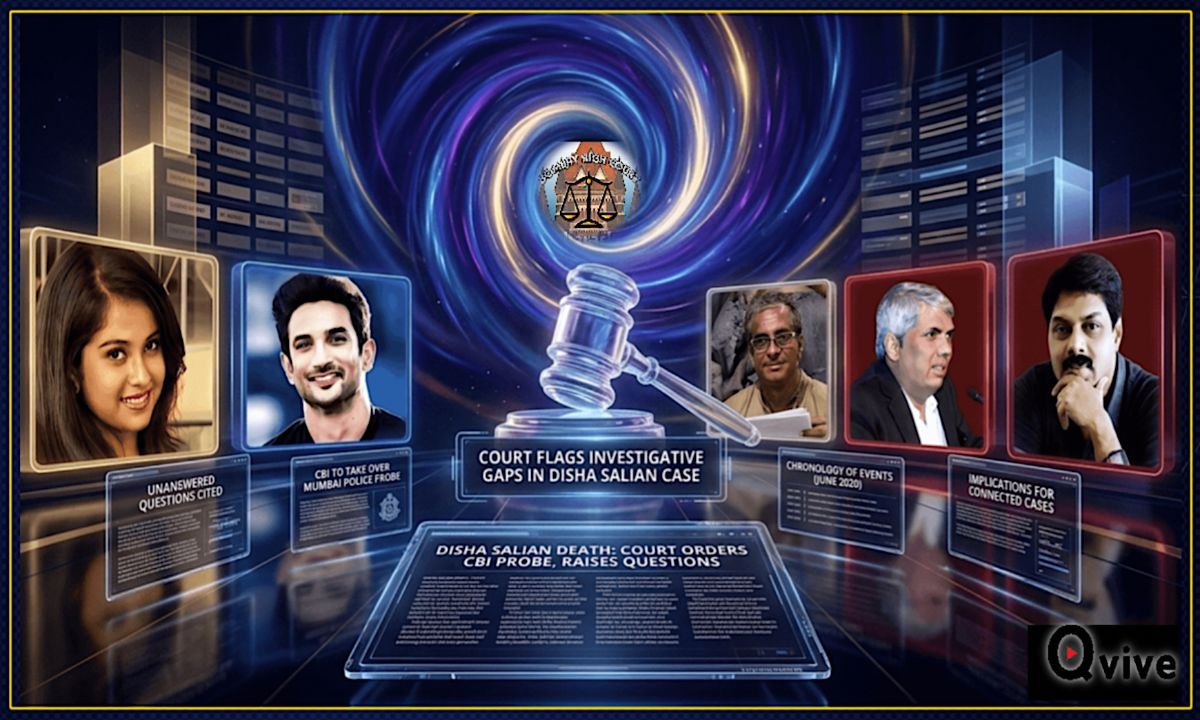
Mumbai, September 2, 2026: The long-running legal battle over the death of Disha Salian, the former manager associated with late actor Sushant Singh Rajput, has entered a decisive new phase. The Bombay High Court has directed the Central Bureau of Investigation (CBI) to register an FIR and conduct a comprehensive investigation into the circumstances surrounding Salian’s death in June 2020.
The order came on a petition filed by Disha’s father, Satish Salian, who has for years challenged the manner in which the case was initially investigated. He has alleged that his daughter was gang-raped and murdered and that the circumstances of her death were incorrectly represented as an accidental fall or suicide. Those allegations have not been established by a court and will now be subject to the CBI investigation.
The bench comprising Justice Sarang Kotwal and Justice Ranjitsinha Bhonsale directed the CBI to appoint a senior and experienced investigating officer, record Satish Salian’s statement and investigate all aspects surrounding Disha’s death. The court also directed the Malvani Police Station to hand over the relevant case material to the CBI.
Disha Salian’s Death and the Questions That Followed
Disha Salian, who had worked as a celebrity manager and was associated professionally with actor Sushant Singh Rajput, died on June 8, 2020, after falling from the 14th floor of a residential building in Mumbai’s Malad area.
Her death occurred only days before Sushant Singh Rajput’s death on June 14, 2020, resulting in enormous public interest and speculation about whether the two cases were connected.
The Mumbai Police initially registered an Accidental Death Report (ADR). Following its inquiry, the police maintained that Disha’s death was a suicide.
Satish Salian did not accept that conclusion. He subsequently approached the Bombay High Court seeking registration of an FIR and a fresh investigation, alleging that his daughter had been gang-raped and murdered.
Bombay High Court’s Landmark Direction

On September 2, 2026, a division bench comprising Justice Sarang V. Kotwal and Justice Ranjitsinha Raja Bhonsale directed the CBI to investigate Disha Salian’s death.
The court directed the CBI to:
- Register an FIR.
- Record Satish Salian’s statement.
- Appoint a senior and suitably experienced investigating officer.
- Examine all aspects surrounding the circumstances of Disha’s death.
- Obtain the relevant case records and material from the Mumbai Police.
- Take further action against individuals only if sufficient evidence emerges.
The Bombay High Court also provided a safeguard for the Salian family. If the CBI ultimately concludes that no prosecutable case is made out, it can submit an appropriate summary report to the competent court, while Satish Salian retains the liberty to challenge that report.
“The Investigation Raised More Questions Than Answers”
One of the most important observations from the High Court concerned the adequacy of the earlier investigation.
The court noted that the police had sufficient opportunity to investigate but had not registered an FIR for a cognisable offence. Instead, the matter had remained under the framework of an inquiry under Section 174 of the CrPC.
The judges found that approach inadequate in the circumstances before them and concluded that another investigating agency was required.
The significance of this observation is procedural rather than a declaration that the allegations have been proved. The court has opened the way for an independent investigation to determine what actually happened.
Questions Surrounding the Earlier Investigation
The case has generated questions over several aspects of the original investigation.
Issues raised during the legal proceedings and in public discussion have included:
- The circumstances surrounding Disha’s fall.
- The timing and chronology of police action.
- CCTV footage.
- The handling of forensic material.
- The post-mortem report.
- The nature and location of injuries.
- The recording of witness statements.
- The seizure and examination of Disha’s mobile phone.
- The timing of investigative seizures and documentation.
- The handling and preservation of other relevant evidence.
The petitioner’s side has also raised allegations concerning inconsistencies in the earlier investigation.
However, allegations of fabrication, evidence tampering, conspiracy or deliberate police misconduct must be distinguished from judicially established facts. The CBI investigation will have to determine whether such claims are supported by evidence.
Satish Salian’s Emotional Reaction
The court order carried enormous emotional significance for Satish Salian.
Speaking after the judgment, Disha’s father became emotional and expressed gratitude to the judiciary.
According to reports, Satish said that he had not shed tears even when Disha died but found himself crying after the court’s decision.
He thanked those who had supported him throughout his long legal battle and said that he would cooperate with the CBI investigation and follow the advice of his lawyers.
He described the development as a step toward the truth and declared:
“Truth has triumphed.”
For Satish, the order represents the reopening of a question he has continued to pursue for years.

Satish Salian’s Appreciation for Advocate Nilesh Ojha
Satish Salian has also placed strong confidence in his legal team, particularly Advocate Nilesh Ojha, who has represented him in the High Court proceedings.
Nilesh Ojha played a central role in seeking registration of an FIR and a CBI investigation.
Following the September 2 order, Nilesh Ojha explained the practical implications of the judgment: the CBI would record Satish’s statement, register the FIR, appoint a senior officer and take over the relevant case material. He also highlighted the provision allowing the petitioner to challenge a negative CBI report through a protest petition.
For Satish, Nilesh Ojha’s role represents more than courtroom representation. The lawyer has been a key part of the family’s sustained effort to have the circumstances surrounding Disha’s death formally examined.
The September 2 order is therefore also a significant moment for the legal team that pursued the matter through the High Court.
Satish Salian Praises Ashutosh Pathak, Editor-in-Chief of Qvive Network
Alongside the legal development, another important part of Satish Salian’s journey has been his appreciation for those who helped keep his concerns in the public domain.
Among them, he has specifically expressed his gratitude to Qvive Network’s Editor-in-Chief, Ashutosh Pathak.
In material published by Qvive in March 2025, the network highlighted Satish Salian’s appreciation for its coverage and for Ashutosh Pathak’s commitment to what the family viewed as truth and transparency.
For Satish, Qvive’s role was not simply about reporting another news story. The account presented by the network describes how its sustained coverage gave him renewed confidence to speak publicly and continue pursuing his legal battle.
That appreciation is significant because the case remained in the public consciousness for years despite the absence of a formal FIR concerning the allegations now being investigated.
The Lawyers in the Proceedings
The court record included a substantial legal team representing different sides.
For Satish Salian:
Advocate Nilesh Ojha appeared as lead counsel, alongside advocates including Abhishek Mishra, Vijay Kurle, Shivchand Mishra, Ishwarlal Agarwal, Tanveer Nizam, Dipali Ojha, Anushka Sonawane and others.
For the State of Maharashtra:
Chief Public Prosecutor Shishir Hiray appeared with Additional Public Prosecutor Sangeeta Shinde and other lawyers.
For Aaditya Thackeray:
Senior Advocate Sudeep Pasbola appeared with advocates including Rahul Arote, Uttam Singh Rathore, Shubham Gharbudve and Rajan Gurnani.
For the CBI:
The CBI’s representation included Kuldeep Patil and other advocates, including Saili Dhuru, Digvijay Kachare, Anay Joshi, Yukta Sawant and Sanika Joshi.
Allegations Involving Aaditya Thackeray
Satish Salian’s petition has named several individuals, including politician Aaditya Thackeray, in allegations concerning his daughter’s death.
Aaditya Thackeray’s legal team has opposed those allegations.
Forensic and Investigative Questions
The case has also involved extensive debate about forensic evidence.
Questions raised have included the post-mortem report, injuries, CCTV footage, the timing of investigative action, the handling of Disha’s mobile phone and other evidence.
The petitioner’s side has argued that these issues warranted a deeper investigation.
The High Court’s decision does not automatically validate every allegation made about the evidence. Instead, it recognizes that there are sufficient circumstances requiring a proper investigation.
The CBI will now have the responsibility of independently examining these issues.
The Police Investigation and Accountability
The case has raised broader questions about investigative accountability.
The High Court found that the earlier inquiry under Section 174 of the CrPC was inadequate in the circumstances and that the police had had sufficient opportunity to investigate without registering an FIR.
This finding is important because the court did not simply direct another preliminary inquiry. It directed the registration of an FIR and a substantive CBI investigation.
Claims that particular officers fabricated records, manipulated evidence or participated in a conspiracy are more serious allegations and must be established through evidence and due process.
The new investigation will therefore be important not only for determining the circumstances of Disha’s death but also for examining whether the original investigation properly handled the evidence.
The Connection With Sushant Singh Rajput
Disha Salian’s death has repeatedly been discussed in connection with the death of Sushant Singh Rajput because she died only six days before him.
This proximity led to numerous theories suggesting that the two cases were connected.
However, theories and allegations should not be treated as established facts.
The CBI’s fresh investigation into Disha’s death will now have an opportunity to examine the evidence independently and determine whether there is any legally demonstrable connection to other events or individuals.
What Happens Next?
The September 2 order begins a new investigative process.
The CBI will now be expected to:
- Register the FIR.
- Record Satish Salian’s statement.
- Appoint a senior and experienced investigating officer.
- Obtain the case records and relevant material from Mumbai Police.
- Examine forensic and medical evidence.
- Examine CCTV and digital evidence where relevant.
- Question witnesses and other persons as required.
- Determine whether a cognisable offence has been established.
- Take action against individuals only where sufficient evidence emerges.
- Submit a chargesheet if the evidence supports prosecution.
- Submit an appropriate summary report if no prosecutable case is established.
If a closure or negative report is filed, Satish Salian retains the right to challenge it through a protest petition.
A Battle for Justice — But Also a Test of Due Process
The significance of the High Court’s order extends beyond one family.
It raises fundamental questions about the relationship between victims’ families, investigative agencies, courts and the media.
A family seeking answers deserves a genuine investigation.
At the same time, a person named in an allegation deserves protection from being declared guilty without evidence.
The High Court’s order attempts to maintain both principles.
The CBI must therefore follow the evidence wherever it leads — whether that evidence supports the allegations, contradicts them or produces an entirely different conclusion.
Final Notes
- Bombay High Court orders CBI probe and FIR in Disha Salian case.
- CBI to appoint a senior investigating officer and examine all relevant evidence.
- Mumbai Police to hand over case records and materials to the CBI.
- Court says no one should be treated as an accused without sufficient evidence.
- Satish Salian becomes emotional and says, “Truth has triumphed.”
- Satish thanks everyone who supported his legal fight.
- He specifically appreciates Editor-in-Chief Ashutosh Pathak of Qvive Network for their coverage and support.
- Satish also acknowledges Advocate Nilesh Ojha for his legal efforts.
- Allegations of gang rape, murder and misconduct remain subject to investigation.
- Court raised questions about aspects of the earlier police inquiry.
- CBI will examine forensic, medical, CCTV, digital and witness evidence.
- The case’s connection with Sushant Singh Rajput remains a matter for evidence-based investigation.
- Any future prosecution will depend on evidence gathered by the CBI.
After six years of unanswered questions, a new chapter has finally begun.