

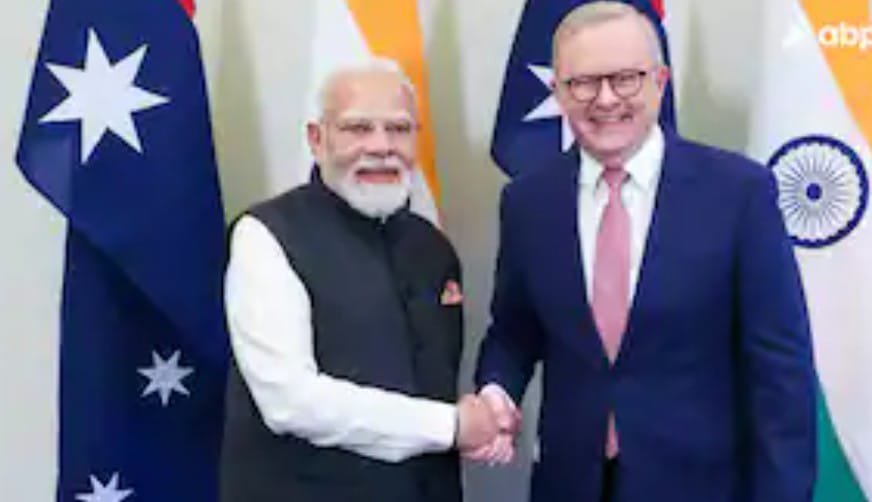
PM Modi arrived in Australia after his visit to Indonesia to a warm welcome. During his visit, PM Modi signed a significant agreement with Australia regarding uranium supplies. This agreement is being considered a major victory for India.
This is being hailed as a major step forward for India’s energy ambitions. India faces a huge demand for electricity. Meanwhile, Australia has known uranium reserves that it does not utilize. Numerous legal hurdles and political sensitivities have prevented trade there.
The two countries have also issued a joint statement stating that under this system, uranium can be exported for long-term use only for peaceful purposes within the safety standards set by the International Atomic Energy Agency (IAEA).
Australia possesses 28% of the world’s uranium reserves. It neither uses nuclear power nor produces nuclear weapons. It exports all its uranium. India, with a population of 1.4 billion, aims to install 100 gigawatts of nuclear power capacity by 2047 to power 60 million Indian homes. India has doubled its nuclear power capacity in recent decades. Nuclear power accounts for only 3 percent of total electricity production, due to a uranium shortage.
India conducted its first nuclear test in 1974. Following its 1998 nuclear test, India was subjected to an international technology ban and a ban on uranium trade. However, the situation changed in 2008 when the Nuclear Suppliers Group granted India an exemption to purchase uranium from its members. Furthermore, the two countries will jointly build a temporary space tracking terminal on Australia’s Cocos Keeling Islands in the Indian Ocean. This will support India’s spaceflight projects.
Australia is a signatory to the Nuclear Non-Proliferation Treaty. This treaty recognizes only the United States, China, Britain, France, and Russia as nuclear weapon states and prohibits the sale of uranium to nuclear-capable countries like India, which have not signed the treaty. India calls this treaty discriminatory. The treaty only recognizes countries that tested nuclear devices before 1967 as nuclear-capable states. Under this rule, India has been denied nuclear-capable status.
Speaking to the media, Australian Prime Minister Albanese said that this arrangement facilitates the export of Australian uranium to India to develop non-fossil fuel power capacity.
After talks with his Australian counterpart, Anthony Albanese, Prime Minister Modi said, “Today we have signed an important agreement on nuclear energy. This will pave the way for uranium supplies from Australia to India. It will accelerate our clean energy goals.”