

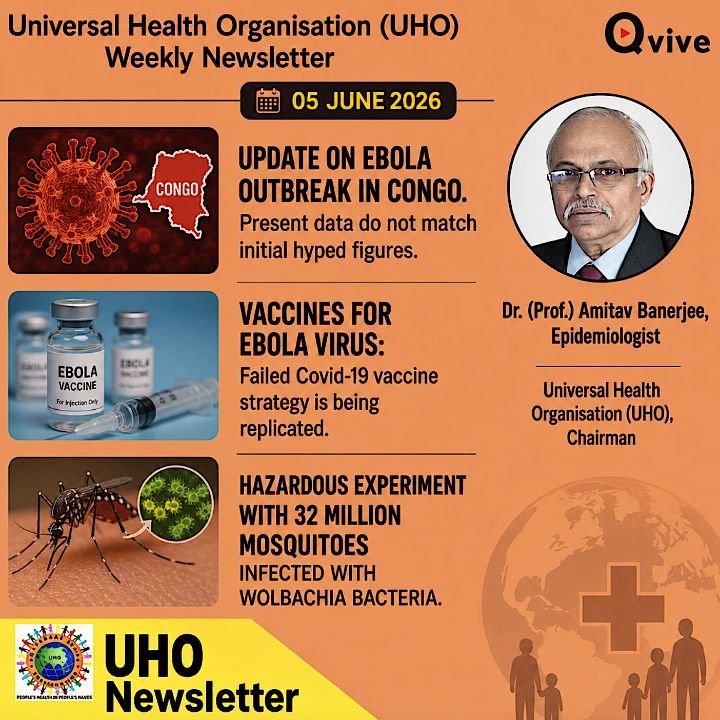
Highlights:
- Update on Ebola outbreak in Congo. Present data do not match initial hyped figures.
- Vaccines for Ebola virus: Failed Covid-19 vaccine strategy is being replicated.
- Hazardous Experiment with 32 million mosquitoes infected with Wolbachia Bacteria.
Website: https://uho.org.in
By Dr. Amitav Banerjee, Chairperson of the Universal Health Organisation (UHO)
Update on Ebola outbreak in Congo. Present data do not match initial hyped figures.
According to the European Centre for Disease Prevention and Control, there has been a total of 344 confirmed cases, including 60 confirmed related deaths, and 116 suspected cases under investigation as of 1 June.
It may be recalled that few weeks earlier inflated figures of over 900 estimated cases and around 119 suspected deaths from Ebola in DRC Congo were being reported. We feel that focusing only on one disease at a time, deaths due to many other endemic fevers like malaria and others may be misdiagnosed and counted towards Ebola inflating the panic and at the same time neglecting treatable conditions like malaria.
This has happened earlier. In December 2024, 1000 of cases of mysterious fever was labeled “Disease X” which ultimately turned out to be due to other endemic infections like malaria, etc.
Uganda has reported a total of 15 confirmed cases, including one death. At least seven cases were associated with local transmission events and four with travel links to DRC, according to health officials.
We feel the initial inflated figures may be due to media hype to catch the public imagination which unfortunately leads to panic. However, a responsible body like the WHO should have corrected the inflated figures immediately. Perhaps the panic suits vested interests who want to promote vaccines and pharmaceuticals. It also suits the WHO which is desperately trying to push the WHO Pandemic Treaty and the amendments to the International Health Regulations (IHR).
Vaccines for Ebola virus: Failed Covid-19 vaccine strategy is being replicated.
The Coalition for Epidemic Preparedness and Innovation (CEPI) announced that it will invest more than $60 million to accelerate development of experimental Ebola vaccines built on platforms similar to those used for the COVID-19 vaccines.
The funding comes as a rapidly growing outbreak of the Bundibugyo strain of the Ebola virus spreads in the Democratic Republic of Congo and neighboring Uganda.
Out of the $60 million amount for the vaccine development, $50 million would be earmarked for developing an mRNA vaccine against Ebola, #8.6 million would be spent for a vaccine developed by Oxford University and manufactured by the Serum Institute of India, and an initial $3.2 million for one developed by the International AIDS Vaccine Initiative.
The mRNA vaccine for the Ebola virus would be using the same technology which was used for the Covid-19 vaccines.
The Oxford-Serum Institute vaccine, will be using a modified version of the chimpanzee common cold virus, or adenovirus — the same basic platform used in the AstraZeneca (Covishield) Covid-19 vaccine. One would recall the severe adverse reactions of the Covid-19 vaccine, Covishield, and the subsequent withdrawal of the vaccine due to tendency to cause vaccine induced thrombocytopenic thrombosis (VITT).
The approach in both the vaccine development is “very similar” to Covid-19 vaccines because “both cause human cells to manufacture a viral antigen by giving … modified genetic information inside a virus that carries it into the cell.”
Critics have questioned the development of these vaccines. Independent Scientific Consultant, Brian Hooker said the Ebola vaccine effort raises concerns because it relies on technologies developed and deployed during the COVID-19 pandemic.
“The safety records of the Moderna and AstraZeneca COVID shots are poor at best,” Hooker said.
These technologies are highly flawed and woefully undertested,” he said.
The vaccines failed to deliver on key promises, Neither the jabs were effective at reducing the disease or transmission and boosters actually increased the likelihood of individuals contracting the virus that they were supposedly protected from,”
Others also questioned whether the virus poses a threat significant enough to justify a large-scale vaccine push.
Data scientist and immunology researcher Jessica Rose, said,“This is yet another perfect example of a virus that is an exceedingly unlikely candidate in terms of global spread … precisely because it is easy to recognize … and to contain …
“… this is another straw-grasping attempt to secure relevancy and funding by certain entities and organizations.”
UHO concurs with these views and would like to add that the money being spent on a vaccine technology which failed miserably in the last pandemic, should be better used to improve the overall living conditions of the people of DRC Congo, improve the public health infrastructure of the country, and educate the people on preventive practices, i.e. how to handle animal carcasses and avoide hazardous funeral rituals such as kissing and handling the bodies of the deceased.
These measures would not only control Ebola virus but also bring down the mortality and human suffering from the many other endemic diseases in Congo which may be contributing far more mortality and morbidity than the Ebola virus. What about the difference between the early estimate of 900 cases of Ebola and the present figure of 344 confirmed cases. And more importantly what about the earlier estimate of 119 deaths and the current figure of 60 confirmed deaths. These discrepancies indicate that many other treatable cases of deaths are being missed.
Hazardous Experiment with 32 million mosquitoes infected with Wolbachia Bacteria.
Google wants to “stop bad bugs with good bugs”, and it’s not talking about coding. The tech company has asked the US government for permission to release up to 32 million sterilized mosquitoes in California and Florida.
As part of its successful “Debug” program, Google is tapping into its tech expertise to raise an army of sterile male mosquitoes to lower the number of illness-spreading bugs. While mosquitoes do spread diseases such as dengue, West Nile virus, Zika, chikungunya and malaria, attacking them to the exclusion of other measures such as proper drainage, water management, overall hygiene, sanitation, better housing and socioeconomic development, is a shortsighted strategy particularly by way of experiments which can have uncertain and hazardous consequences.
A notice from the federal register shows the US Environmental Protection Agency (EPA) is reviewing Google’s request to release up to 16 million mosquitoes annually, in Florida and California, over the span of two years. The EPA will decide whether to greenlight Google’s request for an experimental use permit after a public comment period, which ends on 5 June.
Male mosquitoes don’t bite or carry disease. One of the main approaches Google is testing involves rearing male mosquitoes with a naturally occurring bacterium, called wolbachia, which stops them from having offspring with wild female mosquitoes. When an infected male tries to mate with a wild female, her eggs won’t hatch; Google explains in a blogpost: “the population gets smaller with each generation.”
UHO has some concerns. While the strategy may appear sound theoretically, there are a lot of uncertainties, some of which can prove hazardous.
First, mosquitoes are not just pests. They are part of local ecosystems. Birds, bats, frogs, and fish rely on mosquitoes and mosquito larvae as food. When you aggressively suppress an entire species at this scale, you are tinkering with a food chain that evolved over thousands of years. Once you alter ecological balance, unintended consequences can follow quickly.
Second, eliminating or severely suppressing one mosquito species does not mean the problem magically disappears. Other invasive species can fill that ecological niche. We could very easily end up trading one problem for another — potentially one we understand even less.
These concerns are legitimate as an experiment with gene modified mosquitoes went wrong as described below.
The 2023 Five Billion Gene-Edited Mosquitos in Brazil to end dengue backfired.
The release of5 billion male gene-edited mosquitoes in 2023 by the Bill Gatesprojectwas intended to REDUCE the number of mosquitoes in Brazil.
The underlying logic was that the male gene-edited mosquitoes would be mating with normal female mosquitoes with a view to undermining the reproductive process and significantlyreducing the number of normal mosquitoes.
That did not happen.
What happened in March 2024 was exactly the opposite. Early 2024: number of mosquitoes increased?
Brazil’s Health Minister casually blamed it on the hot weather and “above-average rainfall.”
According to a Yale University research project,
“some of the [gene edited] mosquitoes likely had “hybrid vigor,” resulting from “a hybrid of the natural mosquito with the gene-edited mosquito.”
What has occurred is the creation of “a more robust population than the pre-release population [of mosquitoes] which may be more resistant to insecticides, in short, resistant “super mosquitoes.””
What was the outcome? After an initial period in which the target mosquito population markedly declined, after about 18 months the mosquito population recovered to pre-release levels. Consequently, in the first five weeks of 2024, 364,855 cases of dengue infection were reported, the health ministry [Brazil] said, four times more than dengue cases in the same period of 2023.”
Was this surge in dengue infection the result of hot weather and “above-average rainfall” as outlined by the Ministry of Health?
Or was it the result of the release of the 5 billion gene-edited “modified mosquitoes” in 2023?
The impacts of the release of gene-edited mosquitoes have over the years been the object of extensive laboratory research.
Was there foreknowledge in terms of prior scientific research as to what was going to happen, namely the surge in the number of hybrid “Super Mosquitoes” as well as the reproduction (through the mating process) of the hybrid variety of mosquitoes?
Brazil had committed itself to supporting the factory production of gene-edited mosquitoes, with a commitment to release another 5 billion gene-edited mosquitoes in 2024. Will that project be carried out? The Mosquito Factory in Brazil prevails in its long-term objectives. It is the largest mosquito factory.
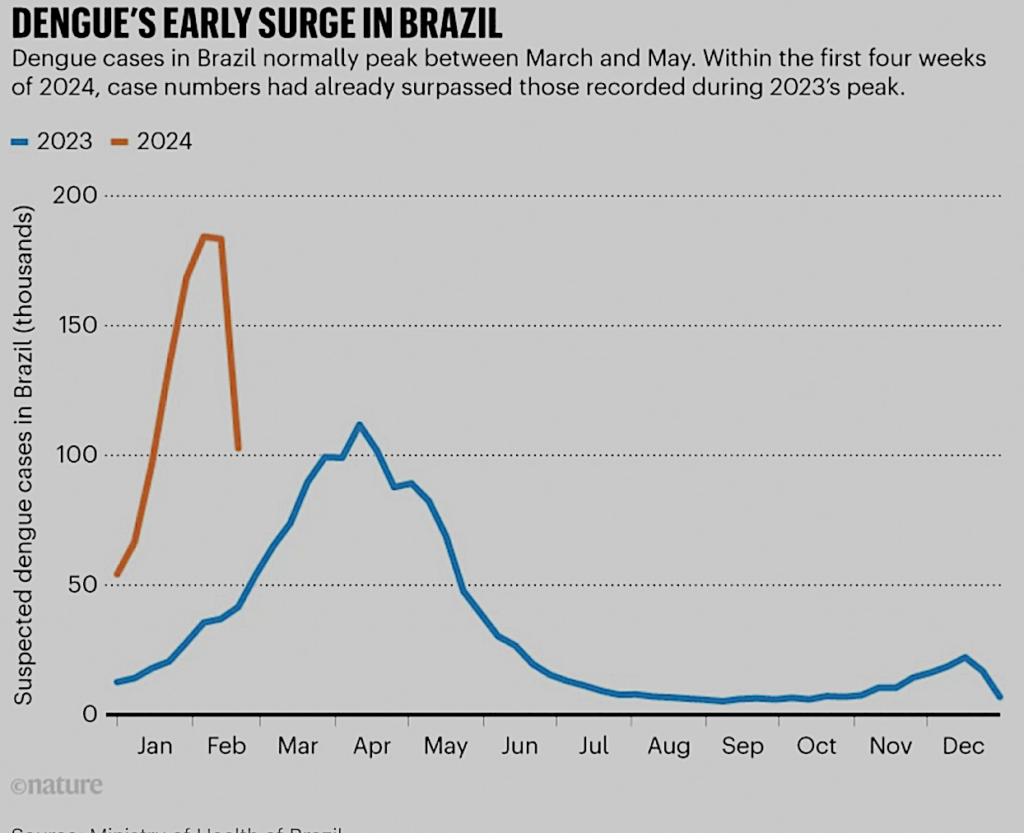
We could not get data of dengue cases in Brazil after this period (deliberate omission?). We will keep monitoring for this data and update from time to time.
Meanwhile, a small African nation, Burkina Faso, has ordered the immediate halt of an initiative backed by US billionaire Bill Gates to employ genetically modified insects to cure malaria and other mosquito-borne ailments. The government announced the destruction of all related samples in the country. Criticism of the initiative includes ethical concerns about environmental and ecological implications. UHO recommends proper study with inputs of experts from biology, ecology, and other related fields before launching such hazardous experiments.
The weekly newsletters bring the updates on the science, battered and bruised during the pandemic, legal updates and impact of activism for a just society, across the world. These are small steps to promote Transparency, Empowerment and Accountability – the ethos of the UHO.
Announcement: Membership & endorsements to the UHO invited: https://uho.org.in/member.php
Also Read: