

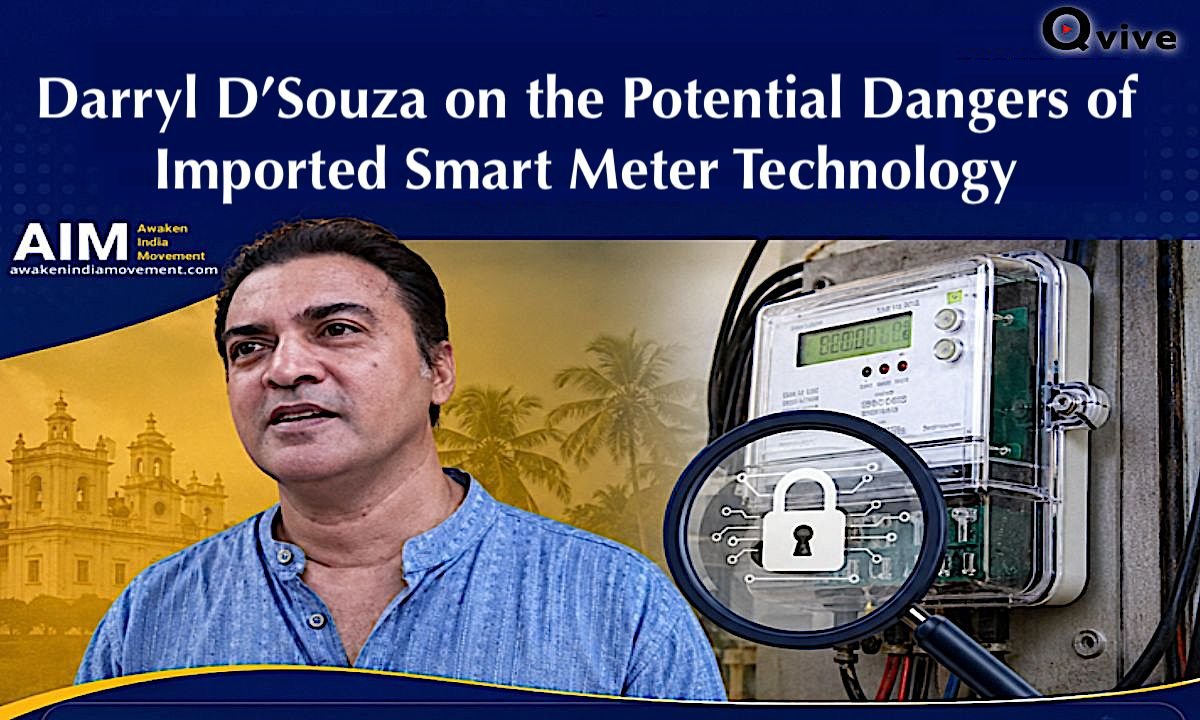
The push to replace traditional analog electricity meters with “smart meters” has become a point of intense public contention in India, particularly in Goa.
An industrial engineer by training, Darryl D’Souza has built a reputation for combining technical analysis with grassroots activism. He is also a healthcare professional who has represented India at BRICS-related international forums and is actively involved in promoting sustainable agriculture as an organic farmer.
Beyond his professional pursuits, Darryl serves as a National Steering Committee (NSC) member of the Awaken India Movement (AIM), a civil society platform known for its engagement on issues relating to public policy, health rights, governance, and individual freedoms.
His efforts really shaped the legal actions in Goa, highlighting that the decision to get vaccinated against COVID-19 must be voluntary.
Today, he is applying the same research-driven and technical approach to scrutinize the implementation of smart electricity meters in Goa.
His concerns extend beyond billing and infrastructure, focusing on key areas:
- Lack of Transparency and Incomplete Information from Authorities
- Filed 2 RTIs with 17 questions; electrical department could answer only 1 satisfactorily.
- No clear cost-benefit analysis provided despite a significant budget allocation (~₹890 crores).
- Limited public awareness efforts, with information biased toward only positive aspects, omitting negative impacts.
- Health and Environmental Risks
- No conclusive tests proving smart meters and associated mesh network signals (radiofrequency emissions) are safe for humans, animals, plants, and pollinators.
- Observed decline in bee populations post-5G rollout in Goa, which threatens pollination and food security.
- Smart meters are described as experimental technology, lacking sufficient safety validation.
- International cases (e.g., USA courts) have linked smart meters to serious issues like brain tumors, mental dysfunction, and fires in homes.
- Economic and Social Impact
- Smart meters may reduce the need for meter readers, risking job losses without clear plans for redeployment.
- Questionable reduction in electricity losses: Goa’s current losses are 8.59%, while the central scheme (RDSS) claims 15% or less; no evidence smart meters can significantly improve this.
- Savings from smart meters are not transparently passed on to consumers through reduced electricity rates.
- Privacy and Cybersecurity Vulnerabilities
- Smart meters collect detailed personal usage data, revealing lifestyle patterns (e.g., when residents are home or away).
- Risk of data theft and hacking is significant, especially with meters using SIM cards and internet connectivity.
- In the context of global cyber warfare (termed as World War 3 by the speaker), such vulnerabilities pose national security threats, including potential for grid disruption.
- Official responses dismiss hacking concerns despite growing evidence of cyberattacks on critical infrastructure worldwide.
- Lack of Public Consultation and Alternative Solutions
- No meaningful, two-way public dialogue or consultation with technical experts.
- Suggested alternatives include monitoring transmission losses at transformer levels rather than individual consumer meters.
- Emphasis on the need for transparent communication including both benefits and risks.
Across India, numerous organizations, citizen groups, unions, and political movements have publicly opposed or raised concerns about the rollout of smart meters:
National-Level Organizations
- All India Forum Against Privatisation (AIFAP)
- Has organized meetings and campaigns opposing electricity privatization and smart meter deployment in multiple states.
- Works alongside electricity workers’ unions and consumer groups.
- All India Federation of Electricity Employees (AIFEE)
- Representatives have participated in national discussions criticizing aspects of smart meter implementation and privatization-linked reforms.
- Vidyut Karmachari Sanyukt Sangharsh Samiti
- Particularly active in northern India and has raised concerns regarding power-sector reforms and smart meter policies.
Goa
- Awaken India Movement
- Members including Darryl D’Souza have raised concerns regarding smart meters, focusing on health, privacy, cybersecurity, transparency, and accountability.
- Goa Human Rights Commission
- While not opposing smart meters, it has become a forum where concerns regarding the rollout have been formally presented.
Maharashtra
- Ghar Haqq Sangharsh Samiti
- Has organized public meetings opposing smart meter installations in Navi Mumbai.
- Indian National Congress (Maharashtra unit)
- Conducted protests demanding a halt to smart meter installations and questioning tariff impacts.
- Vanchit Bahujan Aghadi
- Organized demonstrations against smart meter deployment and related policies.
- Shiv Sena (UBT)
- Raised objections regarding implementation procedures and citizen consultation.
Gujarat
- Aam Aadmi Party (Surat units)
- Participated in awareness campaigns and protests against smart meter installations in parts of Surat.
- Local residential welfare associations and housing societies in Surat
- Organized meetings and submitted objections to distribution companies.
Tripura
- Indian National Congress (Tripura unit)
- Communist Party of India (Marxist)
- Tripura Electricity Consumers Association
These groups have publicly protested or criticized smart meter implementation and billing-related issues.
Kerala
- Trade unions associated with the power sector and sections of the workforce opposed aspects of the proposed smart meter rollout under the TOTEX model. Their resistance contributed to Kerala delaying implementation in its earlier form.
States Where Significant Opposition Has Been Reported
- Goa
- Maharashtra
- Gujarat
- Tripura
- Kerala
- Himachal Pradesh
- Uttar Pradesh
Opposition has come from a mix of citizen groups, consumer associations, employee unions, resident welfare associations, and political parties, though the reasons vary—from tariff concerns and privatization fears to cybersecurity, privacy, procurement transparency, and consumer rights.
SMART METER INSTALLATION: KNOW YOUR RIGHTS
Many consumers are facing smart meter installation without proper consent, prior notice, or a clear legal explanation.
To help citizens raise their concerns formally, the Awaken India Movement (AIM) has prepared ready-to-use objection formats that can be edited and sent to your electricity distribution company, with a copy marked to the local police station.
Download the formats here:
https://awakenindiamovement.com/smart-meter-objection-formats-download-use/
This has worked in many Mumbai cases — those who sent the email were able to stop replacement of their meters.
If you wish to raise objections or seek information, act before the installation team arrives.
Please share this information with your housing society, family members, friends, offices, and shop owners.
Also Read: