


The Giving Pledge has turned out to be a big win for billionaires in terms of public image because it lets them act like they’re heroes. Anyone who has spent time with super-rich people knows they can be really stingy, rude, and not very nice. By making billionaires look better in the eyes of the public, the Giving Pledge has made it harder for governments, especially in India, to think about making financial changes that would help workers and small businesses get a fair share of the wealth created over the last thirty-four years. So, in simple terms, when it comes to the Giving Pledge, it feels like we’ve been tricked.
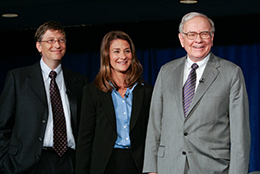
The Giving Pledge is a commitment by billionaires to donate the majority of their wealth to philanthropy, either during their lives or through their wills. Founded in 2010 by Warren Buffett, Bill Gates, and Melinda French Gates, it began with 40 U.S. billionaires and expanded globally. The initiative aims to inspire a culture of generosity among the ultra-wealthy. Signatories are encouraged to publicly share their philanthropic motivations and collaborate to enhance their impact through shared learning and community engagement.
About the Giving Pledge, https://givingpledge.org/about
The article titled “The $600 billion challenge” discusses a philanthropic campaign led by Bill and Melinda Gates, along with Warren Buffett, to encourage billionaires to pledge at least half of their net worth to charity. The campaign involved a series of private dinners with influential billionaires to discuss philanthropy. The article details the participants, the discussions that took place, and the subsequent leak of the event. It also outlines the progression of the campaign, including the idea of a pledge, the establishment of a new website, and the efforts to garner support from other billionaires. The article emphasizes the potential impact of the campaign on philanthropy and society as a whole.
In May 2009, it was revealed that Bill Gates and Warren Buffett, America’s two wealthiest men, had orchestrated a secretive dinner meeting for billionaires in New York City. David Rockefeller was reportedly the host, with attendees including Mayor Michael Bloomberg and Oprah Winfrey, and the conversation centered around philanthropy.
Despite media inquiries, Buffett and Gates opted not to comment, which only heightened the intrigue surrounding the event. The Chronicle of Philanthropy described it as “unprecedented,” while ABC News and the Houston Chronicle referred to it as “clandestine.” A humorous take from New York magazine imagined George Soros starstruck by Oprah’s presence. Meanwhile, a radio broadcaster ominously suggested, “Ladies and gentlemen, there’s mischief afoot and it does not bode well for the rest of us.” Patty Stonesifer, former CEO of the Bill & Melinda Gates Foundation and an attendee, later clarified to the Seattle Times that the meeting was simply a gathering of friends and colleagues “discussing ideas” about philanthropy.
This article kind of reminds me of two other stories from Fortune magazine that also had Buffett on the cover. The first, from 1986, posed the provocative question, “Should you leave it all to the children?” Buffett’s response was a definitive no. The second article, titled “Warren Buffett gives it away,” was published in 2006 and detailed his strategy to gradually donate his Berkshire Hathaway (BRKA) wealth to five foundations, with the Bill & Melinda Gates Foundation at the forefront. To delve deeper into Buffett’s approach to philanthropy, refer to “My philanthropic pledge.”
Note: These link pages are no longer available.
The philanthropy dinners involved discussions on a wide range of topics related to philanthropy and charitable giving. Some of the main topics of discussion included:
- Philanthropic Strategy: The participants discussed the strategy of aiming for a 50% slice of net worth to be pledged to charity. They explored the practicality and impact of this approach.
- Secrecy and Exposure: There were conversations about maintaining secrecy around the philanthropic sales pitch to avoid embarrassment for moguls who might choose not to participate. The exposure of influential individuals to the philanthropic campaign was also a point of discussion.
- Challenges in Foreign Philanthropy: The participants addressed the challenges of raising the philanthropic bar in foreign countries, including issues related to tax laws, lack of charitable institutions, and the difficulty in identifying suitable recipients for charitable gifts.
- Causes and Impact: The charitable causes discussed covered a wide spectrum, including education, culture, healthcare, the environment, public policy, and support for the poor. The emotional and practical impact of large-scale philanthropy on individuals and society was also a key topic.
- Increasing Philanthropy: The conversation turned to how giving by the rich could be increased, with ideas such as national recognition of great philanthropists, a philanthropy guidebook, or a conference of the rich being proposed.
- Fears and Concerns: The dinners also brought out fears and concerns related to philanthropy, such as the impact of going public with big gifts, managing pleas from charities, and dealing with international philanthropy.
These discussions reflected the complexity and depth of the philanthropic campaign and its potential impact on charitable giving.
The philanthropy discussions involved several key figures, including:
- Bill and Melinda Gates: They were the driving forces behind the philanthropic campaign, aiming to encourage billionaires to pledge at least half of their net worth to charity.
- Warren Buffett: In the investment world, Buffett joined forces with the Gates to lead the philanthropic campaign.
- John Doerr: A veteran venture capitalist from Kleiner Perkins, and his wife, Ann, were among the veteran philanthropists in attendance at the dinners.
- The Morgridges: Another couple who played a role in the philanthropy discussions, contributing to the selection of the meeting site.
- Kenneth Langone and Elaine Langone: Noted philanthropists and participants in the second dinner held at the New York Public Library.
- H.F. “Gerry” Lenfest and Marguerite Lenfest: Noted philanthropists from Philadelphia who were involved in the philanthropy discussions.
- David Rockefeller Sr.: Shared his experiences and insights into philanthropy during the discussions.
These individuals, along with other influential philanthropists and billionaires, played a significant role in the private dinners and the broader philanthropic campaign, contributing to the depth and diversity of the discussions.
Ref: https://fortune.com/2010/06/16/the-600-billion-challenge/?iid=sr-link1
Pledge Signatories List
Ref: https://givingpledge.org/pledgerlist
Annual Gathering Connects Giving Pledge Community Through Learning and Action
May 28, 2024 – The Giving Pledge celebrates its 14th Annual Gathering this week, where signatories come together to learn, connect, and collaborate on efforts to address urgent global challenges through philanthropy.
Over the past year, Giving Pledge signatories have continued to demonstrate inspirational, innovative, and impactful examples of generosity across the globe. Below are just a few examples of this impact:
- MacKenzie Scott donated over $2 billion in the past year, including an open call with Lever for Change to give $640 million to over 360 US community-led nonprofits driving progress on key issues such as health, education, and socioeconomic mobility.
- The Heising-Simons Foundation, including Liz Simons, Mark Heising, and their daughter Caitlin Heising (Next Gen) joined together with Pierre and Pam Omidyar’s Omidyar Networkas part of a new coalition of 10 philanthropies to support public interest efforts that mitigate artificial intelligence’s (AI) harms and promote responsible use and innovation. Together, these institutions are collectively contributing more than $200 million to align their investments.
- Francine A. LeFrak opened the Francine A. LeFrak Wellness Center in New Jersey, which provides health services and job training to court-involved and formerly incarcerated people, who often face reduced access to care and systemic barriers.
- Nandan Nilekani donated INR 315 Crores ($39 million) to Indian Institute of Technology Bombay, his alma mater, to support infrastructure and innovation, marking one of the largest alum donations to an Indian educational institution. Rohini Nilekani contributed INR 100 Crores ($12.5 million) to NIMHANS and NCBS to advance mental health research and treatment in India.
The Giving Pledge signatories range in age from their 30s to over 100. Globally, signatories represent 30 countries: Australia, Brazil, Canada, China, Colombia, Cyprus, France, Germany, India, Indonesia, Israel, Malaysia, Monaco, the Netherlands, New Zealand, Norway, Peru, Portugal, Russia, Saudi Arabia, Slovenia, South Africa, South Korea, Switzerland, Tanzania, Turkey, Ukraine, the United Arab Emirates, the United Kingdom, and the United States.
Ref: https://givingpledge.org/pressrelease?date=05.28.2024
Members from India who have joined the Giving Pledge
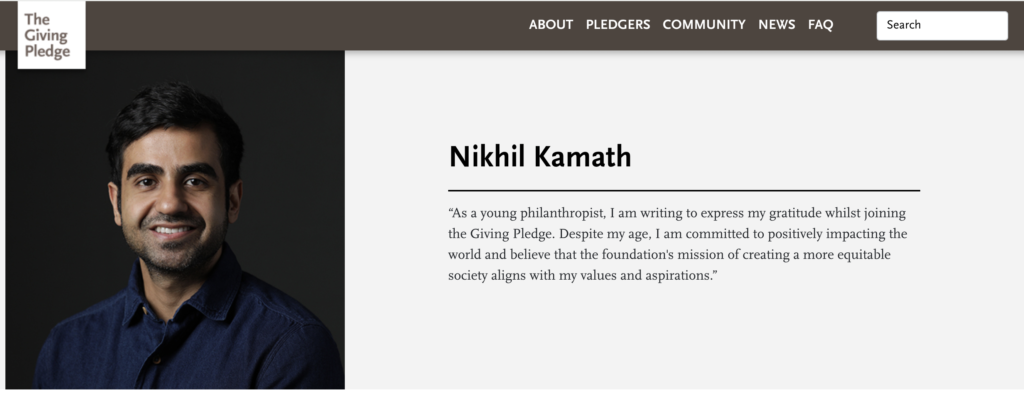
Nikhil Kamath, co-founder of Zerodha and a billionaire, has emerged as the youngest individual from India to commit to ‘The Giving Pledge,’ an initiative established by renowned investors Bill Gates and Warren Buffet. He is the fourth Indian to make this pledge, following in the footsteps of Azim Premji, Kiran Mazumdar-Shaw, Rohini and Nandan Nilekani. Participants in this philanthropic foundation are dedicated to donating a significant portion of their wealth to charitable endeavors.
Kamath aims to make significant contributions in the fields of climate change, energy, education, and health. This initiative is in addition to his own foundation, the Young Indian Philanthropic Pledge (YIPP), which works alongside startup leaders to ensure that at least 25 percent of their net worth is allocated to philanthropic activities.
Nithin Kamath directs the Rainmatter Foundation, which is committed to backing organizations and projects that focus on climate action, environmental health, and related livelihoods in India.
EDELGIVE HURUN INDIA PHILANTHROPY LIST 2024
Ref: https://hurunindia.com/blog/edelgive-hurun-india-philanthropy-list-2024/
Rates of Criminality Amongst Giving Pledge Signatories
Ref: https://forum.effectivealtruism.org/posts/d8nW46LrTkCWdjiYd/rates-of-criminality-amongst-giving-pledge-signatories
The forum article discusses the findings of an investigation into the rates of criminal misconduct amongst people who have taken The Giving Pledge, a commitment by wealthy individuals to give most of their money to charity. The author found that rates of criminal misconduct amongst Giving Pledge signatories are fairly high, with 25% of signatories having been accused of financial misconduct and 10% convicted. Additionally, 4% of signatories have spent at least one day in prison and 41% have had at least one allegation of substantial misconduct. The author concludes that the rate of criminal behavior amongst major philanthropists is high, which means that altruism may not substantially lower the risks compared to the general population and that negative impacts to EA’s public perception may occur independently of whether donors actually commit crimes.
It provides a detailed summary of the investigation’s findings, including the methodology used to collect data and the specific allegations of misconduct made against Giving Pledge signatories. The author also discusses the potential implications of these findings for the effective altruism (EA) community, which seeks to use evidence and reason to determine the most effective ways to improve the world. The high rates of criminal misconduct amongst Giving Pledge signatories may raise concerns about the potential risks of relying on major philanthropists to fund EA organizations and initiatives.
Overall, the forum “Rates of Criminality Amongst Giving Pledge Signatories” is worth reading for anyone interested in the intersection of philanthropy and criminal behavior. The investigation’s findings provide valuable insights into the potential risks and challenges of relying on major philanthropists to fund charitable causes and may have important implications for the EA community. By understanding the potential risks and challenges associated with major philanthropy, individuals and organizations can make more informed decisions about how to effectively allocate resources to improve the world.
David Rockefeller recruited Henry Kissinger
— Modern Problems (@ModProCom) December 12, 2022
Henry Kissinger recruited Klaus Schwab.
Bill Gates took over for David Rockefeller.
Bill Gates and Klaus Schwab are running the GREAT RESET
Gates runs THE BILLIONAIRES CLUB with Soros, Buffet, Bloomberg, and Turner#StopTheWEFnow pic.twitter.com/xZBunq5v4G
World Economic Forum By 2030 You’ll Own Nothing And You’ll Be Happy
Source:Givingpledge, Flickr – Image, Linkedin-Image, Twitter
Also Read: