

Highlights:
- Trends of mortality from Cervical Cancer in India over the three decades.
- The Lancet paper claims HPV vaccine brought down cervical cancer rates in the UK.
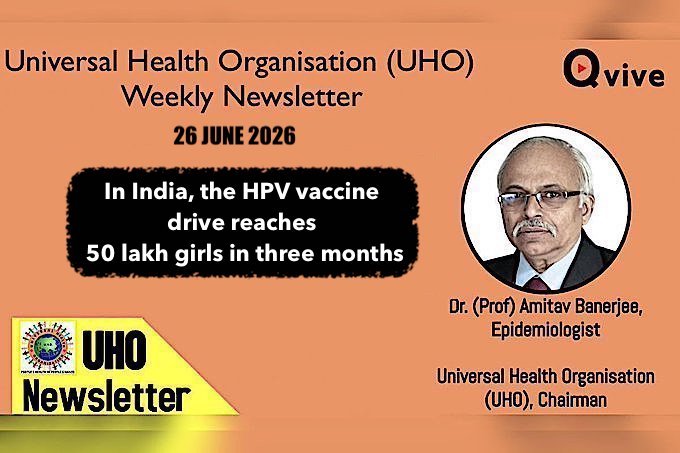
- In India, the HPV vaccine drive reaches 50 lakh girls in three months.
Website: https://uho.org.in
By Dr. Amitav Banerjee, Chairperson of the Universal Health Organisation (UHO)
Trends of mortality from Cervical Cancer in India over the three decades.

trends in incidence and mortality of cervical cancer in India and its states, 1990-2019:
data from the Global Burden of Disease 2019 Study. BMC Cancer. 2022 Feb
7;22(1):149. doi: 10.1186/s12885-022-09232-w. PMID: 35130853; PMCID: PMC8819855.
We are beginning this week’s newsletter with the trends in mortality from cervical cancer in India, with the above graph along with the data source on which this declining trend is based, to set the context for evaluating subsequent publications claiming reduction in cervical cancer rates following HPV vaccination.
In the Indian context, we see that there is a steep decline in deaths from cervical cancer in the past three decades, even before the introduction of the HPV vaccine. This is because the cervical cancer rates has fallen down because there are other factors contributing to it such as poor genital hygiene, unsafe sex, multiple sex partners (these three factors would also increase chances of infections with Human Papilloma Virus or HPV), repeated child births, use of oral contraceptives, malnutrition and smoking. Increase in socioeconomic standards leading to good genital and menstrual hygiene, awareness of risk factors, and safe sexual practices, and overall health promotion is likely to have caused this sharp declining trend.
Now suppose the universal HPV vaccine had been launched in 1990 in India. We can publish a paper (with heavy grants from the manufacturers) to show that the introduction of the HPV vaccine in the national program brought about a drastic drop in deaths from cervical cancer over three decades.
Exactly, the same strategy has been adopted by a recent paper published in the prestigious medical journal The Lancet.
The Lancet paper claims HPV vaccine brought down cervical cancer rates in the UK.
As mentioned above a recent paper in The Lancet tricks readers into believing that the HPV vaccine has drastically brought down rates of cervical cancer in the age groups 20 – 24, 25 – 29, and 30 – 34 years overlooking the many contributing factors which might have contributed to the decline.
The authors of this study, the principal author with ties with the vaccine manufacturers (Merk Sharp and Dohme, MSD), did a population based analysis of HPV vaccine coverage with trends of cervical cancer deaths between 2001 to 2024, in different age groups and attributed the fall in death rates from cervical cancer to the vaccine. They overlooked many other factors which can give rise to spurious association. Over the years people enjoy better socioeconomic status, are more literate, aware of safe sexual behaviour and so on. All these can give rise to wrong conclusion about the efficacy of the vaccine. The trends from India over the past three decades illustrate this very well. Particularly in developing countries like India due to gender discrimination in addition to economic factors a large proportion of women suffer malnutrition which is associated with higher mortality from cervical cancer.
We also have concerns that they are picking up the wrong age groups for evaluation of the impact of the vaccine as the median age of cervical cancer is around 50 years. This follow up would take a couple of decades and the promoters of the vaccine with various conflicts of interest are in a hurry. Perhaps by premature launch of universal HPV vaccination they deliberately want to eliminate any control group which may bring out that the unvaccinated also experience a decreasing trend because of various other factors mentioned earlier.
Besides having ties with the manufacturer of the HPV vaccine, MSD, the lead author also was was a member of the data safety monitoring board for the IARC India HPV Vaccine Trial assessing the safety and efficacy of the single dose HPV vaccine.
UHO expresses its concerns that researchers with conflicts of interests linked to the industry are conducting such trials in the country.
In India, the HPV vaccine drive reaches 50 lakh girls in three months.
Such moves are paying dividends for the HPV vaccine manufactures at least as illustrated in a news item in ET Health World. It states that since the launch of the HPV vaccine drive in the country three months ago, around 50 lakh girls have received the HPV jab. The target is 1.15 teenage girls.
The news report does mention the incidence of deaths of teenage girls in 2010 in the country, during a HPV vaccine trials (mentioned as demonstration project, wrongly), but glosses over it mentioning that subsequent investigations found no causal links between the deaths and vaccination.
UHO expresses concern that this “heads I win, tails you lose” phenomenon will be observed in coming years i.e. any downward trends in cervical cancer unrelated to the vaccine will be attributed to the vaccine and in case of any adverse events or deaths no “causal links” will be found because of lack of thorough investigations due to poor adverse events after immunization (AEFI) monitoring in the country.
The best strategy to mask ill effects of a product is to make it universal: same with mRNA technology.
UHO anticipates that in coming years, the majority, if not all, vaccines will be launched on the mRNA platform, notwithstanding the serious concerns of adverse effects of this gene based technology after its mass scale application for the Covid-19 vaccines.
Confirming this apprehension is the recent approval by the FDA, USA, for its use for developing the influenza vaccines.
The FDA’s Vaccines and Related Biological Products Advisory Committee today voted 9-0 to recommend approval of Moderna’s mRNA flu vaccine for the 50-64 and 65-plus age
groups. However, we feel, the vote “does not erase the fundamental concerns surrounding this application.” We also think that said time frame of trials for the mRNA vaccines is too small to detect long-term risks.
Dr Angus Dalgleish, professor emeritus of oncology at City St. George’s, University of
London, said, “There is no need for any specific flu vaccine.” He cited the high number
of serious adverse events related to the mRNA COVID-19 vaccines.
“The case for mRNA gene therapies for any infectious disease can never be approved with current technology, given the totally unacceptable serious side effect risks,” Dalgleish said.
Since mRNA-1010 is based on the same “flawed” platform as the COVID-19 shots, we anticipate “exactly the same problems as for the COVID shots,
It may be recalled that Dr Vinay Prasad, the former Director of FDA’s vaccine division, declinedtoreview Moderna’sinfluenzavaccineapplicationduringhistenure.
Vinay Prasad departed from the FDA in April 2026. His exit was driven by an escalating series of public disputes with major pharmaceutical companies over drug reviews, controversial vaccine policy changes, and internal workplace frictions.
UHO feels the message is clear. If you reject applications for untested and potentially hazardous pharmaceutical products, you risk losing your job.
The weekly newsletters bring the updates on the science, battered and bruised during the pandemic, legal updates and impact of activism for a just society, across the world. These are small steps to promote Transparency, Empowerment and Accountability – the ethos of the UHO.
Announcement: Membership & endorsements to the UHO invited: https://uho.org.in/member.php
Also Read: