

A lot of commuters were taken by surprise at traffic signals of MG Road, Cubbon Road, Jayanagar, Kundalahalli and Sarjapur Road when the signal turned red and the heart symbol appeared.
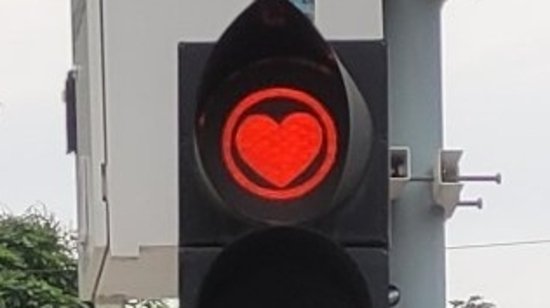
Traffic police told BM that the sign can be used to help people understand that their lives are important, while it is also an initiative by a Bengaluru hospital to access emergency services by a single click through a scanning QR code installed at the traffic signals.
Over 20 locations in Bengaluru have heart-shaped signals. The locations where the heart shaped signals are put up are Manipal Old Airport, Trinity Circle, Brigade Road, Anil Kumble LIC, MG Road Main, Cubbon Park,
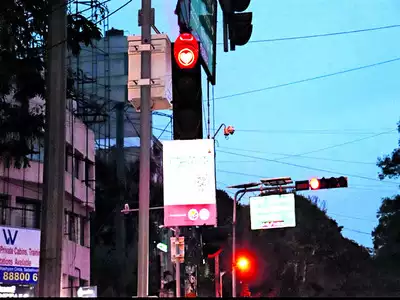
Indian Express, Mehkri Circle, Hebbal under the flyover, Sahakar Nagar, Sankey Road, Yeshwantpur Main, Whitefield Big Bazaar, Hope Farm, Kundalahalli, Sarjapur, Sony World Koramangala, Jayanagar and Lalbagh West Gate Townhall.
The initiative was carried out by Manipal Hospitals along with Bengaluru Traffic Police (BTP) and Bruhat Bengaluru Mahanagara Palike (BBMP).
The codes installed can help the affected person connect to the emergency number, and with a single click, the person will be directed to ambulance service.
A senior official from the Cubbon Park Traffic Police said, “The heart shaped traffic signal is put up to signify that every life is important. One should not ride or drive fast and jump signals. People should be cautious and follow traffic rules. This apart, it also indicates that their loved ones are waiting back home and one should follow all the safety measures. “
According to the Manipal Hospitals, the initiative will be spread to more parts of Bengaluru. Another QR code has also been installed to navigate people through the correct steps involved in CPR. The code explains the steps to be followed to help revive the affected person.
While the initiative came into effect on World Heart Day, not many are aware of it. “While I was passing by the MG Road signal, I saw the red light taking the shape of a heart. I couldn’t really think of any reason,” said Shaikh Omar, Project Manager at a private firm in Residency road.
While a few people who observed the QR code made use of the emergency services. Over 20 people had reached out to the ambulances since the installation and 35 for CPR. The numbers are said to be climbing constantly.
On the occasion of #WorldHeartDay, Manipal Hospitals installed innovations to encourage Bangalore to be a 'heart smart city'. pic.twitter.com/cYSJPKx4uC
— Manipal Hospitals (@ManipalHealth) October 2, 2022
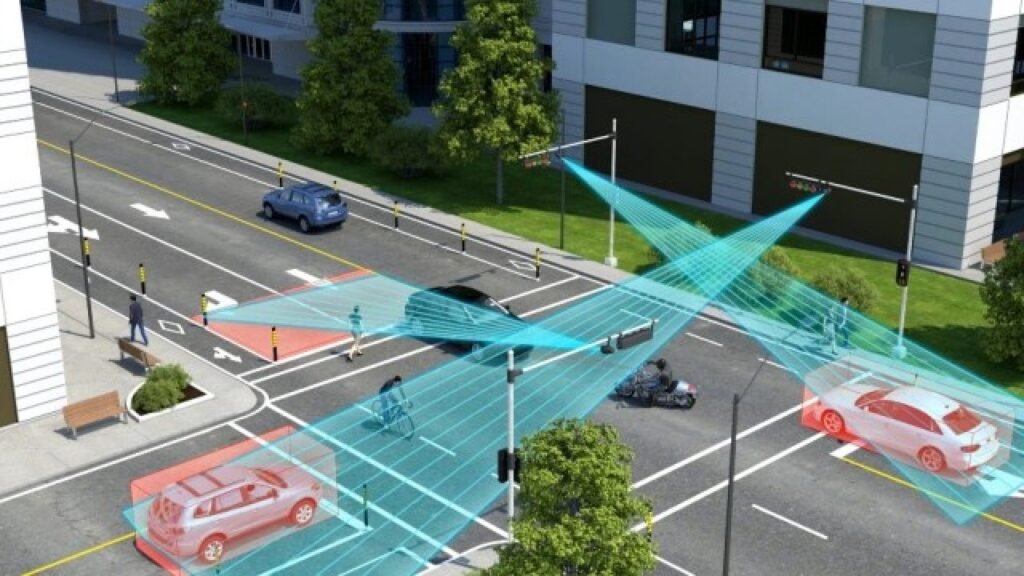
CLICK HERE RFID is modern and advanced tagging technology which allows keeping track of items and products regardless of any concerned industry. In this new era, we witness great inventions and discoveries now and then. On them is RFID technology developed from the smart, new, digital, and engineering technology. Looking deeper and clear into the innovation of RFID technology, it is used widely in every sector and industry to increase their productivity and efficiency. RFID is a technology that enables digital data encoded in RFID tags (smart labels) is captured and read through radio waves. https://www.assetinfinity.com/blog/smart-tags-in-healthcare-industry Following are three components of RFID: The RFID reader is the brain of the RFID system and it is necessary for a system to perform any function. The RFID reader transmits and receives radio waves to communicate the information with RFID tags. The readers are of two types – An RFID antenna is used to convert RFID reader signal into RFID waves to send to RFID tags. They receive their power from RFID readers directly. Without some type of RFID antennas, the reader won’t be able to properly send and receive signals to RFID tags, either it is integrated or standing alone. These transponders are making RFID innovation user-friendly and accurate. In the simplest form RFID tag constitute two parts – RFID tags do not have any battery, instead, they receive energy from the radio waves generated by the RFID reader. It has 3 frequency range: There are three types of RFID tags: Almost all the applications of RFID System on Roads are designed on the observance of Road Crashes that happened in some of the previous years. Let’s get started. The RFID tags are fixed on the roads’ surface and know their own location. A vehicle estimates its position by obtaining the position of a tag while passing/crossing over the tag. This RFID tag provides abundant information to the driver like: The user is benefited with real-time data of lane level navigation services which were not possible with the current Global Positioning System (GPS) as it used to provide low positioning accuracy. The unmanned ground vehicle is an idea in which everybody is dreaming of years. Many governments, universities, and private companies have tried and worked on this project like Google’s driverless car, General Motors, etc. Following are the reasons why RFID system on Roads is an excellent system to support driverless vehicles: There should be a certain distance between two of the vehicles for safe driving and road journey. This is an important parameter that gets unnoticed for safe driving. It is required to get aware of the real-time distance of vehicles on the road so that the driver can maintain a safe distance and can take necessary action on time (if required). What people usually do is estimate the distance of any vehicle from their vision and experience, as a result, affects by visibility. The vehicle distance estimation totally depends on the time synchronization among the vehicles and fast speed RFID read & write operations. It is required to get aware of the real-time distance of vehicles on the road so that the driver can maintain a safe distance and can take necessary action on time (if required). What people usually do is estimate the distance of any vehicle from their vision and experience, as a result, affects by visibility. The vehicle distance estimation totally depends on the time synchronization among the vehicles and fast speed RFID read & write operations. RFID (Radio Frequency Identification) technology utilizes radio waves to read and capture the data from the storage tag. The RFID tag can be attached to any object like clothes, electronic gadgets, daily use items, inventories, fleet, etc. It gets difficult in case of a good quantity fleet to read the informative RFID tags. ( https://www.assetinfinity.com/blog/types-of-rfid-tags-useful-for-organizations ) The attractive feature of the RFID technology is that the tag does not require direct line-of-sight of the reader to get itself detected. CLICK HERE Intelligent Traffic Management System (ITMS), is one of the advanced solution to the congested traffic conditions face by many cities.Those cities which are transmuting from rural to urban cities also created similar chaos. As a result of rapid industrialization and urbanization, many cities are facing increased volume of population which resulted in an unplanned city infrastructure. Unplanned infrastructures includes Road & Junctions, Sewerage Networks, and Utility Ducts etc. Increased population will be requiring Multi-mode Transport System for seamless daily commute. Because of the unplanned City infrastructure, heavy traffic congestion, traffic violations, road accidents and a disconnected Transport System will be a curse to the growing population. How Information and Communications Technology (ICT) enables Smarter Traffic Management System? A Smarter or Intelligent Traffic Management System (ITMS) will enables a well-managed traffic on the city roads. Solution will diminishes the traffic congestion, environmental pollution, less accidents & violations and restructure the improved utilization of Multi-Mode Transport System. Create linkages to support Information sharing through traffic controllers, Variable Message Signs, Public Address (PA) systems etc. Vital Components of the System comprises of: Automatic Number Plate Recognition (ANPR) System Red Light Violation Detection (RLVD) System E- Challan System automatic Number Plate Recognition (ANPR) System is one of the traffic enforcement solution which utilities Optical Character Recognition (OCR) technology for identifying and determining the numbers from the license plate of vehicles. Images of Vehicle is captured through CCTV camera and the captured image is analysed using dedicated computer software. Once the software recognizes the characters with the help OCR, it will automatically give the number on the screen. SVD System is also has a similar mechanism of determining violation. But instead of having an evidence camera as a trigger, it might be using a Radar technology to detect and trigger the camera for capturing a fast- moving vehicle. The major challenge in SVD system is that the camera should be capable enough to capture the snapshot of a fast-moving vehicle in both day time as well as night. In such a scenario, higher frame rate camera is the only option. Once all the systems are in place, the identified violations based on the ANPR system will be recorded in a central server from where a ticket/ challan will be automatically generated and sent to the Vehicle Owner through e-mail/ sms/ by post. adaptive Traffic Control System (ATCS) is one of the important ITMS component in restructuring the issues pertaining to City traffic. In the previous case, the system deals with Traffic Law enforcement issues whereas in ATCS, it is a different kind of business. ATCS focus on how to improve the free flow of Traffic in a City with the help of true technological intelligence. Important Technologies in Intelligent Transportation System Advanced Tracking System: Nowadays majority number of vehicles are fitted with in-vehicles GPS. The GPS system offers a two way communication helping traffic professionals to locate vehicles, check speeding vehicles, and provide emergency services. Smartphones, mobile apps, Google maps have become useful tools in tracking them, knowing road quality, traffic density and locating different routes and places. Advanced Sensing Technologies: These include intelligent sensors both in vehicles and road infrastructure. The Radio Frequency Identification (RFI) and intelligent beacon sensing technologies are ensuring safety of drivers in cities world over. Road reflectors, inductive loops are in built with road, helping in traffic control and safe driving especially during night. They can also inform about the vehicle density in a particular time period and can identify vehicles at both slow as well as high speed. lights system. The technology offers correct algorithm and database even when applied to multiple lanes, road junctions and vehicles. These lights can adjust themselves during critical and peak hour traffic situations without any manual presence. Emergency E-Call Vehicle Service: During emergency situation like accident or any mishap, in-vehicle sensors can establish a contact with the nearby emergency center. The e-call will help driver to connect with the trained operator and also transmit important information directly to the center such as time, location, direction of vehicle and vehicle identification. The e-call service has been made mandatory across Europe in all new approved vehicles. Benefits of Intelligent Transportation System Minimize Pollution: the aim of ITS is to promote use of public transport in general masses. By providing single point services and giving access to real time information about transport schedule, delays consumers will be drawn towards public transport reducing private car usage thereby lowering traffic congestion and lowering pollution levels. Also people will be motivated towards the use of clean fuel, bike sharing and carpooling habits. Security and Safety: the real time data analysis through GPS, CCTV, wireless and internet connectivity, advanced sensing technologies can help provide emergency and critical care services to drivers and travelers when required. Surveillance of public transportation can help city managers in alerting against terror elements and avoiding mishaps or terror attacks. now have multi-layer parking system. Also there are apps which guide users about the free parking space available nearby. While developed nations like United States, Europe, and Dubai have been investing heavily in ITS network for over a decade now. It is still a challenge for developing nations. The major problems faced by these countries in adoption of ITS network is lack of funding, lack of IT infrastructure, lack of formal transportation system, unplanned cities, illiteracy, poor public infrastructure etc. To emulate west, a lot has to be done in this arena from huge infrastructure funding to change in habits of general population and government’s initiative for better transportation infrastructure for present and future generation. Source: easytrip, assetinfinity, bangaloremirror, HT-Image, smartcitygroup Also Read: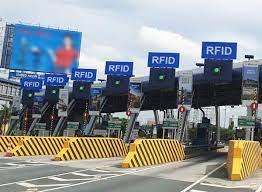
Components of RFID
1. RFID reader
2. Antenna
3. Transponders (RFID Tags)
Applications of RFID System on Roads
1. Navigation System
Unmanned Ground Vehicles
5. Vehicle Distance Estimation
Conclusion
Speed Violation Detection System
PA System
Adaptive Traffic Control System Centralized Control Command Center