

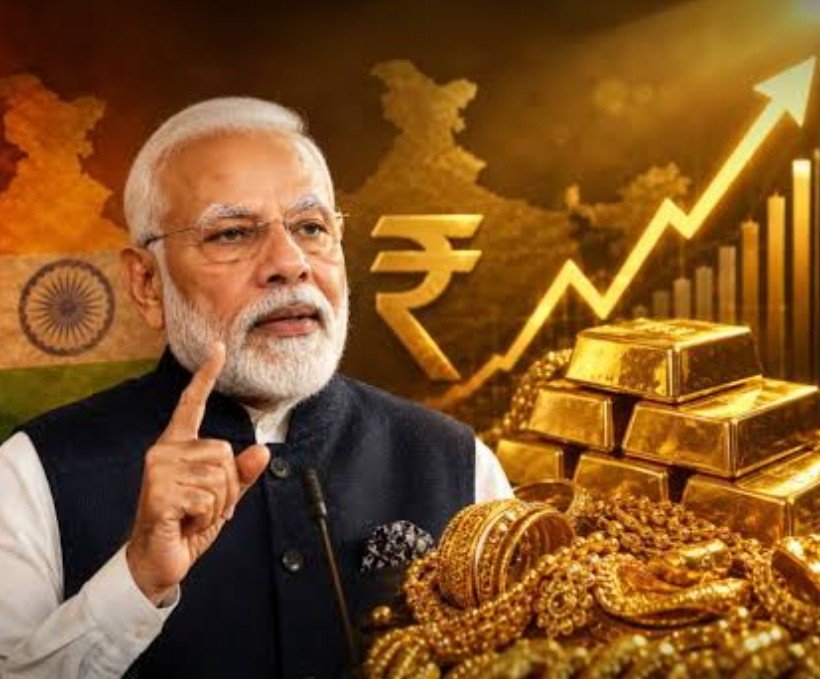
The Middle East war, along with the unrest in the Strait of Hormuz, has led to an unexpected increase in not only petroleum and gas prices, but also a sharp decline in gold prices. India purchases 80% of its petroleum and gas and 90% of its gold from abroad. Anticipating the rapid depletion of India’s foreign exchange due to this price increase, Prime Minister Narendra Modi appealed to citizens to refrain from purchasing gold for a year. However, this threat of war has now been virtually averted. Meanwhile, China is currently purchasing large quantities of gold from the international market. China’s foreign exchange is also spent on gold purchases, so China isn’t buying gold without reason. There must be some reason. The most important point is that if a war situation arises and the dollar weakens, this gold could be useful to a country. In such a situation, should India not focus on gold purchases now? What the Prime Minister will say to his countrymen and banks regarding gold purchases after the end of the war between Iran and the United States will only be known in the coming days. However, J.P. Murugan, a major player in the gold market, has presented a comprehensive analysis of the rising gold prices. Let’s find out what this analysis contains.
Analysts at J.P. Morgan Global Research estimate that gold prices could reach new record levels by the end of 2026, reaching nearly $6,000 per ounce in the fourth quarter and close to $6,300 per ounce in 2027, as reported by ANI. It also states that this forecast is made despite recent weakening investor interest and some stagnation in the market for some time.
According to the report, the average price of gold is expected to be $6,000 per ounce in the fourth quarter of 2026, and it could rise to $6,300 per ounce by the fourth quarter of 2027. The report states, “Gold price projections for 2026 and 2027 are higher than current levels. JPMorgan Global Research analysts estimate that gold prices will reach $6,000 per ounce by the end of the year, and $6,300 per ounce is possible in 2027.”
This projection comes at a time when gold prices have fallen in recent months. According to the report, spot gold prices surged strongly in early 2026, but declined in March and recently reached an annual low of $4,170 per ounce.
JPMorgan stated that geopolitical developments and monetary policy uncertainties are impacting the future of the precious metal. “Future demand and price stability depend on the resolution of current geopolitical conflicts and Federal Reserve policy—neither of which is certain at this time,” the report states.
JPMorgan Base And Greg Shearer, head of precious metals, said that investor enthusiasm for gold has currently waned. He said, “Gold remains technically stuck in a precarious position, slightly above its 200-day moving average of around $4,340 per ounce and currently confined below its 50-day moving average of $4,730 per ounce.”
“Amidst this slowing momentum, and growing concerns that the Fed may have to raise interest rates to respond to energy-driven inflation, gold has remained a low-hanging fruit for most investors,” Shearer said.
Despite this, the report states that the factors that have driven strong demand for gold over the past few years remain largely intact.
According to JPMorgan, concerns about high inflation, declining purchasing power, US fiscal pressures, geopolitical fragmentation, and policy uncertainty continue to support demand for gold as a safe-haven investment.
Central banks in the report The role of central banks, which have been a key driver of gold price surges in recent years, is also highlighted. Although official data shows that central banks sold 129 tonnes of gold in the first quarter of 2026 and recorded net purchases of only 16 tonnes, JPMorgan said alternative estimates suggest actual buying activity was much stronger.
The report, citing World Gold Council estimates, said that based on over-the-counter market data and Swiss refinery throughput, gold purchases could reach 244 tonnes in the first quarter of 2026, up from 208 tonnes in the previous quarter.
According to the report, China appears to be one of the major sources of demand. “China’s net imports of gold increased to 317 tonnes in the first quarter of 2026, almost three times higher than the previous quarter,” Shearer said.
He added, “In addition, the People’s Bank of China has increased its reported purchases, which are up from 16 tonnes in the first quarter of 2026 to 317 tonnes in the first quarter of 2026.” “China’s gold accumulation appears to be part of a broader strategy to diversify reserves and strengthen the renminbi’s position as an alternative reserve currency,” the report said, adding that gold has increased from a pace of about one tonne per month over six months to five tonnes in March and eight tonnes in April.