

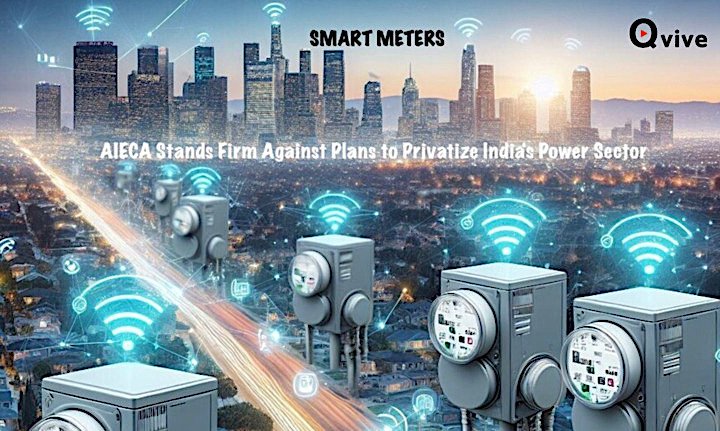
The All India Electricity Consumers’ Association (AIECA) has expressed serious concerns about the privatization of the power sector and the requirement for smart meters to be installed across the country. During a national convention in Delhi, attended by more than 900 consumers from different states, the association highlighted the negative effects this could have on both consumers and workers.

Swapan Ghosh, the President of AICEA, led the national convention. During the event, several important figures spoke, including Shailendra Dubey, the Chairman of the All India Power Engineers Federation (AIPEF), Samar Sinha, the President of the All India Power Mens Federation, Ashok Rao, a Patron of AIPEF, Bimal Das, an Advisor to AACEA, and A K Jain, along with other national leaders, as reported by V K Gupta.
In his opening speech, Dubey stated that privatizing electricity has been a failed attempt. This process began in Delhi back in 2002, and even after 22 years, the government has not evaluated the advantages and disadvantages of these so-called reforms. The privatization of electricity in places like Delhi, Mumbai, and Uttar Pradesh has resulted in ongoing and unfair increases in electricity prices.
The Chandigarh electricity department is now in the hands of a private company, even though many workers and customers strongly disagreed with this decision. The new smart meters being set up in different states will leave many workers who read meters and handle billing without jobs. The main people affected by the privatization of electricity are the consumers and employees, but the government has ignored their concerns.
Ashok Rao mentioned that a World Bank report indicates that privatizing the power sector does not enhance the performance of power distribution companies. Regarding the installation of smart meters, he called on the central government to conduct audits to review government spending and the benefits gained from it.
A K Jain mentioned that smart meters have already been set up for industries, and if smart meters are introduced for home users, it could lead to higher rates and worsen the financial situation of electricity distribution companies.
Venugopal, the general secretary of AIECA, announced that a protest week will be held in the first week of April. The goal is to inform consumers about the harmful impacts of power privatization and the use of prepaid meters. In June, they plan to send memorandums to the central energy minister via the state governors.

AICEA will also back the electricity workers’ strike on June 26, which is against the privatization efforts happening in Uttar Pradesh, Rajasthan, and other states throughout the nation.
Other speakers mentioned that electricity, which is a crucial public service, is being gradually transferred to private companies focused on making profits. They argue that this change has resulted in unfair increases in prices.
This will change electricity from a public service into a very profitable product for companies to benefit from. They also criticized the tough actions taken by some state governments, like cutting off electricity in homes with old meters to make way for smart meters.
Smart meters, while promoted for their benefits like real-time energy tracking and improved billing accuracy, come with several potential drawbacks, particularly in the Indian context:
- Increased Costs for Consumers:
- Although installation is often free, the rollout costs (e.g., India’s Rs 3,03,758 crore Revamped Distribution Sector Scheme) are typically passed onto consumers through higher tariffs over time. This can burden low-income households.
- Prepaid smart meters require upfront payment, which can strain finances, especially if recharge amounts deplete quickly due to outstanding balances or higher usage detection.
- Privacy Concerns:
- Smart meters collect detailed data on electricity usage patterns (e.g., every 30 minutes), potentially revealing personal habits like when occupants are home or asleep. In India, where data protection laws are still evolving, this raises significant privacy risks if data is misused or shared without consent.
- Billing Disputes and Perceived Overcharging:
- Many users in India, such as residents in Vadodara and Gujarat, have reported higher bills after smart meter installation, attributing it to faster depletion of prepaid balances or inaccuracies. While authorities often claim this reflects unpaid dues or actual usage, the lack of transparency fuels distrust.
- Technical Issues and Reliability:
- Smart meters can malfunction, lose connectivity, or fail to integrate with older systems, leading to billing errors or loss of “smart” functionality. In India, inconsistent network coverage in rural areas exacerbates this issue.
- Health and Safety Risks:
- Some critics globally argue that radiofrequency (RF) emissions from smart meters pose health risks, though evidence remains debated. In India, this concern is less prominent but occasionally raised by activists.
- There’s also a reported risk of fire hazards due to faulty installations or interference with appliances, as seen in isolated international cases.
- Lack of Consumer Choice:
- In some regions, installation has been perceived as mandatory, leading to protests (e.g., Gujarat, Mumbai) when consumers felt coerced or uninformed about opting out.
- Job Losses:
- Automation of meter reading reduces the need for manual readers, impacting employment in a country like India with a large workforce reliant on such jobs.
Vaskoora Protest: Locals Oppose Smart Meters Over High Bills
Residents of Habba Kadal, Srinagar oppose installation of smart meters
Protest of Smart Meter: માંગરોળમાં સ્માર્ટ મીટરને લઈને થયો સંગ્રામ | Surat
The Assam Tea Tribes Student Association (ATTSA) held a two-hour protest at the APDCL Margherita office, demanding the removal of smart meters. They claim these meters are harming the livelihoods of tea garden workers and call for their replacement within seven days. #ATTSA… pic.twitter.com/O0WdtCvDZk
— India Today NE (@IndiaTodayNE) September 16, 2024
Residents oppose installation of Smart Meters, hold protest in Jammu’s Jeevan Nagar
https://fb.watch/yy5RPSG8j_/?mibextid=rS40aB7S9Ucbxw6v
India lacks a specific nationwide law banning smart meters, as their rollout is part of a government-backed initiative. However, certain legal provisions and mechanisms could be leveraged to challenge or stop their installation, depending on the context:
- Electricity Act, 2003:
- Section 47: Deals with the power of distribution licensees to recover charges and security deposits. Critics, like the petitioner in the Gujarat High Court case (2024), have argued that prepaid smart meter regulations (requiring advance payment) may not align with this section if not properly notified or approved by Parliament.
- Section 55: Mandates the use of meters but doesn’t specify “smart” meters, leaving room to argue that forcing a switch from postpaid to prepaid smart meters exceeds the Act’s intent without consumer consent.
- Section 166: Establishes State Electricity Regulatory Commissions (SERCs), which can be petitioned to halt installations if they violate consumer rights or regulations.
- Central Electricity Authority (CEA) Regulations:
- The CEA’s 2019 notification under the Electricity Act introduced smart meter provisions. However, as raised in the Gujarat High Court, these regulations may be legally questionable if not tabled before Parliament, per constitutional norms for subordinate legislation. This could be a basis to challenge their enforceability.
- Consumer Protection Act, 2019:
- Section 2(9): Defines consumer rights, including the right to be informed and protected against unfair practices. If smart meters lead to inflated bills or forced installations without consent, consumers can file complaints with consumer forums.
- Section 2(47): Addresses unfair trade practices, which could apply if discoms mislead consumers about costs or benefits.
- Right to Privacy (Constitutional):
- The Supreme Court’s 2017 ruling in Justice K.S. Puttaswamy v. Union of India recognized privacy as a fundamental right under Article 21. Excessive data collection by smart meters without robust safeguards could be challenged as a privacy violation in courts.
- Local Government and Public Interest Litigation (PIL):
- Citizens or activists can file PILs in High Courts or the Supreme Court, citing public health, financial burden, or procedural irregularities (e.g., lack of parliamentary approval). The Gujarat High Court’s notices in 2024 to authorities reflect this approach.
- State-Level Resistance:
- States have some autonomy in electricity matters (a concurrent subject under the Constitution). Local laws or resolutions (e.g., Mumbai’s BEST suspending installations in 2024 after protests) can delay or stop rollouts if political or public pressure mounts.

Authorities Placing Smart Meters in India
The deployment of smart meters in India involves multiple stakeholders at central, state, and local levels:
- Central Government:
- Ministry of Power: Oversees the national policy, including the Revamped Distribution Sector Scheme (RDSS) launched in 2021, with an outlay of Rs 3,03,758 crore to install 19.79 crore smart meters by 2025-26.
- Central Electricity Authority (CEA): Formulates technical standards and regulations for smart meters.
- Nodal Agencies:
- REC Limited and Power Finance Corporation Limited (PFCL): Appointed to implement RDSS efficiently, often through public-private partnerships.
- Energy Efficiency Services Limited (EESL): A joint venture under the Ministry of Power, tasked with rolling out smart meters to address billing and collection inefficiencies of discoms.
- State-Level Distribution Companies (Discoms):
- These are the primary entities installing smart meters:
- Madhya Gujarat Vij Company Ltd (MGVCL): Active in Gujarat (e.g., Vadodara, Anand).
- Gujarat Urja Vikas Nigam Ltd (GUVNL): Coordinates Gujarat’s four discoms, targeting 1.64 crore smart meters.
- Brihanmumbai Electric Supply and Transport (BEST): Operates in Mumbai’s island city.
- Other state discoms like Tata Power (in parts of Mumbai) and various state electricity boards nationwide.
- These are the primary entities installing smart meters:
- Private Players:
- Companies like Tata Power, Genus Power, and HPL Electric & Power have secured contracts worth billions to supply and install smart meters under RDSS.
- State Electricity Regulatory Commissions (SERCs):
- Regulate discoms and can intervene if consumer complaints escalate (e.g., approving opt-out policies or halting rollouts).
In India, opposition to smart meter installation has emerged from a diverse group of individuals, organizations, political parties, and local communities, driven by concerns over increased electricity bills, privacy issues, job losses, and perceived coercion. While there isn’t a single comprehensive list of every entity involved, several notable groups and figures have publicly taken a stand against the rollout. Below is an overview based on available information up to March 24, 2025:
Political Parties and Leaders
- Rashtriya Janata Dal (RJD):
- In Bihar, the RJD, led by state president Jagdanand Singh, launched statewide protests starting October 1, 2024, against smart meters. They alleged corruption in the state’s Energy Department, claiming the meters benefit private companies and extort money from consumers. The party organized sit-ins and marches across block headquarters, demanding a halt to installations.
- Congress Party:
- In Gujarat, the Congress, alongside INDIA Alliance partner AAP, supported protests against smart meters in cities like Surat, Rajkot, Jamnagar, Anand, Godhra, and Dahod in 2024. Congress leader Ami Ravat criticized the focus on smart meters over providing electricity to unconnected households.
- In Mumbai, Varsha Gaikwad, a Congress leader and MLA, called for a “Jan Akrosh Morcha” on July 10, 2024, under AICC Maharashtra in-charge Ramesh Chennithala, to protest electricity price hikes and Adani smart meter installations, framing it as a fight against crony capitalism.
- Aam Aadmi Party (AAP):
- AAP joined Congress in Gujarat to back protests against smart meters in 2024, approaching district administrations to demand suspension of the project.
- Communist Party of India (Marxist) (CPI(M)):
- In Tamil Nadu, CPI(M) initiated a campaign against smart meters, arguing they threaten government subsidies and could lead to privatization of electricity supply.
- Jan Suraaj:
- In Bihar, Prashant Kishor, founder of Jan Suraaj, opposed smart meters in 2024, linking them to broader governance failures under Chief Minister Nitish Kumar, predicting electoral backlash in the 2025 Assembly polls.
- Bharatiya Janata Party (BJP) (in Jammu & Kashmir):
- Facing pressure in Jammu & Kashmir, the BJP sought a rollback of smart meter installations in 2023, emphasizing the need to prioritize the interests of low-income residents, despite the party’s broader support for modernization elsewhere.
Farmer and Trade Organizations
- Samyukta Kisan Morcha (SKM):
- In Bargarh, Odisha, farmers affiliated with SKM uprooted over 1,000 prepaid smart meters in a protest reported on March 17, 2025. SKM leaders like Rakesh Tikait, Ashish Mittal, Satyawan, Aflatoon, and Rajinder supported this action, highlighting a tradition of result-oriented farmer struggles in the region.
- Jammu Chamber of Commerce and Industry (JCCI):
- In Jammu & Kashmir, the JCCI organized protests in 2023 against smart meters, citing inflated bills and discrepancies in readings. Unsatisfied with verbal assurances, they threatened escalated action post-festive season, seeking written guarantees from authorities.
Local Communities and Activists
- Gujarat Residents:
- In Vadodara, Surat, Rajkot, and other cities, local residents protested in 2024 after receiving allegedly inflated bills post-smart meter installation. The movement gained traction, leading Gujarat’s four discoms to pause installations and install “check meters” in government offices to rebuild trust.
- Mumbai Residents and Activists:
- In Mumbai’s island city (Colaba to Sion/Mahim), public outcry in 2024, supported by activists and politicians like MLA Amin Patel, forced BEST to suspend smart meter installations for residential users on August 21, 2024. Nearly 3 lakh meters had been installed before the halt.
- Bihar Protesters:
- Beyond political parties, sections of the public in Bihar protested in 2024, aligning with RJD’s marches, driven by fears of rising costs and service disconnections for low-income households.
- Tamil Nadu Consumers:
- Alongside CPI(M), local communities in Tamil Nadu resisted smart meters, citing billing transparency issues and potential subsidy losses.
- Madhya Pradesh and Rajasthan Consumers:
- Residents reported unexpected power cuts and faulty readings after installations, contributing to grassroots opposition in these states.
Legal and Consumer Advocacy Efforts
- Gujarat High Court Petitioners:
- In 2024, individuals and groups filed petitions in the Gujarat High Court, challenging the legality of smart meter regulations under the Electricity Act, 2003. The court issued notices to the Central Government and discoms, questioning whether these regulations were tabled before Parliament, fueling broader resistance.
- Consumer Groups:
- While specific names aren’t widely documented, consumer advocacy groups have supported legal challenges and public awareness campaigns, particularly around privacy and billing disputes, as noted in various states.
Context and Impact
The opposition spans urban and rural areas, with protests leading to tangible outcomes in some cases:
- Gujarat: Installation paused after high-level discom meetings in 2024.
- Mumbai: BEST suspended residential installations in August 2024.
- Bihar: The Nitish Kumar government considered slowing or halting the rollout until after the 2025 polls due to growing unrest.
This resistance reflects a mix of economic, social, and political grievances, with groups leveraging public sentiment, legal avenues, and direct action. However, the movement isn’t fully unified—each region and entity has its own motivations, from protecting subsidies to opposing privatization or addressing local billing woes.
Below is a sample letter you can adapt to write to the authorities in India to request stopping or reconsidering the installation of smart meters. This letter is formal, concise, and incorporates legal and practical points relevant to your situation. Adjust the details (e.g., names, addresses, specific grievances) based on your circumstances and the authority you’re addressing (e.g., discom, SERC, or local government).
[Your Full Name]
[Your Address] [City, State, PIN Code] [Email Address] [Phone Number] [Date: March 25, 2025]To
[The Designation of the Authority, e.g., Managing Director] [Name of the Authority, e.g., Madhya Gujarat Vij Company Ltd (MGVCL)] [Office Address] [City, State, PIN Code]Subject: Request to Stop Installation of Smart Meters and Address Consumer Concerns
Dear Sir/Madam,
I am writing to express my concerns regarding the ongoing installation of smart meters in [your area/locality, e.g., Vadodara] under the [mention scheme if known, e.g., Revamped Distribution Sector Scheme]. While I understand the intent to modernize electricity distribution, I respectfully urge you to reconsider or halt this initiative due to its adverse impact on consumers like me and potential legal irregularities.
The installation of smart meters poses several disadvantages, including:
- Financial Burden: Post-installation, many residents, including myself, have observed inflated electricity bills [or specify your issue, e.g., “faster depletion of prepaid balances”], which disproportionately affects low-income households.
- Privacy Violation: The detailed data collection by smart meters raises serious concerns about the misuse of personal information, especially given the absence of robust data protection safeguards.
- Lack of Consent: The process appears coercive, with insufficient communication about opting out, undermining consumer choice.
- Technical Issues: Reports of malfunctioning meters and billing disputes further erode trust in this technology.
Moreover, I question the legal basis of this rollout. The Gujarat High Court’s notices in 2024 to the Central Government and discoms highlighted that regulations under the Electricity Act, 2003, may not have been tabled before Parliament, potentially rendering them unenforceable. Additionally, under Section 47 and Section 55 of the Act, forced transitions to prepaid smart meters without consumer approval may exceed statutory intent. The Consumer Protection Act, 2019, also safeguards my right to be informed and protected from unfair practices, which I believe are being violated here.
In light of these issues, I request the following:
- Immediate suspension of smart meter installations in [your area] until public consultations are held.
- Provision of an opt-out option for consumers who prefer conventional meters.
- Transparency regarding costs, data usage policies, and evidence of parliamentary approval for the smart meter regulations.
- A written response addressing these concerns within [specify a reasonable timeframe, e.g., 15 days].
I urge you to prioritize consumer welfare over hasty implementation. Should this matter remain unresolved, I may seek redressal through the [State Electricity Regulatory Commission/consumer forum/courts], as is my right. I have enclosed [mention any evidence, e.g., “copies of inflated bills”] to substantiate my claims and am willing to discuss this further.
Thank you for your attention to this pressing issue. I look forward to your prompt action and response.
Yours sincerely,
[Your Full Name] [Signature, if submitting a hard copy] [Consumer Account Number, if applicable]Enclosures: [List any attachments, e.g., bill copies, news articles]
Additional Information:
Smart meters are manufactured by a variety of companies worldwide, ranging from large multinational corporations to specialized firms focused on energy management and metering solutions. These manufacturers often develop both the hardware (the physical smart meter devices) and the programming or software that enables their functionality, such as real-time data collection, communication with utility systems, and user interfaces. Below is an overview of key players in the smart meter industry and insights into the programming typically used, based on their prominence and contributions to the field.
Major Manufacturers of Smart Meters
- Landis+Gyr
- Overview: A Switzerland-based global leader in energy management solutions, Landis+Gyr is one of the most prominent smart meter manufacturers. They provide advanced metering infrastructure (AMI) and smart grid technologies.
- Products: Their smart meters, like the Revelo and E360 series, offer real-time data collection, remote management, and integration with IoT systems.
- Programming: Landis+Gyr develops proprietary firmware and software platforms (e.g., Gridstream Connect) that support two-way communication, data analytics, and grid management. These systems often integrate with utility software via standards like DLMS/COSEM (Device Language Message Specification/Companion Specification for Energy Metering).
- Itron Inc.
- Overview: A U.S.-based company, Itron is a major player in smart metering for electricity, gas, and water. They serve utilities and municipalities globally, with over 200 million devices deployed.
- Products: Itron’s smart meters (e.g., the eHZB meter) include advanced metering capabilities and support for smart grid applications.
- Programming: Itron uses a combination of embedded firmware and software solutions like Itron Analytics and OpenWay, which leverage IoT protocols (e.g., IPv6) and communication standards such as Zigbee, RF Mesh, or cellular networks (4G/5G).
- Honeywell International Inc. (Elster)
- Overview: Honeywell, through its Elster division (acquired in 2015), is a significant manufacturer of smart meters for electricity, gas, and water. It operates globally and focuses on precision and reliability.
- Products: The Elster smart meters support AMI and include features like remote monitoring and tamper detection.
- Programming: Honeywell integrates its meters with software like Connexo, which uses open standards (e.g., IEC 62056) and supports cloud-based analytics and cellular communication.
- Sensus (a Xylem brand)
- Overview: Sensus, owned by Xylem Inc., specializes in smart metering and communication technologies for utilities, with a strong presence in the U.S. and beyond.
- Products: Their smart meters provide real-time data for electricity, gas, and water, often integrated into smart grid systems.
- Programming: Sensus employs its FlexNet communication network, a proprietary system that uses radio frequency (RF) and supports AMI. The software is designed for scalability and cybersecurity, adhering to standards like ANSI C12.19.
- Siemens AG
- Overview: A German multinational, Siemens is a key player in industrial manufacturing, including smart metering solutions for utilities.
- Products: Siemens’ smart meters (e.g., Gridscale X series) focus on grid management and distributed energy resources.
- Programming: Siemens develops software like EnergyIP MDM, which integrates with smart meters for data management and analytics, using protocols like MQTT and OPC UA for communication.
- Schneider Electric
- Overview: A France-based company, Schneider Electric offers energy management solutions, including smart meters for residential, commercial, and industrial use.
- Products: The PowerLogic and EM6400NG+ series are examples of their smart metering offerings.
- Programming: Schneider’s meters are supported by software like EcoStruxure, which uses IoT and cloud computing for real-time monitoring and control, often based on open protocols like Modbus.
- Genus Power Infrastructures Ltd.
- Overview: An India-based company, Genus Power is a leading smart meter manufacturer in Asia, with a significant market share in India’s metering industry.
- Products: They produce single-phase and three-phase smart meters with features like remote load management and GSM/RF communication.
- Programming: Genus develops firmware and software for AMI, often tailored to regional standards and integrated with utility billing systems.
Other Notable Manufacturers
- Kamstrup (Denmark): Known for high-precision smart meters, especially for water and electricity, with software supporting remote monitoring and analytics.
- Sagemcom (France): A European leader offering smart meters with open communication standards and advanced security features.
- EDMI (OSAKI Electric Co., Ltd., Japan): Specializes in energy management systems and smart meters, with a focus on Asia-Pacific markets.
Programming and Software Used
The programming for smart meters involves both embedded firmware (running on the meter itself) and external software (for data management and communication). Here’s a breakdown:
- Embedded Firmware
- Purpose: Controls the meter’s core functions, such as measuring consumption, storing data, and enabling communication.
- Languages: Typically written in low-level languages like C or C++ for efficiency on resource-constrained hardware (microcontrollers).
- Standards: Adheres to protocols like DLMS/COSEM, ANSI C12.19, or IEC 62056, ensuring interoperability with utility systems.
- Features: Includes real-time clock synchronization, tamper detection, and data encryption for security.
- Communication Protocols
- Wireless: Zigbee, RF Mesh, LoRaWAN, NB-IoT, or cellular (3G/4G/5G) for transmitting data to utilities.
- Wired: Power Line Communication (PLC) or RS485 for direct connections.
- IoT Integration: Many modern smart meters use MQTT or REST APIs to connect with cloud platforms.
- External Software
- Utility Side: Platforms like Itron’s OpenWay, Landis+Gyr’s Gridstream, or Siemens’ EnergyIP process meter data for billing, analytics, and grid management. These often use cloud-based architectures and support big data analytics with AI.
- Consumer Side: Apps or web portals (e.g., Schneider’s EcoStruxure or Honeywell’s user interfaces) allow users to monitor usage, often built with modern frameworks like JavaScript, Python, or Java.
- Cybersecurity: Encryption standards (e.g., AES-256) and secure boot mechanisms protect data integrity.
- Customization
- Manufacturers often provide customizable firmware and software development kits (SDKs) to utilities, allowing them to adapt the meters to specific regional requirements or grid systems.
Trends in Smart Meter Programming
- IoT and AI: Increasing use of IoT for connectivity and AI for predictive maintenance and demand forecasting.
- Open Standards: Growing adoption of open protocols to ensure interoperability across different manufacturers’ devices.
- Cloud Integration: Shift toward cloud-based platforms for scalability and real-time data access.
- Sustainability: Programming now often includes features to support renewable energy integration and energy efficiency.
Source: Linkedin-image, Youtube
Also Read: