

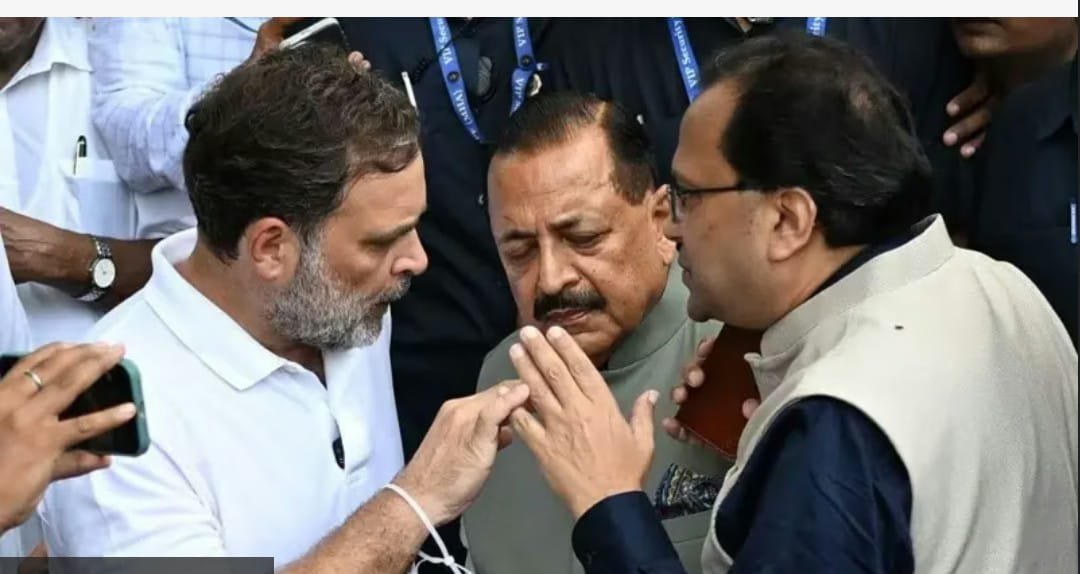
Yesterday, July 21st, the Congress party held a massive protest demanding the resignation of Education Minister Dharmendra Pradhan in connection with the NEET UGC question paper leak. This protest, led by Rahul Gandhi, took place very close to the Prime Minister’s residence, making the issue extremely sensitive and explosive. Rahul Gandhi’s protest was organized so secretly and forcefully that it left the Narendra Modi government in a state of panic. The government then hastily dispatched Union Minister Jitendra Singh to speak with Rahul Gandhi. What transpired between the two is known only to them, but Jitendra Singh revealed that Rahul Gandhi initially demanded the government raise the NEET UGC paper leak issue in the House, which the government accepted. However, Rahul Gandhi subsequently reneged on his promise and demanded that he would not stop the protest until the government accepted the resignation of Education Minister Dharmendra Pradhan. Following this, the government swung into action, and after considerable effort, the police removed several senior Congress leaders, including Rahul Gandhi and Priyanka Gandhi, from the scene and took them to various locations. Rahul Gandhi was taken to Chhatrasal Stadium, and Priyanka Gandhi to the Mandir Marg police station, where she was later released.
The matter was quickly resolved, but it left behind several lingering questions. The biggest question in this case was how our intelligence system failed to gather any prior information about such a large protest outside the Prime Minister’s residence, even when a large number of people were already attending Congress President Mallikarjun Kharge’s birthday celebrations. Rahul Gandhi’s social media invitation to his protest outside the Prime Minister’s residence raised fears that these protesters might enter the Prime Minister’s residence and cause something untoward to Prime Minister Narendra Modi, leading to a situation similar to Bangladesh or Nepal.
With this powerful demonstration by the Congress party led by Rahul Gandhi near the Prime Minister’s residence, the question has now arisen: has Rahul Gandhi become a puppet in the hands of anti-India forces, both within the country and abroad, who believe in disintegrating India, and is actively carrying out their plans through his actions?
To answer this question, it is important to examine Rahul Gandhi’s activities. During several of his previous foreign visits, Rahul Gandhi has stated that democracy no longer exists in India. Furthermore, during several events in India, he has stated that Narendra Modi will cease to be Prime Minister after six months. He also stated that just as the “Jiji” (General Secretary) changed the government in Bangladesh and Nepal, the “Jiji” (General Secretary) will replace Narendra Modi’s government in India. In such a situation, although the students involved in the NEET UG case or their parents did not attend the protest led by Rahul Gandhi outside the Prime Minister’s residence on July 21st, the manner in which Rahul Gandhi spoke of his will and, through social media posts, urged people to join the protest taking place right outside the Prime Minister’s residence, strongly resembled the actions taken to forcibly overthrow the government in Bangladesh and Nepal.
Rahul Gandhi enjoys Z-category and SPG security in India. Under these security measures, he is required to inform these security agencies whenever traveling abroad. However, Rahul Gandhi does not do this during his foreign trips. He does not disclose his whereabouts, his activities, or whom he is meeting. Even before the violent protest outside the Prime Minister’s residence on July 21st, Rahul Gandhi had been abroad for 20-22 days without informing anyone. No one knew who he was meeting there or what plans he was working on. This time, he didn’t even say anything about Indian democracy abroad. Even after returning to India, he remained silent, even though India’s intelligence agencies didn’t suspect him. However, this time, the possibility of Rahul Gandhi’s involvement in the matter began to surface among the general public. On July 21st, he demonstrated with a strong protest outside the Prime Minister’s residence, demonstrating that his foreign trip was not without reason.
Article 19(1)(a) of the Indian Constitution grants freedom of expression to all citizens of India. This right allows every citizen to freely express their opinions, views, and beliefs verbally, in writing, or through any other medium. This right is a key part of Part III (Fundamental Rights) of the Indian Constitution. Rahul Gandhi is a citizen of India, the Leader of the Opposition in the Lok Sabha, and a prominent leader of the Congress, a major political party in the country. Consequently, he has complete freedom to protest. However, the Indian Constitution also stipulates that he cannot avail himself of this freedom in certain cases.
Under Article 19(2) of the Indian Constitution, the state can impose certain reasonable restrictions (such as in cases of sovereignty, security, public order, and contempt of court). Under Article 19(1)(a) of the Indian Constitution, Rahul Gandhi and other protesters could have demonstrated only in cases and places where Article 19(2) of the Indian Constitution did not prohibit them from doing so. But if Rahul Gandhi deliberately violated Article 19(2) of the Indian Constitution by secretly and suddenly staging such a massive protest near the Prime Minister’s residence as part of a conspiracy, shouldn’t he face serious legal action?
Prime Minister Narendra Modi’s government is equally responsible for this matter. After the Bharatiya Janata Party won elections and formed governments in various states, Prime Minister Narendra Modi and Home Minister Amit Shah have no different from others, claiming that whatever they do is right. Under this, if we look at the activities of his own party, he appoints whoever he wishes as Chief Minister of any state and National President of his party. There is no set process for this, it is solely the will of these two. While senior party leaders may prefer to remain silent given the current situation, they too harbor resentment within.
The BJP’s success in winning elections in various states and forming governments has perhaps led PM Modi to believe that he is now in a position to rule the country at will. This is why he and his party, the BJP, label anyone who opposes his policies as traitors. For example, recent changes to the Motor Vehicles Act have established a 10-year prison sentence and a fine for anyone involved in an accident. There is no maximum penalty limit, but the penalty generally exceeds 7 lakh rupees. Now, how can a poor driver who drives someone else’s car to feed his family pay such a hefty fine? And what will be the condition of his family if he ends up in jail for 10 years?
Let’s talk about the failure of PM Modi’s government on the education front, which prompted the Congress party, led by Rahul Gandhi, to stage such a massive protest outside the Prime Minister’s residence. While the new Education Policy 2020 introduced by Prime Minister Narendra Modi’s government contains numerous inconsistencies, PM Modi’s government, driven by arrogance, is doing nothing to address these discrepancies. When the question paper leak in the NEET UG exam surfaced, the government initially refused to acknowledge it, and even after admitting to the matter under public pressure, it failed to take any significant action. When students and opposition political party leaders held Education Minister Dharmendra Pradhan responsible and demanded his resignation, PM Modi refused to reprimand him, let alone take action against him.
Only when the NEET UG question paper leak scandal gained such momentum did Prime Minister Narendra Modi take notice. Speaking on the matter at the NDA conference, he stated that foolproof examination procedures would be implemented in the future and that those responsible for the current NEET UG question paper leak would be punished severely by hiring a top lawyer. Most people are considering this statement by Prime Minister Narendra Modi a cover-up, as he did not mention Education Minister Dharmendra Pradhan in the matter. On the other hand, here too, the talk of giving the harshest punishment to the culprits only reflects the arrogance of the Prime Minister, because according to criminology, even the harshest punishment cannot stop crime. On the contrary, in such cases, the criminals commit crimes by conspiring with the law keepers on the strength of corruption. The case of question paper leak in NEET UG exam also confirms this because those who prepared the question paper are also involved in the leak of this question paper. Also, in this case, a law was made for 5 to 10 years of imprisonment and a huge fine of Rs 1 crore for organized crime. Crime is stopped by vigilance and punishment to the culprits, even if it is small.
This demonstration led by Rahul Gandhi on July 21 proved one thing that at this time, whether it is the minister of the ruling party or the leader of the opposition political party, everyone sacrifices even the interest of the country for their own benefit, but the Indian citizens are alert and they are not going to be misled by any of these leaders and neither is India Bangladesh or Nepal, rather it is a strong democracy.