

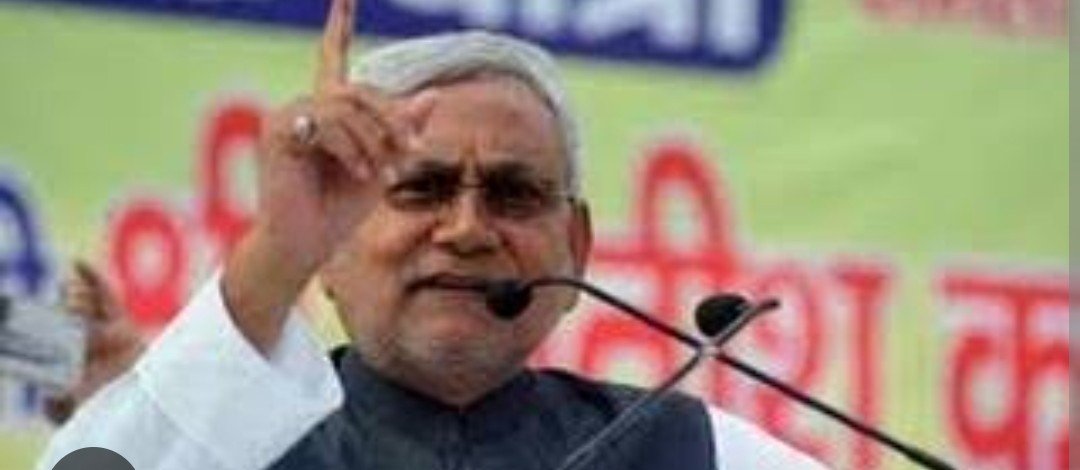
After resigning as Chief Minister of Bihar, Nitish Kumar appointed his favorite, Samrat Chaudhary, from the BJP camp, as the NDA’s Chief Minister. Following this development, a major question arose in Bihar politics: “With Nitish Kumar losing the Bihar Chief Ministership, will his political career also gradually come to an end?” Leader of the Opposition in the Bihar Assembly and RJD leader Tejashwi Yadav even stated that the BJP has trapped Nitish Kumar and, by appointing Samrat Chaudhary as the Chief Minister of his party, has put an end to his future political career. Nitish Kumar himself became quite emotional during his final cabinet meeting before resigning as Chief Minister.
So, should we assume that Nitish Kumar’s political career is slowly coming to an end?
If you look closely at Nitish Kumar’s political career, you’ll find that it’s by no means certain that his political career will end after this. Previously, whenever Nitish Kumar felt threatened by the BJP, he sidelined the BJP and joined the RJD-led Grand Alliance, firmly occupying the Chief Minister’s seat and advancing his political career. It wasn’t just the BJP, but even while serving as Chief Minister, when he felt threatened by the Grand Alliance, he sidelined it and continued to advance his political career by allying with the BJP. This time, too, the RJD camp was offering him the opportunity to become Chief Minister if he left the BJP and joined their side. However, Nitish Kumar has completely changed his old ways, handing over the Chief Minister’s seat to BJP leader Samrat Chaudhary and himself going to the Rajya Sabha. Even after recently bringing his son Nishant Kumar into politics, he made no effort to secure a major position for him by including him in the cabinet.
After winning the Bihar Legislative Assembly elections in 2025, when the NDA government was formed under the leadership of Nitish Kumar, and when Nitish Kumar’s cabinet was being formed, Upendra Kushwaha, the national president of the Rashtriya Lok Morcha, appointed his son Deepak Prakash, who was neither a member of the Bihar Legislative Assembly nor the Legislative Council, as the chief minister.
However, Nitish Kumar, the national president of the JDU and Bihar’s longest-serving chief minister, did not do this for his son, Nishant Kumar. Had he done so, who could have stopped him? But he has a political game to play that is even bigger than the one he has played so far. During his swearing-in ceremony alongside Bihar Chief Minister Samrat Chaudhary, he inaugurated his new political innings by swearing in two senior and loyal MLAs of his party, Vijay Chaudhary and Vijendra Yadav, as deputy chief ministers.
Initiating this new political game, Nitish Kumar briefly made two important remarks. Firstly, he had a heartfelt desire to enter the Rajya Sabha, the upper house of Parliament. Second, he intended to continue playing an active role in Bihar politics despite ceasing to be the Chief Minister of Bihar after his entry into the Rajya Sabha. In this new political space, he cleverly conceals a significant desire, as revealing it at this time could eclipse his new political position. The BJP, a major constituent of the NDA he currently belongs to, could also devour this new political space as Rahu. He has previously declared the goals of this new political space while in the opposition, only to see how all his efforts backfire.
By now, you should have figured out that Nitish Kumar’s entry into the Rajya Sabha, the upper house of Parliament, is the first step in his new political career, which could lead him to the highest practical position in the country: the Prime Minister. I have described the position of Prime Minister as the highest practical position in the country because, although the President holds the highest office in the country, the Prime Minister actually exercises his powers. If Nitish Kumar wishes to assume the highest office in the country, the presidency, the BJP will fulfill his wish only after the current President Draupadi Murmu’s term ends next year. However, Nitish Kumar is unlikely to have such a desire, as this would easily provide the BJP with a significant opportunity to strengthen its political presence in Bihar. On the other hand, Nitish Kumar would be isolated from future politics, and he has not yet been able to establish his son, Nishant Kumar, in politics.
After becoming Chief Minister of any state, a major desire is to become Prime Minister of the country. Some, like Narendra Modi, succeed in this, while a large number of individuals remain at the Chief Ministership. And many soon lose their Chief Ministership within a few days.
Many people like Mulayam Singh Yadav and Lalu Yadav served for long periods as Chief Ministers of Bihar and Uttar Pradesh, states with a large number of Lok Sabha seats. Uttar Pradesh, where Mulayam Singh Yadav was Chief Minister, has the highest number of Lok Sabha seats in the country. He also served as a minister at the Centre. Lalu Prasad Yadav used to call himself a kingmaker. However, even these people could not reach the Prime Minister’s post because they lacked PM material.
But Nitish Kumar has PM material. And on the strength of this PM material, he has been making significant efforts to become PM whenever the opportunity arises. Aiming to build a pan-India image, Nitish Kumar made a significant effort to make the JDU a national party. Beyond Bihar, he expanded his party’s territory by having the JDU contest elections in Arunachal Pradesh. He also participated in the government in Manipur by contesting elections with the ruling party, along with his MLAs. In Kerala, he merged the Socialist Janata Democratic Party with the JDU, leading to the merger of the Socialist Janata Democratic Party (SPD) with the JDU, which also led to the joining of the JDU MLAs. Despite his best efforts, Nitish Kumar failed to secure national party status for the JDU from the Election Commission.
Let’s now discuss Nitish Kumar’s potential as PM material and his previous efforts to secure the position.
When the NDA alliance led by L.K. Advani lost the 2009 elections, Nitish Kumar, then Chief Minister of Bihar, while still a part of the NDA, began working to ensure that L.K. Advani’s candidacy for the 2014 general elections was not contested. His intention was to establish himself as the NDA’s prime ministerial face. However, he succeeded in achieving this feat. The BJP acknowledged the lack of L.K. Advani as its prime ministerial face in the 2014 elections, but maintaining its party’s supremacy in choosing the prime ministerial face, chose the then Chief Minister of Gujarat, Narendra Modi, in 2013. Even after this, Nitish Kumar, through his party leaders, began pressuring him to replace Narendra Modi as the NDA’s prime ministerial candidate, claiming he was PM material. However, other NDA parties stood with the BJP on this issue. Nitish Kumar then, in 2013, opposed Narendra Modi’s nomination as the prime ministerial candidate, and separated the JDU from the NDA. Subsequently, when the NDA, led by Narendra Modi, achieved significant success in the 2014 Lok Sabha elections, Nitish Kumar’s prime ministerial aspirations, which his supporters had repeatedly promoted, were dashed.
Following this, Narendra Modi continued to emerge as the NDA’s prime ministerial face and continued to win, and with this, Nitish Kumar’s hopes of becoming prime minister continued to be dented.
As the 2024 general elections approached, Nitish Kumar intensified his efforts to find a path to the prime ministerial position. He formed the India Alliance with all the opposition parties and joined in getting himself declared its coordinator so that if the opportunity arose to form the India Alliance government by defeating the NDA government, he could attain the post of Prime Minister as the coordinator of this India Alliance. But when this started getting delayed and infighting started within the India Alliance, he took a 180 degree turn from his politics to reach the Prime Minister’s post, leaving the India Alliance and joining the NDA led by PM Modi.
Now, since Nitish Kumar has to adopt a new politics instead of the politics he had adopted earlier to reach the Prime Minister’s post, he has to adopt a different strategy for this. Under this, he left the post of Chief Minister of Bihar and made his favorite Samrat Chaudhary sit on the Chief Minister’s chair. To ensure that he does not spoil his new politics by misdirecting it, he made two of his trusted men the Deputy Chief Ministers instead of his son and is now going to the Rajya Sabha himself, so that he can take his new politics forward from there.