

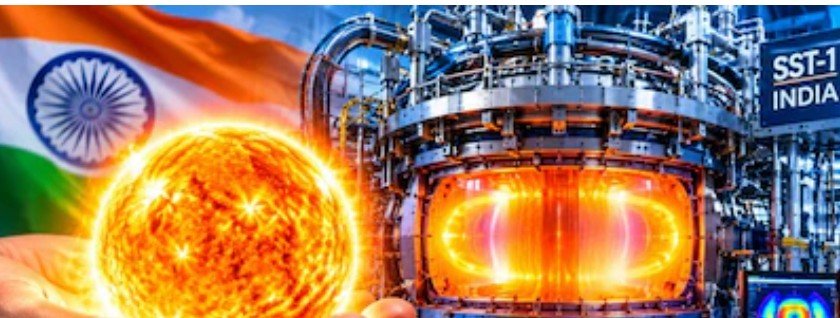
Many countries on Earth are creating their own suns! This sounds like a story straight out of a science fiction film, but scientists from China to India are working in this direction. China calls its EAST (Experimental Advanced Superconducting Tokamak) an “artificial sun.” India is now taking a major step forward in its efforts to generate solar-like energy.
A new and more powerful gyrotron has been added to India’s fusion research machine, SST-1, at the Institute for Plasma Research (IPR) in Gandhinagar, Gujarat. This system operates at a frequency of 82.6 GHz and a capacity of 400 kilowatts. Its purpose is to enhance scientific capabilities in heating and controlling extremely hot plasma for extended periods.
China’s EAST fusion experiment is one of the most talked-about projects in the world. In January 2025, China claimed that EAST maintained plasma at temperatures exceeding 100 million degrees Celsius for more than 1,000 seconds. This is crucial for fusion research because simply generating high temperatures is not enough; maintaining plasma at that temperature for a long time is also essential.
China says it also has another fusion device, the HL-3. In March 2025, this machine reached ion temperatures of approximately 117 million degrees Celsius and electron temperatures of approximately 160 million degrees Celsius. Now, India is also pursuing this extremely difficult fusion technique.
The question now arises: why was there a need to create an ‘artificial sun’?
The answer lies in the power of the sun. In fact, the sun continuously produces energy. Due to the extremely high temperatures and pressures within it, light atoms like hydrogen fuse together. This process is called nuclear fusion. This process releases enormous amounts of energy.
Scientists want to replicate this same process that occurs inside the Sun in a controlled manner on Earth. If this becomes possible, the world could have a very powerful and relatively clean way to generate electricity in the future. However, this is not easy, and scientists face daunting challenges.
Recreating the Sun on Earth is a very difficult task.
The Sun is very large, and its tremendous gravity binds the hot matter inside it. However, scientists on Earth lack such a powerful gravitational force. To overcome this shortcoming, scientists have developed a machine called a tokamak.
A tokamak, simply put, is a large, donut-shaped machine. Inside, gas is heated to such a state that it turns into plasma. This plasma is then kept away from the walls of the machine using a powerful magnetic field, as the plasma’s temperature is so high that touching the walls directly could cause serious problems.
India’s SST-1, or Steady State Superconducting Tokamak, is a similar experimental fusion machine. Its purpose is to understand the technology for generating the extremely hot plasma required for fusion and controlling it for long periods of time. Indian scientists have already conducted fusion experiments and achieved plasma temperatures exceeding 200 million degrees Celsius. This temperature is approximately 20 times higher than the temperature at the Sun’s core.
The question arises: when India has already achieved such high temperatures, why was a new gyrotron needed? The real challenge is not just increasing the temperature, but managing the resulting plasma. The new 82.6 GHz, 400 kW gyrotron will help with this task. A gyrotron is a machine that generates extremely high-frequency microwave energy. This energy is used to heat the plasma within the tokamak.
The new system being used in India offers greater capacity than previous systems. This will allow scientists to better study the hotter plasma and its behavior.
According to scientists, if fusion technology succeeds in the future, it will benefit more than just scientists or space researchers. It will also have a direct impact on the lives of ordinary people. Today, fuels like coal, oil, and gas are used extensively to generate electricity. These create pollution and carbon emissions. However, electricity generated from the artificial sun will alleviate these problems.
If scientists succeed in using fusion in a practical way, it could open up a new avenue for large-scale power generation in the future. This will help reduce dependence on traditional fuels like coal and gas for power generation.
For now, it’s important to understand that the SST-1 is an experimental fusion machine. The new gyrotron is also not a power generator; it’s a powerful system used to heat plasma. This means that India has not yet reached the stage where fusion can generate electricity on a commercial scale.
Nevertheless, this step is significant for scientists. This is because one of the most difficult tasks in achieving fusion energy is controlling extremely hot plasma.
China has achieved significant achievements in controlling extremely hot plasma for long periods of time through EAST. India is progressing its fusion energy production through SST-1.Then, the world could have an energy alternative that could play a major role in meeting the electricity needs of future generations.