

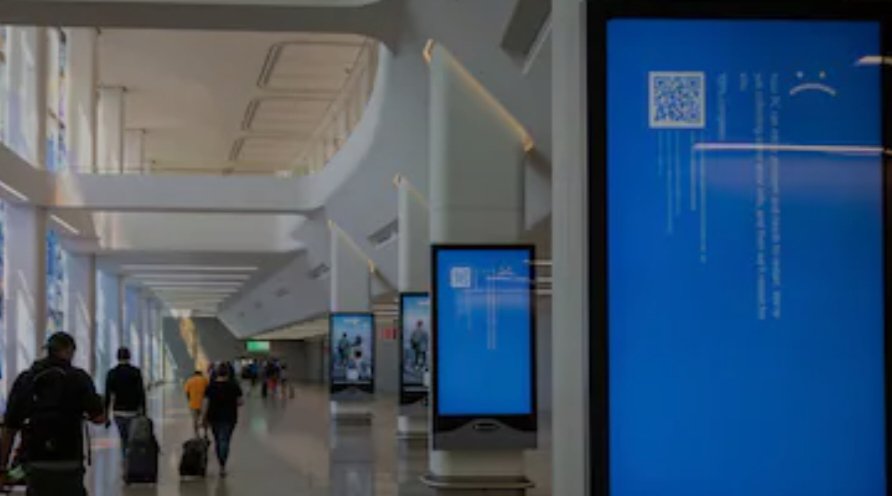
Between November 12th and 14th, 2026, a major technical glitch on Microsoft servers caused widespread chaos worldwide. This outage disrupted millions of users, government offices, banks, and airline services in more than 74 countries for nearly 24 hours. India was not spared, but the devastation caused by the Microsoft outage was relatively less compared to other countries. This was possible because India had a few backups for many matters. Some in the form of traditional hard copies, and some in the form of software, the hardware of which was also available in India and developed entirely using indigenous technology. This type of Microsoft outage, causing devastation across the world, isn’t a one-off occurrence; it happens from time to time. However, India has now resolved to protect itself from the devastation caused by Microsoft outages. Instead of relying on Microsoft, India has begun working on a plan to develop its own technology.
What is this new technology plan of India? But first, let’s understand how the recent Microsoft outage has caused trouble for countries around the world:
Key points related to this global Microsoft outage are given below.
The main causes of the recent Microsoft outage were:
Server overload: According to Microsoft, a key process in its infrastructure (servers) suddenly experienced elevated load. Some servers suddenly became unavailable, overloading the remaining servers, causing them to stop working.
Not a cyber attack: The company has clarified that there is no evidence of a cyber attack, hacking, or AI agent being involved in the incident. It was entirely an internal technical glitch.
Services Affected:
Microsoft 365 Apps: The outage completely disrupted services for Outlook (email), Microsoft Teams, OneDrive, and Copilot (AI tool).
Massive Complaints: Nearly 200,000 complaints were recorded worldwide on Downdetector, a website that tracks outages.
Global Impact: Airlines and travel. Email support systems for airlines like IndiGo and Akasa Air in India were affected, causing inconvenience to passengers.
Government and Healthcare Services: Email and online operations were disrupted in the UK’s National Health Service (NHS), and several government departments in the US, Japan, France, and the Netherlands. In many locations, employees had to resort to paperwork and phone calls.
Corporate and Banking: Online meetings were canceled at millions of companies worldwide, and banking and financial institutions were disrupted.
Regarding the latest situation at Microsoft, Microsoft fully restored its services to all affected regions and customers on Saturday, November 14, 2026, and apologized for the inconvenience.
India is working on a long-term strategy to reduce its dependence on foreign and large tech companies like Microsoft. According to Union Minister Ashwini Vaishnav, India is working on a 20- to 25-year horizon to reduce external dependence on critical technologies and strengthen digital resilience globally.
The main steps and strategies taken by India are as follows:
1. Sovereign and Indigenous Digital Infrastructure:
NIC’s Sovereign Email Platform: India’s central administration uses an indigenous and secure email platform led by the National Informatics Centre (NIC). In November 2026, when a global Microsoft 365 outage affected government and financial institutions in 74 countries, India’s internal network continued to function without interruption.
Domestic Data Centers and Cloud: The government is emphasizing the development of cloud infrastructure and data centers within the country that are subject to Indian laws.
Semiconductor and Hardware Manufacturing:
India is investing heavily in semiconductor inputs and domestic chip manufacturing to eliminate foreign dependence, even at the hardware level.
3. Short-Term, Medium- and Long-Term Plans:
According to the Union Minister, India has divided its technology strategy into three phases:
Short-Term Goals (3 to 5 years): Identifying sensitive sectors that may be affected by geopolitical tensions or policy changes.
Medium-Term Goals (5 to 15 years): Expanding domestic manufacturing and technological capabilities.
Long-term goal (20 to 25 years): Achieve technological strength such that any global technological crisis or server outage (like the recent Microsoft outage) does not impact the country’s operations.