

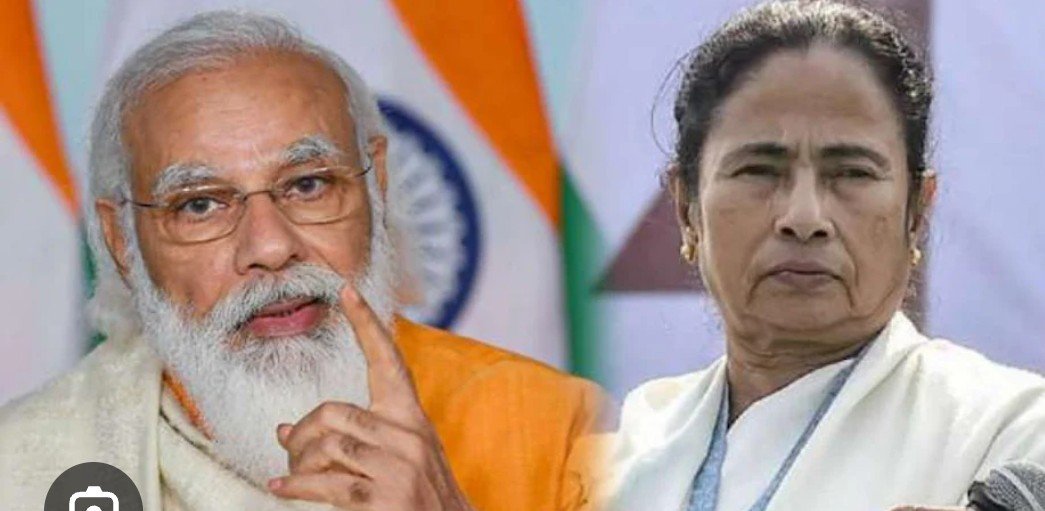
After the completion of the second and final round of voting in West Bengal on May 29th, the polls have been closed to determine the political future of all candidates. On May 4th, all these polls will be opened for counting, and the victory of the various candidates will be determined based on the votes received. Only then will it be truly known whether Mamata Banerjee will lead her party, the TMC, to a fourth term in power in West Bengal, or whether the BJP will emerge victorious, resulting in its first-ever BJP government in West Bengal.
Whether the BJP will officially form the government in West Bengal or the TMC will return to power will be known only after the election results are announced on May 4th. However, even before this, exit polls have begun to pour in after the voting has concluded in West Bengal. While most of these exit polls show the BJP forming the government in West Bengal, some also show the TMC forming the government. If the TMC is in a position to form a government in West Bengal, that’s fine. However, if the BJP forms the government, Mamata Banerjee and her party, the TMC, could certainly create a stir. Even during the election process, Mamata Banerjee has been accusing Chief Election Commissioner Gyanesh Kumar of influencing the West Bengal elections in favor of the BJP, and she has taken this matter from the streets to the Supreme Court. If the court’s decision in her party’s favor, she could seek a fresh election in West Bengal under a different Chief Commissioner, if she falls short of a majority, and could approach the Supreme Court again. But beyond this, she has another major issue. This issue is that after the election process has already begun, Narendra Modi’s central government, despite lacking a majority, tried to influence the West Bengal elections by calling a special session of the Lok Sabha and tabling the Nari Shakti Vandan (Amendment) Bil . Without delving into the question of whether Mamata Banerjee will secure a majority to form a government in West Bengal after the vote count on May 4th, and whether she will take the matter to court if she fails to do so. Let’s explore whether Prime Minister Narendra Modi, by convening a special session of the Lok Sabha even after the election process had already begun in West Bengal, introduced the Nari Shakti Vandan (Amendment) Bill in the Lok Sabha, and then, after it was defeated, attempted to influence the election. While this could also be said in the context of Tamil Nadu, we will focus our discussion on West Bengal.
The Nari Shakti Vandan (Amendment) Bill, introduced by the central government in the Lok Sabha, was defeated on April 17th due to a lack of majority. Despite the defeat of this bill, the BJP did not remain silent; it instead sought to exploit it to its fullest political advantage. Several senior BJP leaders began accusing opposition political parties of working against women’s interests, claiming that women would not forgive them for this. This issue wasn’t just raised by BJP leaders; the Prime Minister himself was also vehemently raising it. Not only did he make this statement during an election rally in Tamil Nadu, but at 8 pm that same day, he also addressed the nation, accusing opposition political party leaders of working against women’s interests and incurring their wrath. Among the opposition leaders he named, West Bengal Chief Minister Mamata Banerjee was prominent. He also declared himself and the BJP to be protectors of women’s interests. He didn’t stop there, but in every subsequent rally he held in West Bengal, he reiterated that opposition political party leaders like Mamata Banerjee prevented the passage of the Nari Shakti Vandana Amendment Act because it was anti-women. He also continued to portray himself and the BJP as women’s benefactors.
The court has the right to decide whether this is legally permissible or not. Here, we simply need to examine whether these statements by Prime Minister Narendra Modi and other BJP leaders had any impact on women. To determine this, we compare the percentage of votes cast by women during the West Bengal Assembly elections since 2006 with the percentage of votes cast by women voters during the current Assembly elections in 2026.
In West Bengal, a region known for its civil rights awareness, women have always participated enthusiastically in voting. During the 2006 and 2011 West Bengal Assembly elections, the number of male voters was higher by a few decimal places, while in 2016 and 2021, the number of female voters was slightly higher by a few decimal places. However, in both phases of the 2026 West Bengal Assembly elections, women’s participation was a higher, with the overall difference being around two percentage points. Whether this increased percentage of women’s voting is due to the enthusiasm of women, repeatedly emphasized by BJP leaders during the election campaign, following the repeal of the Nari Shakti Vandan Amendment Act by Prime Minister Narendra Modi’s government, is a matter of investigation. However, it is evident that women have increased voter turnout this year.
If Mamata Banerjee’s party falls short of a majority after the election results on May 4th, and Mamata Banerjee wishes to approach the Supreme Court, accusing the PM Modi-led BJP government of enacting the Nari Shakti Vandan Amendment Act through a special session while the election process was ongoing, and later blaming the opposition for it during the election campaign, she has the following options available to her:
If she considers it unconstitutional and a political conspiracy by the BJP and PM Modi, she can file a petition in the Supreme Court and challenge the constitutionality of the PM Modi-led BJP.
The Supreme Court already has petitions pending against the delay in the implementation of the Women’s Reservation Act. Mamata Banerjee or her party (TMC) can file an intervention application in these ongoing cases.